

Chronicle of a Bourgeois of Valenciennes
Récits d’un bourgeois de Valenciennes aka The Chronicle of a Bourgeois of Valenciennes is a vivid 14th-century vernacular chronicle written by an anonymous urban chronicler from Valenciennes in the County of Hainaut. It survives in a manuscript that describes local and regional history from about 1253 to 1366, blending chronology, narrative episodes, and eyewitness-style accounts of political, military, and social events in medieval France, Flanders, and the Low Countries. The work begins with a chronological framework of events affecting Valenciennes and its region under rulers such as King Philip VI of France and the shifting allegiances of local nobility. It includes accounts of conflicts, sieges, diplomatic manoeuvres, and the impact of broader struggles like the Hundred Years’ War on urban life in Hainaut. Written from the perspective of a burgher (bourgeois) rather than a monastery or royal court, the chronicle offers a rare lay viewpoint on high politics and warfare, reflecting how merchants, townspeople, and civic institutions experienced the turbulence of the 13th and 14th centuries. Its narrative style combines straightforward reporting of events with moral and civic observations, making it a valuable source for readers interested in medieval urban society, regional politics, and the lived experience of war and governance in pre-modern Europe.
Available at Amazon in eBook and Paperback format.
Before 9th December 1866 [her father] David Beach Grant (age 27) and [her mother] Rebecca Douglas Stewart (age 31) were married.
On 9th December 1866 Adele Beach Grant Countess Essex was born to [her father] David Beach Grant (age 27) and [her mother] Rebecca Douglas Stewart (age 31) in New York.
On 12th July 1882 [her future husband] George Capell 7th Earl of Essex (age 24) and Ellenor Harriet Maria Harford (age 22) were married.
In 1888 [her father] David Beach Grant (age 49) died.
On 11th September 1892 Arthur Algernon Capell 6th Earl Essex (age 89) died. His grandson [her future husband] George (age 34) succeeded 7th Earl Essex, 8th Baron Capell Hadham.
Before 1893 Arthur Cairns 2nd Earl Cairns and Adele Beach Grant Countess Essex (age 26) were engaged. She broke the engagement off - see Obituary, New York Times.

1893. Edward Robert Hughes (age 41). Portrait of Adele Beach Grant Countess Essex (age 26).
On 14th December 1893 George Capell 7th Earl of Essex (age 36) and Adele Beach Grant Countess Essex (age 27) were married at St Margaret's Church, Westminster [Map]. She by marriage Countess Essex. Her uncle Richard Suydam Grant gave her away since her father David Beach Grant had died five years before.
New York Times 15 Dec 1893. MARRIED TO AN EARL.
Miss Adele Grant or New-York Becomes the Countess of Essex.
LONDON, Dec. 14 [1893].—The marriage of Miss Adele Grant (age 27), daughter of the late [her father] Beach Grant of New-York, to the [her husband] Earl of Essex (age 36) took place at 2:30 0'clock this afternoon at St. Margaret's Church, Westminster [Map]. Archdeacon Farrar, assisted by the Rev. Mr. Lee, the Rev. Mr. James, and the Chaplain of the Duke of Essex, the Rev. George Chapel, officiated.
The bride wore a white satin dress, the train of which was embroidered with silver sunrays. The bodice was trimmed with point d'Alençon lace. The bridal veil was of Alençon lace, which the bride's mother wore at her wedding. The only ornament worn by the bride was a diamond tiara, the gift of the Earl of Essex. Instead of a bouquet, she carried an ivory Prayer Book.
There were seven bridesmaids. Those were Edythe Grant, Alberta Paget, Mary Colebrooke, Diana Sturt, the Hon. Eustace Daunay, the Hon. Leila Daunay, and Gwenfra Williams. They wore white satin dresses, draped in soft folds and bordered with mink, and velvet toques trimmed with fur. Each of them carried a long Louis XV. stick, with a gold tip, decorated with roses, the gift of the Earl of Essex. Baron Tuyll was the best man. [her uncle] Suydam Grant, a brother [a mistake for uncle] of the bride, gave her away. The service was full choral. Sir Arthur Sullivan presided at the organ. The floral decorations were extensive and rich.
After the ceremony, a reception was given at the residence of Mrs. Grant, 35 Great Cumberland Place. It was largely attended. In the early afternoon, the newly-married couple departed for their honeymoon, which will be spent at Cassiobury, Watford.
Over 300 presents were received, many of which came from the United States and the Continent.
Adam Murimuth's Continuation and Robert of Avesbury’s 'The Wonderful Deeds of King Edward III'
This volume brings together two of the most important contemporary chronicles for the reign of Edward III and the opening phases of the Hundred Years’ War. Written in Latin by English clerical observers, these texts provide a vivid and authoritative window into the political, diplomatic, and military history of fourteenth-century England and its continental ambitions. Adam Murimuth Continuatio's Chronicarum continues an earlier chronicle into the mid-fourteenth century, offering concise but valuable notices on royal policy, foreign relations, and ecclesiastical affairs. Its annalistic structure makes it especially useful for establishing chronology and tracing the development of events year by year. Complementing it, Robert of Avesbury’s De gestis mirabilibus regis Edwardi tertii is a rich documentary chronicle preserving letters, treaties, and official records alongside narrative passages. It is an indispensable source for understanding Edward III’s claim to the French crown, the conduct of war, and the mechanisms of medieval diplomacy. Together, these works offer scholars, students, and enthusiasts a reliable and unembellished account of a transformative period in English and European history. Essential for anyone interested in medieval chronicles, the Hundred Years’ War, or the reign of Edward III.
Available at Amazon in eBook and Paperback format.
In 1895 [her daughter] Iris Mary Athenais de Vere Capell was born to [her husband] George Capell 7th Earl of Essex (age 37) and Adele Beach Grant Countess Essex (age 28).

2nd July 1897. Henry Bullingham (age 45). Photograph of Adele Beach Grant Countess Essex (age 30) at the Devonshire House Ball as Bernice Queen of Palestine.
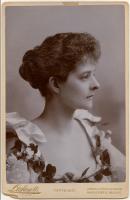
Late 1890s. James Lafayette (age 45). Photograph of Adele Beach Grant Countess Essex (age 31).
In 1899 [her daughter] Joan Rachel de Vere Capell was born to [her husband] George Capell 7th Earl of Essex (age 41) and Adele Beach Grant Countess Essex (age 32). She married 19th June 1922 Osbert Peake 1st Viscount Ingleby and had issue.

In 1905 John Singer Sargent (age 48). Portrait of Adele Beach Grant Countess Essex (age 38).
On 28th September 1905 [her step-son] Algernon George de Vere Capell 8th Earl of Essex (age 21) and Mary Eveline Stewart Freeman were married. He the son of [her husband] George Capell 7th Earl of Essex (age 47) and Ellenor Harriet Maria Harford.


On 16th December 1912 [her uncle] Richard Suydam Grant died. He bequeathed his wealth to his nieces Adele Beach Grant Countess Essex (age 46) and Edythe Scott Grant, Vicomtesse de Breteuil of Paris, both of whom received $591,000.
On 25th September 1916 [her husband] George Capell 7th Earl of Essex (age 58) died at his home Stanley House having been run over by a taxi. His son [her step-son] Algernon (age 32) succeeded 8th Earl Essex, 9th Baron Capell Hadham.
In 1917 [her mother] Rebecca Douglas Stewart (age 82) died.
On 19th June 1922 [her son-in-law] Osbert Peake 1st Viscount Ingleby (age 24) and [her daughter] Joan Rachel de Vere Capell (age 23) were married. She the daughter of [her former husband] George Capell 7th Earl of Essex and Adele Beach Grant Countess Essex (age 55).
On 28th July 1922 Adele Beach Grant Countess Essex (age 55) died. She had a heart attack whilst in her bath at her home 72 Brook Street, New York see Obituary, New York Times.
Chronicle of Walter of Guisborough
A canon regular of the Augustinian Guisborough Priory, Yorkshire, formerly known as The Chronicle of Walter of Hemingburgh, describes the period from 1066 to 1346. Before 1274 the Chronicle is based on other works. Thereafter, the Chronicle is original, and a remarkable source for the events of the time. This book provides a translation of the Chronicle from that date. The Latin source for our translation is the 1849 work edited by Hans Claude Hamilton. Hamilton, in his preface, says: 'In the present work we behold perhaps one of the finest samples of our early chronicles, both as regards the value of the events recorded, and the correctness with which they are detailed; Nor will the pleasing style of composition be lightly passed over by those capable of seeing reflected from it the tokens of a vigorous and cultivated mind, and a favourable specimen of the learning and taste of the age in which it was framed.'
Available at Amazon in eBook and Paperback format.
New York Times 29 Jul 1922. 29th July 1922. Obituary. New York Times.
Former Adele Grant of New York Stricken With Heart Attack After Dinner Party.
TRIED TO SUMMON HELP
Dowager, Once Famous Beauty, Was Model for Herkomer's "A Lady in White." [Note. This appears to be a mistake - A Lady in White]
1922 by The New York Times Company. By Wireless to The New York Times.
London, July 28. Dowager Countess Essex (deceased), who was the daughter of the late [her father] Beach Grant of New York and the second wife of the Seventh Earl of Essex, was found dead in her bath today at her home, 72 Brook Street, by one of her maids.
Lady Essex attended last night a dinner party given by the Hon. Mrs. Rupert Beckett and appeared in the best of spirits. She was driven home by Mrs. Asquith, with whom she was to have lunched today.
Apparently she took her bath before going to bed and had the seizure. She seemed to have endeavored to get help as the hanging electric bell push had been pulled into the bath. The tragedy was not discovered until this morning when Lady Essex's maid found her bed had not been slept in.
The bath room door was locked and the electric lights were full on. When the door was forced Lady Essex was found dead. She had suffered for years from a weak heart and it is presumed that she had the seizure when she could not help herself.
In her prime Lady Essex was famed for her beauty, being tall and graceful, with soft eyes and dark hair. Indeed she belonged to the group that was playfully christened "Lovely Five" and included Lady Warwick (age 60), Lady Lytton (age 80), Lady Westmoreland and the Duchess of Sutherland (age 54). She was the model for Herkomer's famous picture "A Lady in White."
A coroner's inquest into Lady Essex's death will be held on Monday.
Adele Grant. daughter of the late Beach Grant of this city, was married to the [her former husband] seventh Earl of Essex in St. Margaret's Church, Westminster [Map], Dec. 14 1893. Archdeacon Farrar performed the ceremony, the occasion being one of the brilliant social events of that Winter in London. There have been two children, Lady [her daughter] Iris Mary (age 27) and Lady [her daughter] Joan Rachel (age 23), respectively 26 and 22 years old. Presumably they will share their mother's fortune, which is not inconsiderable since her inheritance in 1915 of some $600,000 from her uncle, R. Suydam Grant, of the New York Stock Exchange.
Her husband was a widower when she married him. The present [her former step-son] Earl (age 38), son of his father's first marriage, did not have sufficient income to keep up the magnificent ancestral estate of Cassiobury Park, and last Fall it was offered for sale. On previous occasions it had been rented to Americans, among others to Otto H. Kahn.
An anecdote of the family that reveals the firmness of the Countess is that of her refusal of the tempting offers repeatedly made to her by Lady Meux, widow of Sir Henry Meux, the wealthy brewer. The story has it that Lady Meux, originally a "queen of burlesque" and aunt by marriage of the Earl of Essex, offered to make the Earl her heir if only the Countess would introduce her to society. But the Countess did not allow her thorough disapproval of the brewer's widow to be overcome by the bribe.
Before her marriage Adele Grant had been engaged to the late Earl Cairns, the unfortunate man who acquired the nickname of "Gumboil," thanks to his courtesy title of Lord Garmoyle. She broke off the match on the eve of the wedding owing to the prospective bridegrooms extortionate demands for a settlement. And, in 1920, after the death of her husband, she was reported, not on the highest authority, however, to be engaged to the Duke of Connaught (age 72), brother of Edward Vll. The affair progressed no further than the circulation of the report.
During the World War the Countess did much relief work, serving with Queen Mary's Needlework Guild, on the Urban Executive Committee of the Urban Council for War Relief, and also as President of the Soldiers and Sailors Families' Association.


GrandFather: Oliver De Forest Grant
Father: David Beach Grant
Adele Beach Grant Countess Essex
Mother: Rebecca Douglas Stewart 