

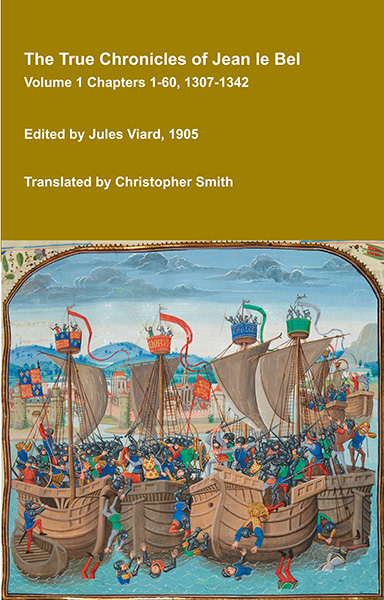
The True Chronicles of Jean le Bel Volume 1 Chapters 1-60 1307-1342
The True Chronicles of Jean le Bel offer one of the most vivid and immediate accounts of 14th-century Europe, written by a knight who lived through the events he describes, and experienced some of them first hand. Covering the early decades of the Hundred Years’ War, this remarkable chronicle follows the campaigns of Edward III of England, the politics of France and the Low Countries, and the shifting alliances that shaped medieval warfare. Unlike later historians, Jean le Bel writes with a strong sense of eyewitness authenticity, drawing on personal experience and the testimony of fellow soldiers. His narrative captures not only battles and sieges, but also the realities of military life, diplomacy, and the ideals of chivalry that governed noble society. A key source for Jean Froissart, Le Bel’s chronicle stands on its own as a compelling and insightful work, at once historical record and literary achievement. This translation builds on the 1905 edition published in French by Jules Viard, adding extensive translations from other sources Rymer's Fœdera, the Chronicles of Adam Murimuth, William Nangis, Walter of Guisborough, a Bourgeois of Valenciennes, Geoffrey le Baker of Swinbroke and Richard Lescot to enrich the original text and Viard's notes.
Available at Amazon in eBook and Paperback format.
Anglo-Saxon Chronicle. This year the army rode over Mercia into East-Anglia, and there fixed their winter-quarters at Thetford [Map]. And in the winter King Edmund fought with them; but the Danes gained the victory, and slew the king [20th November 869]; whereupon they overran all that land, and destroyed all the monasteries to which they came. The names of the leaders who slew the king were Hingwar and Hubba. At the same time came they to Medhamsted [Map], burning and breaking, and slaying abbot and monks, and all that they there found. They made such havoc there, that a monastery [Map], which was before full rich, was now reduced to nothing. The same year died Archbishop Ceolnoth; and Ethered, Bishop of Witshire, was chosen Archbishop of Canterbury.
In 870 Archbishop Æthelred was consecrated Archbishop of Canterbury.
Anglo-Saxon Chronicle. 888. This year Alderman Beeke conducted the alms of the West-Saxons and of King Alfred to Rome; but Queen Ethelswith (age 50), who was the sister of King Alfred, died on the way to Rome; and her body lies at Pavia [Map]. The same year also Ethered, Archbishop of Canterbury and Alderman Ethelwold, died in one month.
On 30th June 888 Archbishop Æthelred died.
Book of Llandaff Chapter 8. Libiau1, Bishop.
Note 1. Consecrated by Ethelred, Archbishop of Canterbury.
Book of Llandaff Chapter 8 Section 26: Tref Ceriau. 26. Village Of Tref Ceriaü, That Is Llanmihangel2, Meibion Gratlaun.
Be it known to all the inhabitants of the southem district of Britain, that a great dispute arose between Lybiau, Bishop of Llandaff, and Tewdwr son of Elised, King of Brecknock, because King Tewdwr sent off the Bishop from his monastery of Lanncors [Map] by himself, having taken away from him his banquet by force and violence. And so great an outrage having been committed, the Bishop on the morrow arose with his family, and left the King under a malediction and perpetual curse; and assembling together all the clergy of the whole diocese, situate between the mouth of the Taratyr on Wye and the mouth of Towy, in full synod at Llandaff, caused the King to be anathematized. And it was told to the King, and to the Bishop of St. David's, whose name was Lumberth3, respecting the curse that had been pronounced. And after an interval of time, messengers having been sent to Bishop Lybiau, and received by him, they met together in the monastery of Lanncors [Map]. And it was adjudged to Bishop Lybiau, that he should have five times the value of the attendants he had when the banquet was taken from him, and also seven times the value of the said Bishop, that is 700 marks of pure gold. King Tewdwr seeing that he could not comply with the judgment, sought pardon through means of his intercessor, Bishop Lumberth, offering, with the acceptance of penance, Tref Ceriau, to God, and to St. Dubricius, St. Teilo, and St. Oudoceus, and to Bishop Libiau, and all Bishops of Llandaff for ever. Pardon being given to him, Bishop Lybiau accepted that land, with all its liberty, without any payment to any mortal man besides to the Church of Llandaff and its Pastors for ever, and with all commonage in field and in woods, in water and in pastures. Its boundary is, — The highway which is on the south, by the thom bush, from thence as far as the river Tangeiel,1a which is on the north, thence by the brook eastward as far as the fountain Chenien; afterwards from this fountain through the diy valley which leads upwards as faras the aforesaid highway again, which is on the south. Of the clergy, the witnesses are, Libiau, Bishop; Lumberth, Bishop; Eneuris, presbyter; Divin, presbyter; Marchwydd, Cerenhir, Rhyfelwr, Dissaith, Henif, Redwn, Canadam, Cynog; of the laity, King Tewdwr, Mor, Sulbrit, EUystan, Bran, Serus, Avel, Davin. Whoever will keep it, may Grod keep him; and whoever will separate it fipom the Church of Llandafl may he be accursed. Amen.
Note 2. Probably Llanfihangel, or St Michael Cwmdu, Breconshire; see pages 414, 416, where its boundaries are described in nearly the same words.
Note 3. Lumberth, Bishop of St. David's. He was consecrated by Ethelred, Archbishop of Canterbury, and was Bishop in 872. He is the same person as Lunyerd, or Llywarch, mentioned by Godwin as the 30th Bishop of that See.
Note 1a. The river Rhiangoll.