

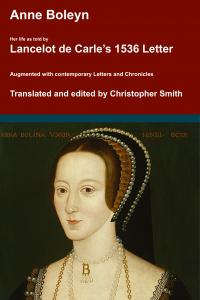
Anne Boleyn. Her Life as told by Lancelot de Carle's 1536 Letter.
In 1536, two weeks after the execution of Anne Boleyn, her brother George and four others, Lancelot du Carle, wrote an extraordinary letter that described Anne's life, and her trial and execution, to which he was a witness. This book presents a new translation of that letter, with additional material from other contemporary sources such as Letters, Hall's and Wriothesley's Chronicles, the pamphlets of Wynkyn the Worde, the Memorial of George Constantyne, the Portuguese Letter and the Baga de Secrets, all of which are provided in Appendices.
Available at Amazon in eBook and Paperback format.
Anglo-Saxon Chronicle. 803. This year died Hibbald, Bishop of Holy-island, on the twenty-fourth of June, and Egbert was consecrated in his stead, on the thirteenth of June following. Archbishop Ethelherd also died in Kent, and Wulfred was chosen archbishop in his stead. Abbot Forthred, in the course of the same year, departed this life.
Anglo-Saxon Chronicle. 804. This year Archbishop Wulfred received his pall.
. Parker MS. Her Wulfred ærce bisc pallium onfengr
. Laud MS. Her Wulfred arceb onfeng pallium.
Charter S165. 811. In the name of our Lord Jesus Christ. In the eternal reign of the same God and our Lord Jesus Christ. I, Coenwulf, by the grace of God, King of the Mercians, grant to the venerable man, Bishop Beornmod, land of my domain, that is, about three plowlands, on the southern side of the city called Rochester, so that he may have and possess it, and I grant him the right to transfer it to whomever he wishes, either during his lifetime or after his death, for eternity.
The boundaries of this land are well known: to the east, the public road; to the south, Wuldaham; to the west, the river Medway; to the north, Mearateag. If anyone attempts to infringe upon or diminish this donation, let them know that they will have to answer before the tribunal of the eternal judge unless they first make amends to God and man.
And let the aforementioned land be free from all royal and secular services. Additionally, I grant the rights to the commons at Otanhyrst, Fraecinghyrst, Sceorfesstede, Crangabyras, Wihtherincfaladsto, and Haeseldaen.
In nomine domini nostri Iesu Christi . Regnante in perpetuum eodem deo et domino nostro Iesu Christo . Ego Coenwulf gratia dei rex Merciorum . Uiro uenerabili Beornmodo episcopo . Trado terram iuris mei id est quasi tria aratra . ad meridianam plagam ciuitatis quae dicitur . Hrofescester [Map] . Ut habeat et possideat et cuicumque uoluerit illo uiuente seu moriente æternaliter tradendam concedo . Sunt autem huius telluris termini notissimi ab oriente uia puplica a meridiae Uuldaham . ab occidente flubius Meduwege ab aquilone Mearateag, Siquis hanc donationem meam infringere aut minuere temptauerit sciat se rationem redditurum ante tribunal aeterni iudicis nisi prius deo et hominibus digne emendauerit . Et praedicta terra sit libera ab omni regali et saeculari seruitio . Adiectis denberis in commune saltu . Otanhyrst . et Fraecinghyrst . Sceorfesstede . Crangabyras . Wihtherincfaladsto . et Haeseldaen .
Ego Coenwulf rex Merciorum hanc donationem meam signo sancte crucis Christi confirmaui .
Ego Wulfred archiepiscopus consensi et subscripsi .
Ego Deneberht episcopus consensi et subscripsi .
Ego Aeðelwulf episcopus consensi et subscripsi .
Ego Sigered rex consensi et subscripsi .
Ego Aelbðryð regina consensi et subscripsi .
Ego Heardberht dux consensi et subscripsi .
Ego Beornmod episcopus consensi et subscripsi .
Ego Beornnoð dux consensi et subscripsi .
Ego Cynehelm dux consensi et subscripsi .
Ego Eadberht dux consensi et subscripsi .
Ego Cyneberht propinquo regis consensi et subscripsi .
Ego Coenwald propinquo regis consensi et subscripsi .
Ego Quoenðryð filia regis consensi et subscripsi .
Ego Eanberht dux consensi et subscripsi .
Ego Aeðelheah consensi et subscripsi .
Scripta est autem haec kartula anno dominicae incarnationis . dccc axi a . indictione . iiii a . His testibus consentientibus et subscribentibus .
A.D. 811. Coenwulf, king of Mercia, to Beornmod, bishop; grant of 3 sulungs (aratra) to the south of Rochester [Map] (at Borstal), Kent, with appurtenant swine-pastures in the Weald. Latin with bounds.
Archive: Rochester
MSS: 1. BL Cotton Ch. viii. 31 (s. ix1; BM Facs., ii. 10)
Note 2. London, Soc. Ant., 175, 186r (s. xviii)
Note 3. Maidstone, Kent Archives Office, DRc/R1 (Textus Roffensis), 136v-137r (s. xii1; facsimile)
Note 4. Maidstone, Kent Archives Office (Liber Temporalium), 4r (s. xiv)
Printed: Hearne, Textus Roffensis, pp. 96-7; Thorpe, Reg. Roff., pp. 21-2; K 198; B 339; Campbell, Rochester, no. 17.
Comments: Bond 1878, p. 7, MS 1 a later imitation; Stevenson 1914, p. 697 n. 41, contemporary; Wallenberg, KPN, pp. 121-4, on place-names; Stenton 1970, p. 131 n. 2, contemporary; Campbell, Rochester, p. xiv, later than 811 but not significantly so, rather suspicious in form, p. xvi, refers to Borstal (cf. endorsement), p. xxiii, authentic; Witney 1976, pp. 235-6, on swine-pastures; Dumville 1987, p. 11.
Notes: Written in stages by two co-operating scribes, the first responsible for the main text and witness-list, the second for alterations, the addition of the names of swine-pastures and the dating clause.A.D. 811. Coenwulf, king of Mercia, to Beornmod, bishop; grant of 3 sulungs (aratra) to the south of Rochester (at Borstal), Kent, with appurtenant swine-pastures in the Weald. Latin with bounds.
Anglo-Saxon Chronicle. 812. This year died the Emperor Charlemagne [aged 69], after a reign of five and forty winters; and Archbishop Wulfred, accompanied by Wigbert, Bishop of Wessex, undertook a journey to Rome.
Anglo-Saxon Chronicle. 813. This year Archbishop Wulfred returned to his own see, with the blessing of Pope Leo; and King Egbert [aged 40] spread devastation in Cornwall from east to west.
Anglo-Saxon Chronicle. 831. Here Archbishop Wulfred passed away.
Manuscript A. 829. Her Wulfred ærcebiscep forþferde.
On 24th March 832 Archbishop Wulfred died.
Anglo-Saxon Chronicle. 852. About this time Abbot Ceolred of Medhamsted, with the concurrence of the monks, let to hand the land of Sempringham [Map] to Wulfred, with the provision, that after his demise the said land should revert to the monastery; that Wulfred should give the land of Sleaford to Medhamsted, and should send each year into the monastery sixty loads of wood, twelve loads of coal, six loads of peat, two tuns full of fine ale, two neats' carcases, six hundred loaves, and ten kilderkins of Welsh ale; one horse also each year, and thirty shillings, and one night's entertainment. This agreement was made in the presence of King Burhred. Archbishop Ceolnoth, Bishops Tunbert, Kenred, Aldhun, and Bertred; Abbots Witred and Weftherd, Aldermen Ethelherd and Hunbert, and many others.