

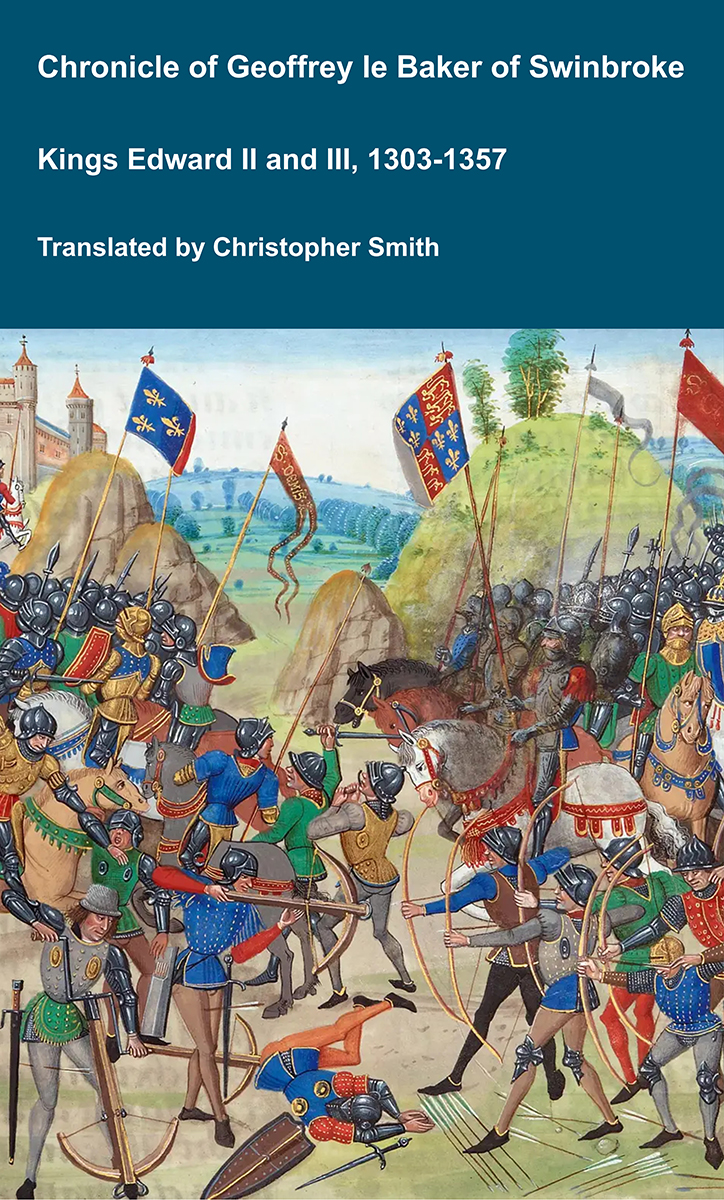
Chronicle of Geoffrey le Baker of Swinbroke
Baker was a secular clerk from Swinbroke, now Swinbrook, an Oxfordshire village two miles east of Burford. His Chronicle describes the events of the period 1303-1356: Gaveston, Bannockburn, Boroughbridge, the murder of King Edward II, the Scottish Wars, Sluys, Crécy, the Black Death, Winchelsea and Poitiers. To quote Herbert Bruce 'it possesses a vigorous and characteristic style, and its value for particular events between 1303 and 1356 has been recognised by its editor and by subsequent writers'. The book provides remarkable detail about the events it describes. Baker's text has been augmented with hundreds of notes, including extracts from other contemporary chronicles, such as the Annales Londonienses, Annales Paulini, Murimuth, Lanercost, Avesbury, Guisborough and Froissart to enrich the reader's understanding. The translation takes as its source the 'Chronicon Galfridi le Baker de Swynebroke' published in 1889, edited by Edward Maunde Thompson.
Available at Amazon in eBook and Paperback format.
Paternal Family Tree: Wuffingas
King Æthelhere of East Anglia was born to [his father] Eni Wuffingas.
Around 636 [his brother] King Anna of East Anglia succeeded King East Anglia.
In 654 King Penda of Mercia defeated the East Anglian army at the Battle of Bulcamp at Bulcamp, Blythburgh. [his brother] King Anna of East Anglia and his son [his nephew] Jurmin Wuffingas were killed. Anna's son His uncle Æthelhere succeeded King East Anglia.
On 15th November 655 King Oswiu of Northumbria (age 43) defeated the Mercian army (probably) at Cock Beck during the Battle of the Winwaed ending the period of Mercian dominance. The battle is believed to have ended Anglo-Saxon paganism.
On 15th November 655 Æthelwald King Deira (age 13), an ally of King Penda of Mercia, withdrew his forces, one of many Mercian allies to do so, weakening King Penda's army.
King Penda of Mercia and King Æthelhere of East Anglia were killed. Penda's son Paeda King South Mercia succeeded King South Mercia.
[his brother] King Æthelwold of East Anglia succeeded King East Anglia after the death of his father at the Battle of the Winwaed.
Anglo-Saxon Chronicle. 15th November 655. This year Penda was slain at Wingfield, and thirty royal personages with him, some of whom were kings. One of them was Ethelhere, brother of [his brother] Anna, king of the East-Angles. The Mercians after this became Christians. From the beginning of the world had now elapsed five thousand eight hundred and fifty winters, when Peada, the son of Penda, assumed the government of the Mercians. In his time came together himself and Oswy (age 43), brother of King Oswald, and said, that they would rear a minster to the glory of Christ, and the honour of St. Peter. And they did so, and gave it the name of Medhamsted [Map]; because there is a well there, called Meadswell. And they began the groundwall, and wrought thereon; after which they committed the work to a monk, whose name was Saxulf. He was very much the friend of God, and him also loved all people. He was nobly born in the world, and rich: he is now much richer with Christ. But King Peada reigned no while; for he was betrayed by his own queen, in Easter-tide.
Great x 2 Grandfather: Wehha Wuffingas
Great x 1 Grandfather: Wuffa King East Anglia
GrandFather: Tytila King East Anglia
Father: Eni Wuffingas