

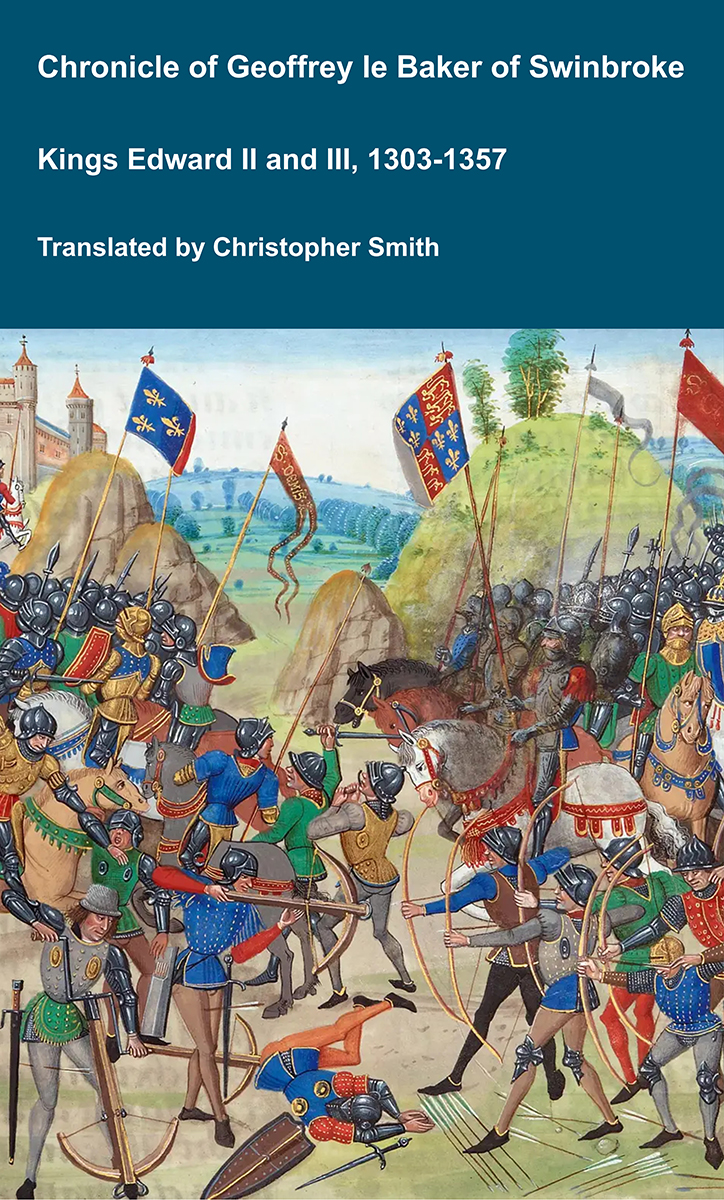
Chronicle of Geoffrey le Baker of Swinbroke
Baker was a secular clerk from Swinbroke, now Swinbrook, an Oxfordshire village two miles east of Burford. His Chronicle describes the events of the period 1303-1356: Gaveston, Bannockburn, Boroughbridge, the murder of King Edward II, the Scottish Wars, Sluys, Crécy, the Black Death, Winchelsea and Poitiers. To quote Herbert Bruce 'it possesses a vigorous and characteristic style, and its value for particular events between 1303 and 1356 has been recognised by its editor and by subsequent writers'. The book provides remarkable detail about the events it describes. Baker's text has been augmented with hundreds of notes, including extracts from other contemporary chronicles, such as the Annales Londonienses, Annales Paulini, Murimuth, Lanercost, Avesbury, Guisborough and Froissart to enrich the reader's understanding. The translation takes as its source the 'Chronicon Galfridi le Baker de Swynebroke' published in 1889, edited by Edward Maunde Thompson.
Available at Amazon in eBook and Paperback format.
Paternal Family Tree: Deira
Osric was born to [his father] Æthelric King Deira.
Around 588 [his father] Æthelric King Deira succeeded King Deira.
In 604 [his father] Æthelric King Deira died. His son Osric succeeded King Deira.
Bede. 633. AD. How King Edwin's next successors lost both the faith of their nation and the kingdom; but the most Christian King Oswald retrieved both.
Edwin (age 47) being slain in battle, the kingdom of the Deiri, to which province his family belonged, and where he first began to reign, passed to Osric, the son of his uncle [his father] Aelfric, who, through the preaching of Paulinus, had also received the mysteries of the faith. But the kingdom of the Bernicians-for into these two provinces the nation of the Northumbrians was formerly divided282-passed to Eanfrid (age 43), the son of Ethelfrid283, who derived his origin from the royal family of that province. For all the time that Edwin reigned, the sons of the aforesaid Ethelfrid, who had reigned before him, with many of the younger nobility, lived in banishment among the Scots or Picts, and were there instructed according to the doctrine of the Scots, and were renewed with the grace of Baptism. Upon the death of the king, their enemy, they were allowed to return home, and the aforesaid Eanfrid, as the eldest of them, became king of the Bernicians. Both those kings284, as soon as they obtained the government of their earthly kingdoms, abjured and betrayed the mysteries of the heavenly kingdom to which they had been admitted, and again delivered themselves up to defilement and perdition through the abominations of their former idolatry.
Note 282. Cf. II, 1, p. 82.
Note 283. I, 34; II, 2, 12.
Note 284. i.e., Osric and Eanfrid.
On 12th October 633 King Penda's alliance of Gwynedd and Mercia defeated the Northumbrians at the Battle of Hatfield Chase.
Eadfrith Deira was captured.
King Edwin of Northumbria (age 47) was killed. He was buried at Whitby Abbey [Map] - see Bede. His first cousin Osric succeeded King Deira. His nephew Eanfrith (age 43) succeeded King Bernicia.
Edwin's son Osfrith Deira was killed.
Anglo-Saxon Chronicle. 634. This year Osric, whom Paulinus baptized, succeeded to the government of King of Deira. He was the son of [his father] Elfric, the uncle of Edwin. And to Bernicia succeeded Eanfrith (age 44), son of Ethelfrith. This year also Bishop Birinus first preached baptism to the West-Saxons, under King Cynegils. The said Birinus went thither by the command of Pope Honorius; and he was bishop there to the end of his life. Oswald (age 30) also this year succeeded to the government of the King Northumbrians, and reigned nine winters. The ninth year was assigned to him on account of the heathenism in which those lived who reigned that one year betwixt him and Edwin.
On 5th August 641 (or 642 or 644 depending on the source) King Penda of Mercia Mercian and Welsh army defeated the Northumbrian army at the Battle of Maserfield. The battle is believed to have taken place at Oswestry, Shropshire. Northumbria was once again separated into two kingdoms.
King Oswald of Northumberland (age 37) was killed. His body was subsequently dismembered with his head and arms mounted on poles. His brother Oswiu (age 29) succeeded King Bernicia. Rhiainfellt Rheged Queen Consort Bernicia by marriage Queen Consort Bernicia.
Osric was killed. His son Oswine succeeded King Deira.
Eowa King Mercia was killed (probably).
Anglo-Saxon Chronicle. 716. This year Osred (age 19), king of the Northumbrians, was slain near the southern borders. He reigned eleven winters after Ealdferth. Cenred then succeeded to the government, and held it two years; then Osric, who held it eleven years. This same year died Ceolred, king of the Mercians. His body lies at Lichfield [Map]; but that of Ethelred, the son of Penda, at Bardney [Map]. Ethelbald then succeeded to the kingdom of Mercia, and held it one and forty winters. Ethelbald was the son of Alwy, Alwy of Eawa, Eawa of Webba, whose genealogy is already written. The venerable Egbert (age 77) about this time converted the monks of Iona to the right faith, in the regulation of Easter, and the ecclesiastical tonsure.
Anglo-Saxon Chronicle. 827. This year was the moon eclipsed, on mid-winter's mass-night; and King Egbert (age 54), in the course of the same year, conquered the Mercian kingdom, and all that is south of the Humber, being the eighth king who was sovereign of all the British dominions. [his uncle] Ella, king of the South-Saxons, was the first who possessed so large a territory; the second was Ceawlin, king of the West-Saxons: the third was Ethelbert, King of Kent; the fourth was Redwald, king of the East-Angles; the fifth was Edwin, king of the Northumbrians; the sixth was Oswald, who succeeded him; the seventh was Oswy, the brother of Oswald; the eighth was Egbert, king of the West-Saxons. This same Egbert led an army against the Northumbrians as far as Dore, where they met him, and offered terms of obedience and subjection, on the acceptance of which they returned home.
[his son] King Oswine of Deira was born to Osric .
Kings Deira: Son of Æthelric King Deira
GrandFather: Yffe Deira
Father: Æthelric King Deira