


Text this colour links to Pages. Text this colour links to Family Trees. Text this colour are links that disabled for Guests.
Place the mouse over images to see a larger image. Click on paintings to see the painter's Biography Page.
Mouse over links for a preview. Move the mouse off the painting or link to close the popup.
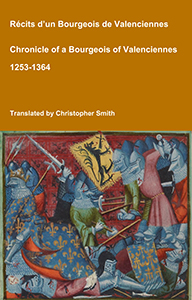
Chronicle of a Bourgeois of Valenciennes
Récits d’un bourgeois de Valenciennes aka The Chronicle of a Bourgeois of Valenciennes is a vivid 14th-century vernacular chronicle written by an anonymous urban chronicler from Valenciennes in the County of Hainaut. It survives in a manuscript that describes local and regional history from about 1253 to 1366, blending chronology, narrative episodes, and eyewitness-style accounts of political, military, and social events in medieval France, Flanders, and the Low Countries. The work begins with a chronological framework of events affecting Valenciennes and its region under rulers such as King Philip VI of France and the shifting allegiances of local nobility. It includes accounts of conflicts, sieges, diplomatic manoeuvres, and the impact of broader struggles like the Hundred Years’ War on urban life in Hainaut. Written from the perspective of a burgher (bourgeois) rather than a monastery or royal court, the chronicle offers a rare lay viewpoint on high politics and warfare, reflecting how merchants, townspeople, and civic institutions experienced the turbulence of the 13th and 14th centuries. Its narrative style combines straightforward reporting of events with moral and civic observations, making it a valuable source for readers interested in medieval urban society, regional politics, and the lived experience of war and governance in pre-modern Europe.
Available at Amazon in eBook and Paperback format.
Paternal Family Tree: Wuffingas
Saint Wihtburh Wuffingas was born to [her father] King Anna of East Anglia (possibly).
Around 636 [her father] King Anna of East Anglia succeeded King East Anglia.
On 20th January 640 King Eadbald of Kent died. His son [her future brother-in-law] Eorcenberht succeeded King of Kent. [her sister] Seaxburh Wuffingas Queen Consort Kent by marriage Queen Consort Kent.
Around 652 [her brother-in-law] Tondberct Gwyre and [her sister] Æthelthryth Wuffingas Queen Consort Deira and Northumbria (age 16) were married. She the daughter of [her father] King Anna of East Anglia.
In 654 King Penda of Mercia defeated the East Anglian army at the Battle of Bulcamp at Bulcamp, Blythburgh. [her father] King Anna of East Anglia and his son [her brother] Jurmin Wuffingas were killed. Anna's son His uncle [her uncle] Æthelhere succeeded King East Anglia.
After her father's death in 654 Saint Wihtburh Wuffingas decided to build a convent at East Dereham. A traditional story relates that while she was building the convent, she had nothing but dry bread to give to the workmen. She prayed to the Virgin Mary and was told to send her maids to a local well each morning. There they found two wild does which were gentle enough to be milked; they provided nutritious drink for the workers. This allowed the workers to be fed.
After 655 [her brother-in-law] King Ecgfrith of Northumbria (age 10) and [her sister] Æthelthryth Wuffingas Queen Consort Deira and Northumbria (age 19) were married. She the daughter of [her father] King Anna of East Anglia. He the son of King Oswiu of Northumbria (age 43) and Eanflæd Queen Consort Bernicia (age 28).
Around 664 Ealhfrith King Deira (age 34) died. His half brother [her brother-in-law] Ecgfrith (age 19) succeeded King Deira. [her sister] Æthelthryth Wuffingas Queen Consort Deira and Northumbria (age 28) by marriage Queen Consort Deira.
Jean de Waurin's Chronicle of England Volume 6 Books 3-6: The Wars of the Roses
Jean de Waurin was a French Chronicler, from the Artois region, who was born around 1400, and died around 1474. Waurin’s Chronicle of England, Volume 6, covering the period 1450 to 1471, from which we have selected and translated Chapters relating to the Wars of the Roses, provides a vivid, original, contemporary description of key events some of which he witnessed first-hand, some of which he was told by the key people involved with whom Waurin had a personal relationship.
Available at Amazon in eBook and Paperback format.
Before 14th July 664 [her brother-in-law] King Eorcenberht of Kent and [her sister] Seaxburh Wuffingas Queen Consort Kent were married. She the daughter of [her father] King Anna of East Anglia. He the son of King Eadbald of Kent and Emma Austrasia Queen Consort Kent.
On 15th February 670 King Oswiu of Northumbria (age 58) died. He was buried at Whitby Abbey [Map] - see Bede. In 670 His son [her brother-in-law] Ecgfrith (age 25) succeeded King Northumbria. [her sister] Æthelthryth Wuffingas Queen Consort Deira and Northumbria (age 34) by marriage Queen Consort Northumbria.
In 673 [her sister] Æthelthryth Wuffingas Queen Consort Deira and Northumbria (age 37) founded Ely Abbey [Map] and was appointed Abbot Ely.
On 23rd June 679 [her sister] Seaxburh Wuffingas Queen Consort Kent was appointed Abbot Ely.
On 23rd June 679 [her sister] Æthelthryth Wuffingas Queen Consort Deira and Northumbria (age 43) died. She was buried at Ely Abbey [Map].
Around 699 [her sister] Seaxburh Wuffingas Queen Consort Kent died. She was buried at Ely Abbey [Map].
In 743 Saint Wihtburh Wuffingas died.
In 798 Saint Wihtburh's remains were dug up and found not to have decayed. This was considered a miracle and her remains were re-interred in the church which she had built in East Dereham. The church became a place of pilgrimage, with people visiting Wihtburh's tomb.
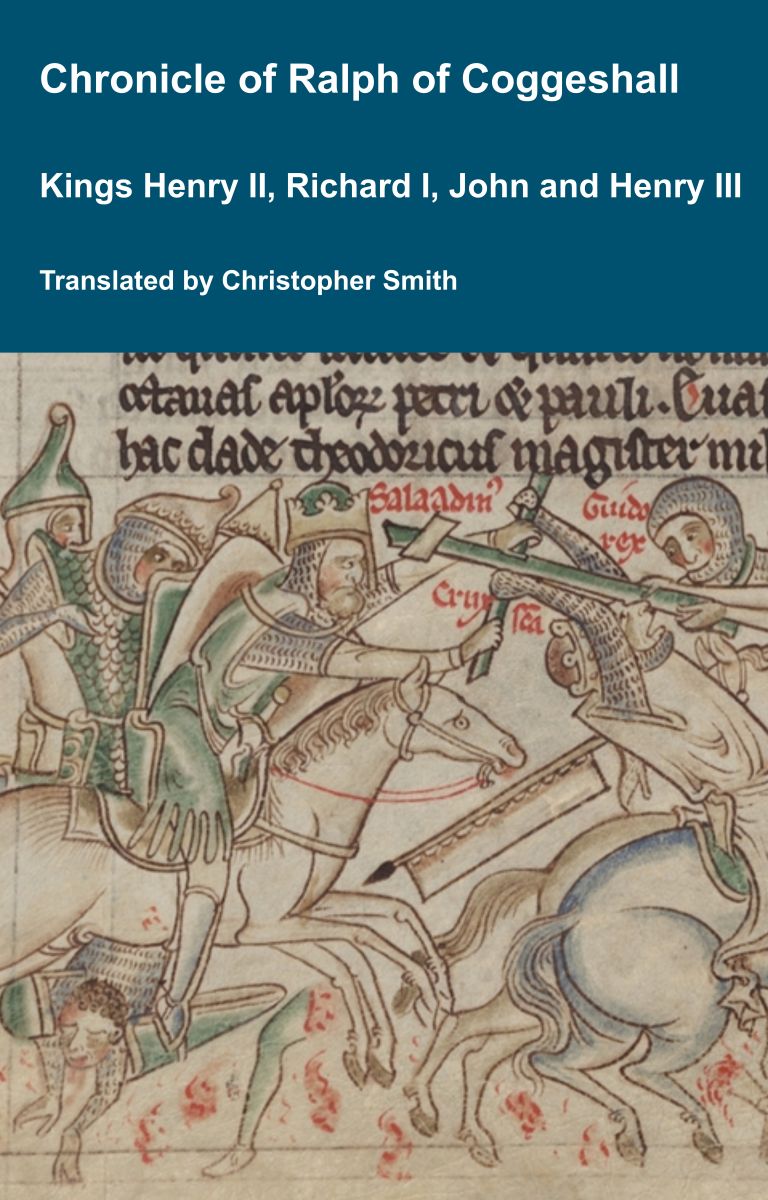
Chronicle of Abbot Ralph of Coggeshall
The Chronicle of Abbot Ralph of Coggeshall (Chronicon Anglicanum) is an indispensable medieval history that brings to life centuries of English and European affairs through the eyes of a learned Cistercian monk. Ralph of Coggeshall, abbot of the Abbey of Coggeshall in Essex in the early 13th century, continued and expanded his community’s chronicle, documenting events from the Norman Conquest of 1066 into the tumultuous reign of King Henry III. Blending eyewitness testimony, careful compilation, and the monastic commitment to record-keeping, this chronicle offers a rare narrative of political intrigue, royal power struggles, and social upheaval in England and beyond. Ralph’s work captures the reigns of pivotal figures such as Richard I and King John, providing invaluable insights into their characters, decisions, and the forces that shaped medieval rule. More than a simple annal, Chronicon Anglicanum conveys the texture of medieval life and governance, making it a rich source for scholars and readers fascinated by English history, monastic authorship, and the shaping of the medieval world.
Available at Amazon in eBook and Paperback format.
In 974 Brithnoth, the abbot of Ely stole her remains so that he could profit from the pilgrims' visits. A spring had arose in Saint Wihtburh's violated tomb. The water in this spring was considered to be compensation for the loss of their saint; pilgrims continued to come to from the spring. The spring has never run dry.
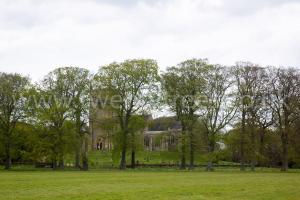
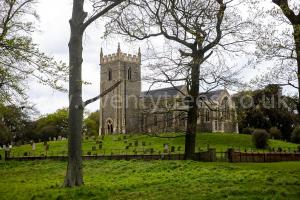
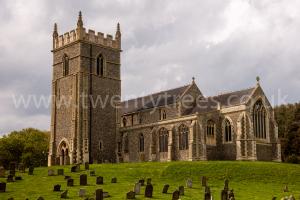
Around 1250. St Withburga's Church, Holkham [Map]. The tower circa 13th Century. The rest of the church extensively rebuilt in 1767. It is now located in the grounds of Holkham Hall, Norfolk. It was built on a mound which may pre-date the church and may represent high ground near to the coast which is now further from the church as a consequence of land reclamation. The church is uniquely dedicated to Saint Wihtburh Wuffingas.
Great x 3 Grandfather: Wehha Wuffingas
Great x 2 Grandfather: Wuffa King East Anglia
Great x 1 Grandfather: Tytila King East Anglia
GrandFather: Eni Wuffingas
Father: King Anna of East Anglia