

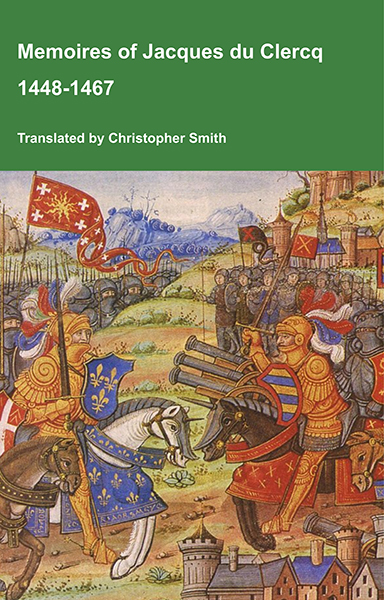
This is a translation of the 'Memoires of Jacques du Clercq', published in 1823 in two volumes, edited by Frederic, Baron de Reissenberg. In his introduction Reissenberg writes: 'Jacques du Clercq tells us that he was born in 1424, and that he was a licentiate in law and a counsellor to Philip the Good, Duke of Burgundy, in the castellany of Douai, Lille, and Orchies. It appears that he established his residence at Arras. In 1446, he married the daughter of Baldwin de la Lacherie, a gentleman who lived in Lille. We read in the fifth book of his Memoirs that his father, also named Jacques du Clercq, had married a lady of the Le Camelin family, from Compiègne. His ancestors, always attached to the counts of Flanders, had constantly served them, whether in their councils or in their armies.' The Memoires cover a period of nineteen years beginning in in 1448, ending in in 1467. It appears that the author had intended to extend the Memoirs beyond that date; no doubt illness or death prevented him from carrying out this plan. As Reissenberg writes the 'merit of this work lies in the simplicity of its narrative, in its tone of good faith, and in a certain air of frankness which naturally wins the reader’s confidence.' Du Clercq ranges from events of national and international importance, including events of the Wars of the Roses in England, to simple, everyday local events such as marriages, robberies, murders, trials and deaths, including that of his own father in Book 5; one of his last entries.
Available at Amazon in eBook and Paperback format.
A Life of John Williams is in Modern Era.
Mary Chauner, at the time she first met Mr. Williams (age 20), lived with her parents in London. Her father, years before, had visited London and had heard the famous John Hayatt preach in the tabernacle. He was so dehghted that on his return home, he gave a glowing report of what he had heard. His wife and daughter had a great desire to hear the preacher. A few years later they came from Denston Hall [Map], the country home, into London to live. Mary became a member of the tabernacle, and through Mr. Wilks, also became interested in missionary work. Her prayer was that she might be sent to tell the heathen of the love of Christ. That prayer was answered, for she afterwards because the wife of John Williams; and it was said of her: "In Christian courage, she was equal to her fearless husband and in patience she surpassed him."
Two pictures of Mr. and Mrs. Williams were placed in the Missionary Society's Museum in London. Mrs. Williams was a little woman with sparkling eyes and a sw^et face. You need not wonder that Mr. Williams chose her as one worthy to help him in his work beyond the seas.
On the 17th of November 1816, just a month after their marriage, Mr. Williams and his young wife embarked in the Harriet for Sydney, Australia.
[20th November 1839] The natives were very shy. Mr. Williams (age 43) observed a number of native boys playing on the shore and thought this to be a sign of peaceable intentions. But Captain Morgan was suspicious on account of the absence of the native women, saying that he knew when they were bent on mischief they sent the women out of the way. Mr. Williams landed and offered his hand to the natives, but they refused to take it. To win their confidence he divided some cloth among them. Mr. Harris had walked up the shore followed by Mr. Cunningham. Stooping to put some stones into his pocket, Mr. Cunningham was startled by a yell and the sight of Mr. Harris rushing out of the bushes. He shouted to Mr. Williams to run for the boat, and looking round he saw Mr. Harris fall, and a nuniber of natives beating him with clubs.
Mr. Williams ran down the beach with the savages after him, who soon beat him down and thrust him through wnth arrows. Their companions in the ship were helpless, even to attempt to get possession of the bodies.
Returning to the ship the Captain exclaimed: "We have lost Mr. Williams and Mr. Harris. They are dead. The natives have killed them." What sorrow the intelligence of this tragedy carried through the Christian isles of the Pacific it would be difficult to describe. In the Society, the Hervey, and the Samoan islands, each man mourned as if he had lost a father. The pathetic cries of the Samoan chiefs were, "Our father, our father! He has turned his face from us! We shall never see him more. He that brought lis the good word of salvation is gone!"
The melancholy tidings did not reach England until the 6th of April, 1840.