

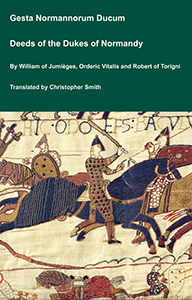
The Deeds of the Dukes of Normandy
The Gesta Normannorum Ducum [The Deeds of the Dukes of Normandy] is a landmark medieval chronicle tracing the rise and fall of the Norman dynasty from its early roots through the pivotal events surrounding the Norman Conquest of England. Originally penned in Latin by the monk William of Jumièges shortly before 1060 and later expanded at the behest of William the Conqueror, the work chronicles the deeds, politics, battles, and leadership of the Norman dukes, especially William’s own claim to the English throne. The narrative combines earlier historical sources with firsthand information and oral testimony to present an authoritative account of Normandy’s transformation from a Viking settlement into one of medieval Europe’s most powerful realms. William’s history emphasizes the legitimacy, military prowess, and governance of the Norman line, framing their expansion, including the conquest of England, as both divinely sanctioned and noble in purpose. Later chroniclers such as Orderic Vitalis and Robert of Torigni continued the history, extending the coverage into the 12th century, providing broader context on ducal rule and its impact. Today this classic work remains a foundational source for understanding Norman identity, medieval statesmanship, and the historical forces that reshaped England and Western Europe between 800AD and 1100AD.
Available at Amazon in eBook and Paperback format.
Annales by William Camden is in Tudor Books.
[20th December 1583] 20. On the other side some Papists bookes against the Queene and Princes excommunicate drew some which had the Popes power in great reverence for their obedience, and amongst others they so distracted one Somervill (deceased), a gentilman, that in haste he undertooke a journey privily to the Queenes Court, and breathing nothing but blood against the Protestants, he furiously set upon one or two by the way with his sword drawne. Being apprehended, hee professed that hee would have killed the Queene with his owne hands. Whereupon he, and by his appeachment Edward Ardern (age 50) his wives father, a man of very ancient gentility in the County of Warwicke, Ardern's wife, their daughter Somervill, and Hall a Priest, as accessaries, were arrraigned and condemned. After three daies Somervill was found strangled in prison; Arderne, being condemned, was the next day after hanged and quartered; the woman and the Priest were spared. This woefull end of this gentleman, who was drawne in by the cunning of the Priest and cast by his own testimony, was commonly imputed to Leicesters (age 51) malice. For certaine it is that hee had incurred Leicesters heavie displeasure, and not without cause, against whom hee had rashly opposed himselfe in all hee could, had reproached him as an adulterer, and detracted him as a new upstart.


