

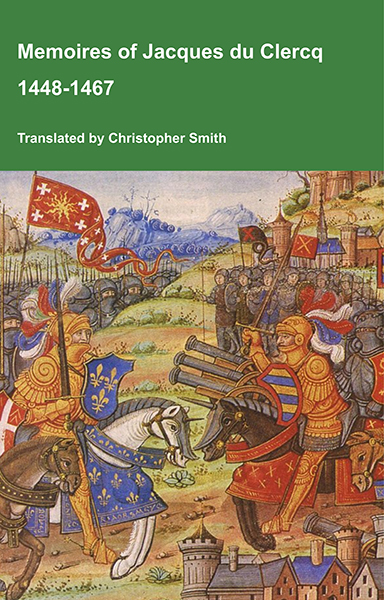
This is a translation of the 'Memoires of Jacques du Clercq', published in 1823 in two volumes, edited by Frederic, Baron de Reissenberg. In his introduction Reissenberg writes: 'Jacques du Clercq tells us that he was born in 1424, and that he was a licentiate in law and a counsellor to Philip the Good, Duke of Burgundy, in the castellany of Douai, Lille, and Orchies. It appears that he established his residence at Arras. In 1446, he married the daughter of Baldwin de la Lacherie, a gentleman who lived in Lille. We read in the fifth book of his Memoirs that his father, also named Jacques du Clercq, had married a lady of the Le Camelin family, from Compiègne. His ancestors, always attached to the counts of Flanders, had constantly served them, whether in their councils or in their armies.' The Memoires cover a period of nineteen years beginning in in 1448, ending in in 1467. It appears that the author had intended to extend the Memoirs beyond that date; no doubt illness or death prevented him from carrying out this plan. As Reissenberg writes the 'merit of this work lies in the simplicity of its narrative, in its tone of good faith, and in a certain air of frankness which naturally wins the reader’s confidence.' Du Clercq ranges from events of national and international importance, including events of the Wars of the Roses in England, to simple, everyday local events such as marriages, robberies, murders, trials and deaths, including that of his own father in Book 5; one of his last entries.
Available at Amazon in eBook and Paperback format.
Annals of Ulster is in Early Medieval Books.
534. Kalends of January first feria, first of the moon.
534 The drowning of Muirchertach Mac Erca i.e. Muirchertach son of Muiredach son of Eógan son of Niall Naígiallach in a vat full of wine on the hilltop of Cleitech [Map] above Bóinn.
534. Repose of Ailbe of Imlech Ibuir.
937. A great, lamentable and horrible battle was cruelly fought between the Saxons and the Norsemen, in which several thousands of Norsemen, who are uncounted, fell, but their king, Amlaíb, escaped with a few followers. A large number of Saxons fell on the other side, but Athelstan [aged 43], king of the Saxons, enjoyed a great victory.
27th October 939. Athelstan [aged 45], king of the Saxons, pillar of the dignity of the western world, died an untroubled death.
[5th August 1063] The son [Gruffydd ap Llywelyn King Wales] of Llewellyn, king of the Britons, was killed by the son of Iago.
Florence Mac-an-Oglaich, Archdeacon of Cill-0iridh1, died.
Note 1. Cill-Oiridh, now Killery, an old church which gives name to a parish near Lough Gill in the barony of Tirerrill and county of Sligo, and adjoining the county of Leitrim. See map prefixed to Genealogies, Tribes, and Customs of Hy-Fiachrach; on which the situation of this church is shewn. See another reference to Cill Oiridh under the year 1416.
6th June 1333. William Burke, Earl of Ulster [aged 20]2, was killed by the English of Ulster. The Englishmen who committed this deed were put to death, in divers ways, by the people of the King of England; some were hanged, others killed, and others torn asunder2, in revenge of his death.
Note 1. Earl of Ulster. There is a much more circumstantial account of the death of this Earl of Ulster given by Pembridge and Grace under this year. Lodge gives the following particulars of it: "He was murdered on Sunday, June 6, 1333, by Robert Fitz-Richard Mandeville (who gave him his first wound), and others his servants, near to the Fords, in going towards Carrickfergus, in the 21st year of his age, at the instigation, as was said, of Gyle de Burgh, wife of Sir Richard Mandeville, in revenge for his having imprisoned her brother Walter and others."
This young earl left an only child, Elizabeth, who was married in the year 1352 to Lionel, third son of King Edward III., and this prince was then created, in her right, Earl of Ulster and Lord of Connaught, and these titles were enjoyed through marriage or descent by different princes of the royal blood, until at length, in the person of Edward IV, they became the special inheritance and revenue of the crown of England. Immediately on the Earl's death the chiefs of the junior branches of the family of Burke or De Burgo, then seated in Connaught, fearing the transfer of his possessions into strange hands by the marriage of the heiress, seized upon his estates in Connaught. The two most powerful of these were Sir William or Ulick, the ancestor of the Earls of Clanrickard, and Sir Edmund Albanagh the progenitor of the Viscounts of Mayo. These having confederated together and declared themselves independent, renounced the English dress and language, and adopted Irish names, Sir William taking the name of Mac William Oughter, or the Upper, and Sir Edmund that of Mac William Eighter, or the Lower. Under these names these two powerful chieftains tyranized over the entire province of Counaught, and though Lionel Duke of Clai'ence, in right of his wife, laid claim to their usurped possessions, the government apears to have been too weak to assert, the authority of the English laws, so that the territories of the Burkes were allowed to descend in course of tanistry and gavelkind. See Hardiman's History of Galway, pp. 56, 57.
Note 2. Torn asunder, i.e. torn limb from limb. Mageoghegan renders it "hanged, drawn, and quartered."
 Become a Member via our Buy Me a Coffee page to read more.