

This is a translation of the 'Memoires of Jacques du Clercq', published in 1823 in two volumes, edited by Frederic, Baron de Reissenberg. In his introduction Reissenberg writes: 'Jacques du Clercq tells us that he was born in 1424, and that he was a licentiate in law and a counsellor to Philip the Good, Duke of Burgundy, in the castellany of Douai, Lille, and Orchies. It appears that he established his residence at Arras. In 1446, he married the daughter of Baldwin de la Lacherie, a gentleman who lived in Lille. We read in the fifth book of his Memoirs that his father, also named Jacques du Clercq, had married a lady of the Le Camelin family, from Compiègne. His ancestors, always attached to the counts of Flanders, had constantly served them, whether in their councils or in their armies.' The Memoires cover a period of nineteen years beginning in in 1448, ending in in 1467. It appears that the author had intended to extend the Memoirs beyond that date; no doubt illness or death prevented him from carrying out this plan. As Reissenberg writes the 'merit of this work lies in the simplicity of its narrative, in its tone of good faith, and in a certain air of frankness which naturally wins the reader’s confidence.' Du Clercq ranges from events of national and international importance, including events of the Wars of the Roses in England, to simple, everyday local events such as marriages, robberies, murders, trials and deaths, including that of his own father in Book 5; one of his last entries.
Available at Amazon in eBook and Paperback format.
Antiquaries Journal V1 1921 Section 1 The Aubrey Holes is in Antiquaries Journal V1 1921 Section 1.
We are indebted to Bodley's Librarian for allowing us to examine the Plan of Stonehenge made by Aubrey in 1666 which forms part of the Monumenta Britannica preserved in the Bodleian Library. Aubrey mentions and marks upon his plan certain depressions, or cavities, at intervals within the circular earthwork. None of them was visible to us, but with a steel bar we searched for and found one, and subsequently more, all apparently at regular intervals round the earthwork. It occurred to us that there might be intermediate cavities, and excavation showed them to be at regular intervals of 1 6 ft., with the exception of two on the south-east side, which are a little closer together. To these we have given the name of "Aubrey Holes" to distinguish them from others that may hereafter be found, and as a compliment to our respected pioneer who left such a useful record.
We have excavated a series of these holes from stone no. 80 (called the Slaughter Stone [Map]) round by the east to one on the south-west, where we stopped, deciding to gain experience before completing the circle. The holes so far excavated are twentythree in number, but the series in the semicircle is not complete, as there is an intervening barrow on the south; so we left out four holes until we can give attention to the barrow. Unfortunately it has been opened before; and to distinguish the disturbed from the undisturbed portion it will have to be very leisurely and carefully worked, for it is very important, and may help us to arrive at the relative ages of barrow, bank, and holes, and settle the order of succession.
The holes vary very little in size and shape: the biggest is 3 ft. 5 in. deep, its maximum diameter 5 ft. 3 in., and the minimum 4 ft. 6 in. The smallest is 2 ft. deep, maximum diameter 2 ft. 6 in., and minimum 2 ft. 5 in. They are as a rule sharp and regular cuttings in the chalk, and are all more or less circular. Many have the edge of the chalk crater shorn away, or crushed down, on the side towards the standing stones of Stonehenge, this being apparently due either to the insertion or withdrawal of a stone, probably the latter. From their appearance and regularity there can be little doubt that they once held small upright stones; for, in two cases at least, a portion of the excavated chalk appears to have been returned, as if the hole had been too deeply dug to suit the intended height of the stone. This returned rubble was extremely hard and compacted, as if a very heavy weight had rested upon it for a long time. With the exception of four holes, all bore evidence of cremated human remains having been deposited in them, and at least three showed signs that actual cremation had been carried out in them. Among the more interesting may be mentioned:
No. 21. Depth, 3 ft. I in. Maximum diameter, 5 ft. 5 in. Minimum diameter, 5 ft. 2 in. It contained 51 sarsen fragments, one being pitted, 61 fragments of foreign stone, 71 of hammerstone sarsen, i piece of Bronze Age pottery, and 4 of RomanoBritish pottery. All these occurred about 20 in. below groundlevel. After that a ball (hand-made) of chalk, i o pieces of unburnt animal bone, and a bone pin in three pieces, burnt, at 2 ft. 3 in. A large cremation, amongst much wood ash dispersed in earthy rubble. This was first met with at 2 ft. below ground-level and continued to the bottom of the hole. Much of the rubble was burnt red. The hole had a sloping inner side (the side farthest from the rampart). At the top of this slope was a small bowlshaped recess containing cremated bones. Presuming that the sloping side was crushed by the withdrawal of the stone, the cremated remains must have been deposited afterwards. The north-west side near the rampart was covered with finely crushed chalk rubble, hardened as if by great pressure (fig. 6).
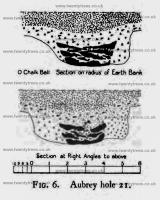
Figure 6. Aubrey Hole 21.
No. 1 6. Depth, 3 ft. 3 in. Maximum diameter, 4 ft. Minimum diameter, 3 ft. 7 in. Contained 38 fragments of sarsen (one a fairly well-shaped hammer), 30 of foreign stone, 5 pieces of Romano-British pottery, a piece of foreign stone (small, rather flat, showing signs of use by rubbing), 3 rough flints, 6 flint flakes, and a flint fabricator at 34 in. below ground-level.
The hole contained a great deal of wood ash with cremated bones in it. This began at 19 in. below ground-level and continued to the bottom. The side of the hole had a layer of white chalk rubble in which was a fabricator, 5 in. from the bottom (fig. 7).
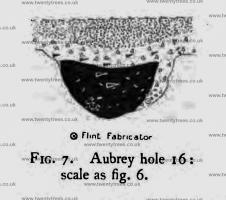
Figure 7. Aubrey Hole 16: scale as fig. 6.
No. 13. Depth, 2 ft. 7 in. Maximum diameter, 3 ft. 7 in. Minimum diameter, 3 ft. 5 in. Contained 28 sarsen fragments, 34 of sarsen hammer-stone down to 25 in. below ground-level; below this 1 large animal bone at 28 in., a bone pin 6½ in. long at 18 in., and a flint fabricator at 22 in.
A few cremated bones were met with just below the humus at 10 in. Wood ash was met with at 24 in. on the inner side of the hole and continued in a slanting direction down and across to the other side. Amongst the wood ash were cremated bones. There was chalk rubble on the inner side under the burnt wood, and a certain amount, as usually found, on the side nearest the rampart (fig. 8).
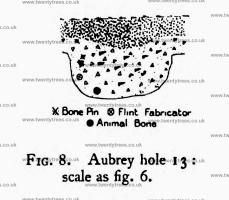
Figure 8. Aubrey Hole 13: scale as fig. 6.
William of Worcester's Chronicle of England
William of Worcester, born around 1415, and died around 1482 was secretary to John Fastolf, the renowned soldier of the Hundred Years War, during which time he collected documents, letters, and wrote a record of events. Following their return to England in 1440 William was witness to major events. Twice in his chronicle he uses the first person: 1. when writing about the murder of Thomas, 7th Baron Scales, in 1460, he writes '… and I saw him lying naked in the cemetery near the porch of the church of St. Mary Overie in Southwark …' and 2. describing King Edward IV's entry into London in 1461 he writes '… proclaimed that all the people themselves were to recognize and acknowledge Edward as king. I was present and heard this, and immediately went down with them into the city'. William’s Chronicle is rich in detail. It is the source of much information about the Wars of the Roses, including the term 'Diabolical Marriage' to describe the marriage of Queen Elizabeth Woodville’s brother John’s marriage to Katherine, Dowager Duchess of Norfolk, he aged twenty, she sixty-five or more, and the story about a paper crown being placed in mockery on the severed head of Richard, 3rd Duke of York.
Available at Amazon in eBook and Paperback format.
No. 3. Depth, 2 ft. 6 in. Maximum diameter, 3 ft. 2 in. Minimum diameter, 3 ft. 4 in. In this some of the excavated chalk had been returned to the hole, presumably to raise the stone to the desired height. The same peculiarity was met with in two other instances. In this there was a thickness of 8 in. over the chalk rock much compressed. The hole had in it a cremation dispersed amongst the earthy rubble which filled it (fig. 9).
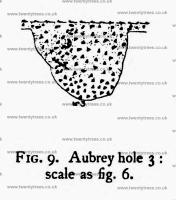
Figure 9. Aubrey Hole 3. scale as fig. 6.
No. 5 hole had a similar layer, which was 5 in. thick. This hole also had a cremation over the hard mass, from 10 in. to 27 in. below the surface (fig. 10).
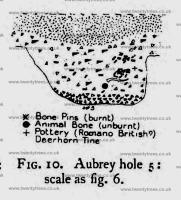
Figure 10. Aubrey Hole 5. scale as fig. 6.
No. 19 was interesting because, after the upper soil was passed, we came upon a mass or white flint flakes at 32 in. discarded by an implement maker who had been working on the spot and who must have demolished a large block of flint to make thin and delicate implements. That they all belonged to the same block was evident, not only from the colour and material, but because some of them fitted together; and they also clearly show the marks made when they were struck off (fig. 11).
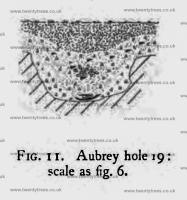
Figure 11. Aubrey Hole 19. scale as fig. 6.
Sarsen and other stone fragments were found in nearly all cases on the upper level, but rarely below 20 in., and they usually decreased in number downwards. It is a curious fact that in almost all the holes there was a litde white chalk rubble on the bottom and against the side nearest the rampart. The reason may possibly be that the stone was dragged out on the opposite side, leaving this deposit undisturbed. It might perhaps be connected with the making of the rampart, but these questions we hope the excavation of the barrow may solve.