

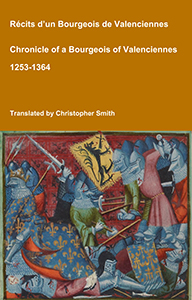
Chronicle of a Bourgeois of Valenciennes
Récits d’un bourgeois de Valenciennes aka The Chronicle of a Bourgeois of Valenciennes is a vivid 14th-century vernacular chronicle written by an anonymous urban chronicler from Valenciennes in the County of Hainaut. It survives in a manuscript that describes local and regional history from about 1253 to 1366, blending chronology, narrative episodes, and eyewitness-style accounts of political, military, and social events in medieval France, Flanders, and the Low Countries. The work begins with a chronological framework of events affecting Valenciennes and its region under rulers such as King Philip VI of France and the shifting allegiances of local nobility. It includes accounts of conflicts, sieges, diplomatic manoeuvres, and the impact of broader struggles like the Hundred Years’ War on urban life in Hainaut. Written from the perspective of a burgher (bourgeois) rather than a monastery or royal court, the chronicle offers a rare lay viewpoint on high politics and warfare, reflecting how merchants, townspeople, and civic institutions experienced the turbulence of the 13th and 14th centuries. Its narrative style combines straightforward reporting of events with moral and civic observations, making it a valuable source for readers interested in medieval urban society, regional politics, and the lived experience of war and governance in pre-modern Europe.
Available at Amazon in eBook and Paperback format.
Archaeologia Cambrensis 1869 Page 263-264 is in Archaeologia Cambrensis 1869.
This is mentioned by Rowlands (Mona Antiqua, second edition, p. 93), who describes it as "a pretty cromlech standing at the top of a hillock at Bodowyr." He also gives a drawing of it (plate v, fig. 2), and the following dimensions,— "length, 7 ft.; breadth, 6 ft.; thickness, 6 ft."; and adds,"ye upper stone is a detruncated pyra mid, and flat at the top." The capstone is four-sided: the north-west side,which is the longest, measures 7 ft.; the south-west side, 6 ft.; the south-east side, 6 ft. 3 ins. (exclusive of the corner which is rounded); the north-east side, 4 ft. 6 ins. It has a pyramidal appearance when looked at from the south-west, but is certainly not "very flat at the top." There are five supporters standing; but the capstone at present rests upon three only, which are shaded in the accompanying ground-plan. From the smallest of these a piece has been detached, and now lies beneath the cromlech. The total height above ground is 7 ft. 6 ins. Several fragments of stone, all of which are marked in the ground-plan, are scattered about under and around the structure. Most probably these were originally used to close up the sides of the chamber. Miss A. Llwyd, in her History of Anglesey (4to., 1833, p. 287), describes the capstone as being "supported by four upright stones"; so that, if she observed correctly, one supporter must have given way after she wrote. Rowlands further remarks that "there is also, on a rising part of the ground there" (Bodowyr)," the highway leading through it, the remains of a small cirque" (Mona Antiq., plate v, fig. 3); " and on another part of the ground there appear the marks of a carnedd, the stones of which, in times past, have been disposed of into walls and buildings."
I have been unable to find the remains of either of these.
Note 1. Pennant, p. 229.