

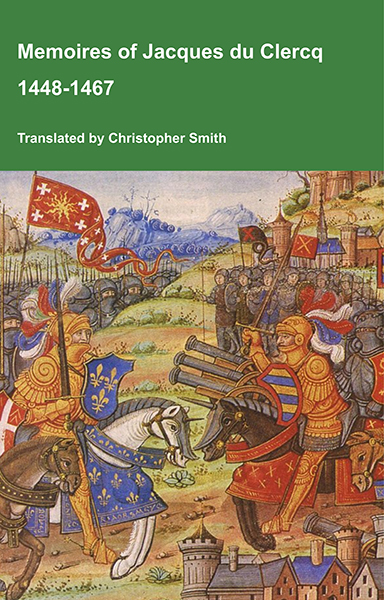
This is a translation of the 'Memoires of Jacques du Clercq', published in 1823 in two volumes, edited by Frederic, Baron de Reissenberg. In his introduction Reissenberg writes: 'Jacques du Clercq tells us that he was born in 1424, and that he was a licentiate in law and a counsellor to Philip the Good, Duke of Burgundy, in the castellany of Douai, Lille, and Orchies. It appears that he established his residence at Arras. In 1446, he married the daughter of Baldwin de la Lacherie, a gentleman who lived in Lille. We read in the fifth book of his Memoirs that his father, also named Jacques du Clercq, had married a lady of the Le Camelin family, from Compiègne. His ancestors, always attached to the counts of Flanders, had constantly served them, whether in their councils or in their armies.' The Memoires cover a period of nineteen years beginning in in 1448, ending in in 1467. It appears that the author had intended to extend the Memoirs beyond that date; no doubt illness or death prevented him from carrying out this plan. As Reissenberg writes the 'merit of this work lies in the simplicity of its narrative, in its tone of good faith, and in a certain air of frankness which naturally wins the reader’s confidence.' Du Clercq ranges from events of national and international importance, including events of the Wars of the Roses in England, to simple, everyday local events such as marriages, robberies, murders, trials and deaths, including that of his own father in Book 5; one of his last entries.
Available at Amazon in eBook and Paperback format.
Archaeologia Cambrensis 1895 Page 157 is in Archaeologia Cambrensis 1895.
Mr. Herbert J. Allen communicates the following account:—"Being the only member of the Cambrian Archaeological Association who went with Major Ap Hugh Williams to inspect the cromlech at Bryn Celli, within half-a-mile of his house, Plas Gwyn, on 19th July last, I venture to send this small note on the subject. The cromlech or stone chamber is most interesting, as the slab forming the roof is covered with small stones and earth. There is a passage leading up to it also topped with rubble and earth, and there are three large stones 'on the outer circumference of the rise', nearly equi-distant from the centre, which presumably formed part of the circle of stones, or were part of the tumulus, or carnedd as the cromlech is called by Rowlands in his Mona Antiqua, and by Pennant in his Tour, but the diameter of the chamber is incorrectly given as 3 feet in the latter account, it being really about 7^ feet. These accounts are quoted by a writer in the second volume of the Arclumlgia Cambrensis, pp. 3-6, who visited the locality in 1846. There is a low stone fence surrounding the chamber and passage, which is mentioned in the article referred to as being about to be erected. This has preserved the remains so well that the description of 48 years ago is, as far as I could judge, fairly correct at the present time, and, as the volume in question is difficult to obtain, I quote the description there given:—' All traces of the carnedd have disappeared except the earth and stones that still lie on the cromlech, where a tree had taken root, but is now withered and dead; and also, on the top of the passage leading to the chamber. The ground, however, rises all around, making the base of a tumulus that now would measure not more than 65 or '0 feet across, and the occurrence of a large stone on the outer circumference of this rise, wouW lead to the conjecture that originally it was surrounded by a circle of such blocks. The passage which led from the outside to the chamber within runs from east to west, and now measures not more than 18 feet in length, by about v feet in height, and 2 feet 6 inches in breadth: it is composed of six large stones in the northern, and five on the southern side; but on the latter several stones are built in, exactly as is now done in the common stone fences of the country. The sides of the chamber or cromlech, which is correctly described as "irregularly hexagonal", are composed of single stones of the width of 5 feet 4 inches, 4 feet, 6 feet, 4 feet and 6 feet respectively, allowing a space of only 20 inches for the entrance, which, with a stone 21 inches wide, makes up the 6 feet side. The upper stone forming part of the roof is 11 feet long by 6 feet 6 inches wide, and 15 inches thick. There is a second stone, placed in rather a slanting position on the northern side, which also makes part of the roof and is of rather smaller dimensions than the former. This has now fallen off and lies upon another by the side of the rest. The central pillar, spoken of by Pennant, lies prostrate in the middle of the chamber. The soil has accumulated within, and no traces of the "stone brush" are now observable. The upper stone, like many other smaller ones which formed part of the carnedd, is of grit; all the others are of chloritic schist, both sorts of stone being found within no great distance from the spot.'"
On our return we passed the interesting Elizabethan house called Plas Coch, also described in the second volume of the Arch. Camb., p. 166, and noticed that the inscription round the top of the porch, showing that it was built "In the Yere of Lord God 1569", is clearly decipherable.
We were also shown at one of the lodges to Plas Newydd a pair of wooden dog-tongs, on which the date "1778" was cut.
(To be continued.)