

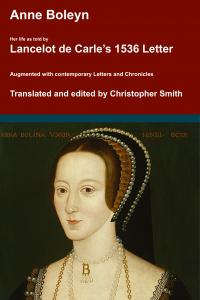
Anne Boleyn. Her Life as told by Lancelot de Carle's 1536 Letter.
In 1536, two weeks after the execution of Anne Boleyn, her brother George and four others, Lancelot du Carle, wrote an extraordinary letter that described Anne's life, and her trial and execution, to which he was a witness. This book presents a new translation of that letter, with additional material from other contemporary sources such as Letters, Hall's and Wriothesley's Chronicles, the pamphlets of Wynkyn the Worde, the Memorial of George Constantyne, the Portuguese Letter and the Baga de Secrets, all of which are provided in Appendices.
Available at Amazon in eBook and Paperback format.
Archaeologia Cambrensis 1925 Page 230 is in Archaeologia Cambrensis 1925.
Rhuddlan Friary [Map] Effigy.
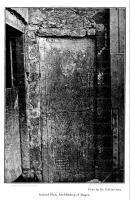
Rhuddlan Friary Effigy. At a distance of a mile from the town of Rhuddlan, lying just beyond its castle, stand the ruins of what was once a Dominican Friary. Tradition assigns its origin as a Friary to seven Welsh gentlemen in 1197. If this be correct, then it must have been taken over by the Dominicans in the early part of the thirteenth century. The first historical notice is the appointment of Anian, the prior of Rhuddlan - "Y Brawd Du" - as Bishop of St. Asaph, in 1268. To-day little remains of this Friary. In years gone by, it formed a quarry for building, and now stand only the remains of the dormitory and domestic offices transformed into barns. Fixed in some of the walls in the open shippon were various effigies-all more or less in imperfect condition and exposed to the weather. Chief amongst these was the tombstone monument of William Fresney, Archbishop of Rages (Edessa), of which a description has been already published in Arch. Camb., 1912, pp. 121-5. The monument consists of a life-sized figure of the Archbishop, with crosier, mitre, chasuble, alb and maniple, with hand uplifted in blessing, and the inscription, now more or less illegible in parts-" Priez pour l'alme Frere William Ercheveske de Rages."
As the stone was beginning to show serious signs of weathering, the permission of Capt. Conwy, R.N., C.M.G., the owner of the property, was obtained for its removal to safer quarters, and on November 9th and 10th, 1923, the monument was safely removed from the Friary, under the superintendence of the Rev. W. J. Davies, Vicar of Rhuddlan, and Mr. J. O. Hughes, the estate agent, with some of his workmen, and re-erected against the north side of the sacrarium of the Parish Church.