

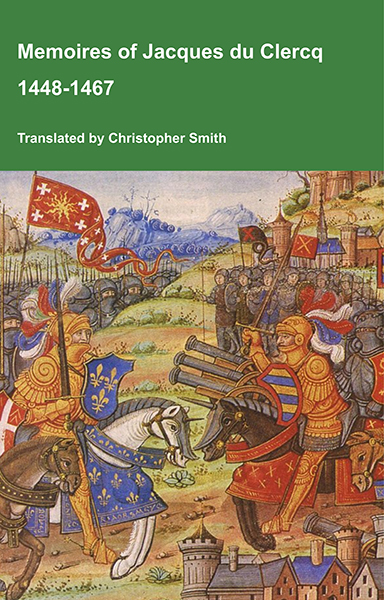
This is a translation of the 'Memoires of Jacques du Clercq', published in 1823 in two volumes, edited by Frederic, Baron de Reissenberg. In his introduction Reissenberg writes: 'Jacques du Clercq tells us that he was born in 1424, and that he was a licentiate in law and a counsellor to Philip the Good, Duke of Burgundy, in the castellany of Douai, Lille, and Orchies. It appears that he established his residence at Arras. In 1446, he married the daughter of Baldwin de la Lacherie, a gentleman who lived in Lille. We read in the fifth book of his Memoirs that his father, also named Jacques du Clercq, had married a lady of the Le Camelin family, from Compiègne. His ancestors, always attached to the counts of Flanders, had constantly served them, whether in their councils or in their armies.' The Memoires cover a period of nineteen years beginning in in 1448, ending in in 1467. It appears that the author had intended to extend the Memoirs beyond that date; no doubt illness or death prevented him from carrying out this plan. As Reissenberg writes the 'merit of this work lies in the simplicity of its narrative, in its tone of good faith, and in a certain air of frankness which naturally wins the reader’s confidence.' Du Clercq ranges from events of national and international importance, including events of the Wars of the Roses in England, to simple, everyday local events such as marriages, robberies, murders, trials and deaths, including that of his own father in Book 5; one of his last entries.
Available at Amazon in eBook and Paperback format.
Archaeologia Volume 11 Section IV is in Archaeologia Volume 11.
Observations on Kits Coity House [Map], in Kent. In a Letter to Samuel Foart Simmons, M. D . F. R. and A. SS. By William Boys, Esq . F. A. S. Read Feb. 9, 1792.
Dear Sir,
In travelling some time ago from this place to London, I turned a few miles out of my way to see Kits Coity House. If you should think the observations I made upon the spot, and the thoughts that have occurred to me since, may be acceptable, I beg leave, by your means, to communicate them to our Society.
Mr. Colebrook [a] and Mr. Grofe [b] have fo fully and accurately described this antient monument, that very little can be added to what they have said of it. One thing, however, struck me, when I saw the place, that seems to have escaped the notice of all who have mentioned the subject. The ground between the monument and the single stone spoken of by those gentlemen, and represented in their plates, runs east and west, in a broad ridge, somewhat contracted at each end, giving one an idea of a common turfed grave, with a head and foot-stone, on a large scale. Was this a tumulus, covering the remains of those of one party, who fell in the battle? And might there not have been, originally, a fimilar appendage to the other (lone monument, now worn down in the enclofure of cultivation, covering the remains of the other party? these turfed graves might contain the bodies both of the chiefs and their followers; while the ftone erections themfelves might be raifed to commemorate the two princes; a fepulchral honour, perhaps appropriated at that time to dignified charadters only. I am aware, that much larger tumuli have been raifed over fingle bodies; but I apprehend, if only one corpfe had been placed in this repofitory, the mound would have been circular, and the (tones would have been at the top in the centre.
Note a. Archaeologia, vol. II. p. 107.
Note b. Antiquities of England, &c. vol. II.
Continues.