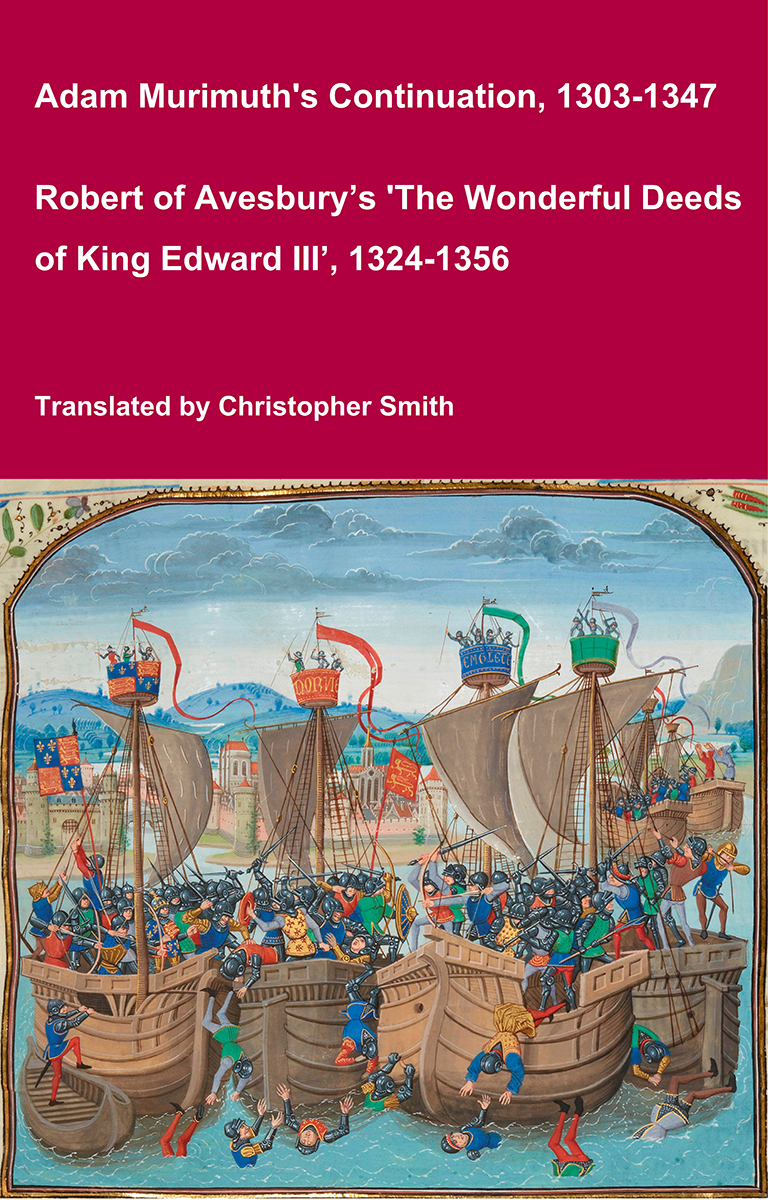
Adam Murimuth's Continuation and Robert of Avesbury’s 'The Wonderful Deeds of King Edward III'
This volume brings together two of the most important contemporary chronicles for the reign of Edward III and the opening phases of the Hundred Years’ War. Written in Latin by English clerical observers, these texts provide a vivid and authoritative window into the political, diplomatic, and military history of fourteenth-century England and its continental ambitions. Adam Murimuth Continuatio's Chronicarum continues an earlier chronicle into the mid-fourteenth century, offering concise but valuable notices on royal policy, foreign relations, and ecclesiastical affairs. Its annalistic structure makes it especially useful for establishing chronology and tracing the development of events year by year. Complementing it, Robert of Avesbury’s De gestis mirabilibus regis Edwardi tertii is a rich documentary chronicle preserving letters, treaties, and official records alongside narrative passages. It is an indispensable source for understanding Edward III’s claim to the French crown, the conduct of war, and the mechanisms of medieval diplomacy. Together, these works offer scholars, students, and enthusiasts a reliable and unembellished account of a transformative period in English and European history. Essential for anyone interested in medieval chronicles, the Hundred Years’ War, or the reign of Edward III.
Available at Amazon in eBook and Paperback format.
Archaeologia Volume 15 Appendix is in Archaeologia Volume 15.
March 14th, 1804. The Rev. the Dean of Raphoe presented to the Society four original drawings of some caves [Ballymacdermot Court Tomb [Map]], which he had discovered on his glebe, in the parish of Killevy, in the county of Armagh in Ireland. Some account of these caves, with engravings, has been published by General Vallencey, in his Collectanea de Rebus Hibernicis; yet, for the satisfaction of such gentlemen as may not have seen that publication, the Dean accompanied his present with a short description, as follows:
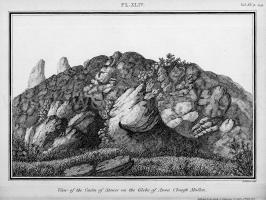
In the parish of Killevy, and Town Land of Anna-Clogh Mullen, is a very large cairn of stones, not less than sixty feet long, and about twelve feet high. (Pl.XLIV.) I was requested by my neighbour. Sir Walter Synnot, to have the cairn opened, in expectation of discovering some urns.
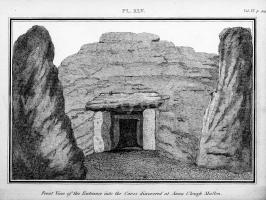
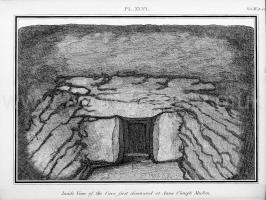
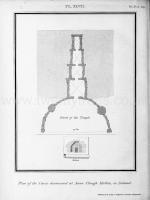
I opened it nearly at the centre, and discovered an apartment about six feet eight inches long, six feet two inches wide, the side walls about three feet perpendicular, consisting of single stones of that breadth, laid on their edges, from whence an arch was sprung of dry corbelling stones, and covered at top with a flag about three feet broad. One of the drawings accompanying this, (Pl.XLV.) is a view of the inside of this apartment; and as there were evidently the appearances of door cases of entrance into other apartments, I determined to examine the cairn on the outside, to discover the entrance from without; and remarking that two of the stones towards one end of the cairn rose higher than the rest, I caused all the loose stones to be removed from them; when I was much surprized to discover a regular front composed of large dry stones, between two pillars of rude single stones, each about nine feet high, as described in the drawing representing the front, (Pl. XLV ) with a door-way of entrance into another apartment similar to the one I first discovered, about eight feet wide, and nine feet six inches long; which opened into a second about six feet six inches wide, and six feet long; which opened into the one I first discovered, and this communicated with a fourth about two feet wide and six feet long.
From the tall pillars at the entrance, a circular range of small stones were fixed in the ground to the distance of about thirty-three feet from the centre of the door of entrance, and the whole terminated by a stone at each end, about two feet six inches high, as is represented in the ground plan. (Pl. XLVII.) In none of the apartments did we discover any urns, or any thing that would lead to the discovery of the purposes for which these caves were designed, but unquestionably they are of great antiquity: nor was there any tradition among the inhabitants, either of the cairn containing such apartments, or the occasion on which it had been formed. As the fourth apartment did not extend much beyond the centre of the cairn, my intention was to have explored the remaining half of the cairn, but being very soon after the diseovery removed to the Deanery of Raphoe, no farther examination has been made.