Chronicle of Walter of Guisborough
A canon regular of the Augustinian Guisborough Priory, Yorkshire, formerly known as The Chronicle of Walter of Hemingburgh, describes the period from 1066 to 1346. Before 1274 the Chronicle is based on other works. Thereafter, the Chronicle is original, and a remarkable source for the events of the time. This book provides a translation of the Chronicle from that date. The Latin source for our translation is the 1849 work edited by Hans Claude Hamilton. Hamilton, in his preface, says: 'In the present work we behold perhaps one of the finest samples of our early chronicles, both as regards the value of the events recorded, and the correctness with which they are detailed; Nor will the pleasing style of composition be lightly passed over by those capable of seeing reflected from it the tokens of a vigorous and cultivated mind, and a favourable specimen of the learning and taste of the age in which it was framed.'
Available at Amazon in eBook and Paperback format.
Archaeologia Volume 25 Section XII is in Archaeologia Volume 25.

Observations on Dracontia [Carnac]; Communicated by the Rev. John Bathurst Deane (age 36), M.A., F.S.A., in a Letter to Henry Ellis, Esq. F.R.S., Secretary. Read 13th December, 1832.
My Dear Sir,
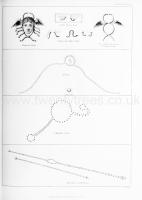
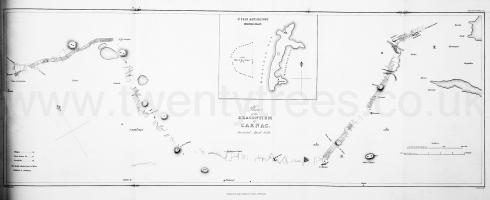
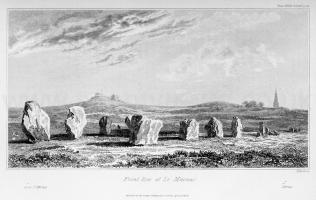
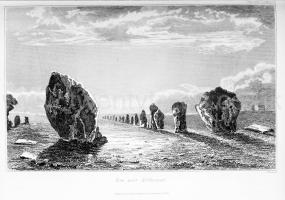
The introductions which you kindly procured for me to the Authorities in Britany having enabled me, through the assistance of Mr. Vicars, a professional surveyor of Exeter, to complete a Plan of the Druidical Temple of Carnac, I have great pleasure in requesting you to lay it before the Society of Antiquaries, together with the following Observations on Dracontia. In these observations there is little of novelty; but I have adopted this method of introducing my remarks upon Carnac, because by it I can convey with greater ease and clearness my sentiments on the figure and dedication of this Sanctuary.
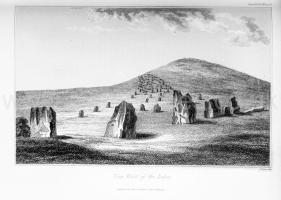
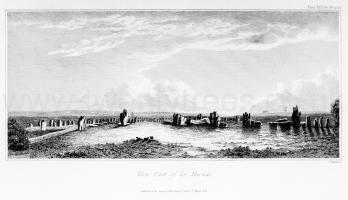
Of all histories the most interesting is the religious history of mankind; and, the more nearly a superstition approaches to the truth, the more animating is the research, and the more gratifying the discoveries which result from it. Such a fascination I have felt in the worship of the Serpent; and in the pursuit of some further architectural evidences of its prevalence in the ancient world, I visited and explored the monuments of Carnac. The result of my inquiries I now offer to the Society, in the humble hope that the zeal which induced me to undertake the task, may atone for the imperfections which attend its execution.
I. The first worshippers of God adored Him in a temple " made without hands," bowing down before His throne under the canopy of heaven: and the first idolaters in like manner bent the knee to Baal in roofless sanctuaries. Whether there was any mystery contained in this practice, or whether it may be attributed to the infancy of the arts, when architecture was too feeble to lift the massy dome upon the unhewn column, I will not stop to enquire. Nothing is more obvious than the gradual improvement of architecture; and nothing more natural than that the primitive worshipper should desire to behold the God of his adoration "face to face," without even a cloud to intercept his eye from the place of His imagined abode. The first temples were therefore open to the heavens.
But there is another peculiarity of these primitive sanctuaries which deserves to be noticed. They were inclosed by no walls, and terminated by no portals, they were as open to the earth around, as to the heavens above them: so that whether we look for the primitive temple in the Solar Circle, or the parallelitha of the Dracontium, we shall perceive the same features, pillar after pillar placed at intervals, singly and independently, yet with a view to one constant principle. Of the mystic character of these columns much curious information has been preserved in history. They were all supposed to be individually animated by an emanation of the Deity to whose honour they were raised. It seems probable that, at first, they were erected singly, and afterwards grouped to form temples. Some such notion seems to be implied in the 28th chapter of Genesis, where the patriarch Jacob is represented as erecting a pillar to Jehovah. The passage is remarkable: " Jacob awaked out of his sleep, and he said, Surely the Lord is in this place and I knew it not! And he was afraid, and said, How dreadful is this place!
Yhis is none other but the house of God, and this is the gate of heaven! And Jacob rose up early in the morning and took the stone that he had put for his pillow, and set it up for a pillar, and poured oil upon the top of it. And he called the name of that place Beth-El."
Here we observe that the open place upon which the patriarch stood is called " the house of God; and he erects a pillar to mark the spot. These circumstances may imply either that temples were at that time unknown, or that they were formed by an enclosure of pillars.
Continues ...