

Adam Murimuth's Continuation and Robert of Avesbury’s 'The Wonderful Deeds of King Edward III'
This volume brings together two of the most important contemporary chronicles for the reign of Edward III and the opening phases of the Hundred Years’ War. Written in Latin by English clerical observers, these texts provide a vivid and authoritative window into the political, diplomatic, and military history of fourteenth-century England and its continental ambitions. Adam Murimuth Continuatio's Chronicarum continues an earlier chronicle into the mid-fourteenth century, offering concise but valuable notices on royal policy, foreign relations, and ecclesiastical affairs. Its annalistic structure makes it especially useful for establishing chronology and tracing the development of events year by year. Complementing it, Robert of Avesbury’s De gestis mirabilibus regis Edwardi tertii is a rich documentary chronicle preserving letters, treaties, and official records alongside narrative passages. It is an indispensable source for understanding Edward III’s claim to the French crown, the conduct of war, and the mechanisms of medieval diplomacy. Together, these works offer scholars, students, and enthusiasts a reliable and unembellished account of a transformative period in English and European history. Essential for anyone interested in medieval chronicles, the Hundred Years’ War, or the reign of Edward III.
Available at Amazon in eBook and Paperback format.
Archaeologia Volume 3 Section XXIX is in Archaeologia Volume 3.
Discoveries in a Barrow [Winster Barrow [Map]] in Derbyshire. Communicated by Mr. Mander, of Bakewell, in the said County. Read at the Society of Antiquaries, March 17, 1768.
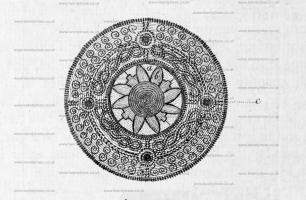
Upon the commons of Winster [Map], a village within the King's great manor de Alto Pecco, which were lately inclosed, are divers barrows, or tumuli, chiefly of stone, and among the rest one of earth, which the inhabitants account the more singular. This being lately opened, there were found in it two glass vessels, between eight and ten inches in height, with wide circular mouths, and a little bulge in the middle, and containing about a pint of water, of a light greenish colour, and exceeding limpid. With these was also found a silver collar or bracelet, about an inch broad, joining at the ends in dovetail fashion, and studded with human heads, and other small ornaments, secured by rivets, which might occasionally be detached. Also an ornament of the size and fashion above [below] represented, composed chiefly of filligree work, of gold or silver gilt, and set with garnets, or red glass. The inward part (a) is raised above the rest, and suppofed to be gold. The partitions, marked (b), were filled with red glass or garnets; as were the four spots marked (c). The rest was filligree, or chain-work. The large sstone which filled the socket in the centre is wanting. To the back of this ornament is affixed a plate of silver, secured by four rivets, lying under the four circular stones in the border. There were also several square and round beads, of various colours, of glass and earth, and some small remains of brass, like clasps and hinges, and pieces of wood, as of a little box, in which the ornaments had been deposited.