

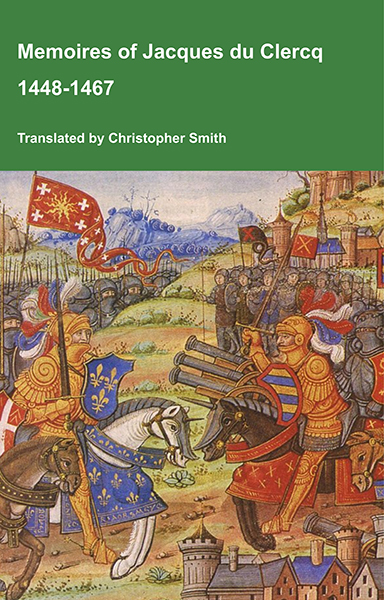
This is a translation of the 'Memoires of Jacques du Clercq', published in 1823 in two volumes, edited by Frederic, Baron de Reissenberg. In his introduction Reissenberg writes: 'Jacques du Clercq tells us that he was born in 1424, and that he was a licentiate in law and a counsellor to Philip the Good, Duke of Burgundy, in the castellany of Douai, Lille, and Orchies. It appears that he established his residence at Arras. In 1446, he married the daughter of Baldwin de la Lacherie, a gentleman who lived in Lille. We read in the fifth book of his Memoirs that his father, also named Jacques du Clercq, had married a lady of the Le Camelin family, from Compiègne. His ancestors, always attached to the counts of Flanders, had constantly served them, whether in their councils or in their armies.' The Memoires cover a period of nineteen years beginning in in 1448, ending in in 1467. It appears that the author had intended to extend the Memoirs beyond that date; no doubt illness or death prevented him from carrying out this plan. As Reissenberg writes the 'merit of this work lies in the simplicity of its narrative, in its tone of good faith, and in a certain air of frankness which naturally wins the reader’s confidence.' Du Clercq ranges from events of national and international importance, including events of the Wars of the Roses in England, to simple, everyday local events such as marriages, robberies, murders, trials and deaths, including that of his own father in Book 5; one of his last entries.
Available at Amazon in eBook and Paperback format.
Archaeologia Volume 30 Section 5 is in Archaeologia Volume 30.
14th April 1842. A Letter from Joun Gage Rokewode, Esq. F.R.S., Director, to Sir Henry Ellis, K.H., F.RS., Secretary, on the sculptured Figures of Welsh Knights at Kilpeck Church in Herefordshire [Map].
Read 14th April, 1842.
Dear Sir Henry,
I have the honor to exhibit to the Society of Antiquaries four plaster Casts of figures in alto relievo, from the south door of Kilpeck church, in Herefordshire. Two represent Apostles, holding the book of the Gospels, and a cross, with a nimbus at the back of each head: the other two are the effigies of Welsh Knights.
As specimens of infant Art the sculptures are not without interest; but our chief object in exhibiting them, is to call the attention of the Society to the Costume of the Knights. (Plate II.) They wear Phrygian caps, close vests of rayed texture, and trousers; and have knotted belts round their waists, fancifully disposed: one bears a long pointed sword, with a large guard at the hilt, and the other a speeies of mace.
The church of St. David of Kilpeck was given by Hugh, the son of William the Norman, (whose family afterwards assumed the surname of Kilpeck), to the monastery of St. Peter of Gloucester in 1134,1 and the present building was erected, we apprehend, not long after the appropriation. It is small, in the circular style throughout, and remarkable for the profusion of ornament used in the details, as may be seen in Mr. G. R. Lewis's Illustrations of this Church.
Shobdon church [Map], in the neighbourhood of Kilpeck, of which only the chancel arch now remains, was built by Oliver de Merlymond, steward to Hugh de Mortimer, about the year 1140, and seems to have been a building in the same florid Norman style as that of Kilpeck. Among the figures sculptured on the arch noticed, are several with rayed vests and trousers.
In the same district is Eardesley church [Map], and, upon the Font there, figures will be found sculptured with the trouser.
The Gauls and Britons wore trousers as we know from Martial, Diodorus, and Strabo, and on some of the Roman coins of the Britannic type we have a personification of the Province in such a costume. The parts of Herefordshire lying without Offa's Dyke were regarded, until the reign of Henry VIIL., as belonging to Wales.
Mr. Holford is in possession of a MS. formerly belonging to the family of Parker of Browsholme, and afterwards in the Townley collection, being the life and miracles of St. Edmund, King of East Anglia, written in the time of Anselm, Abbot of St. Edmund's, who governed the monastery from the year 1119to 1148. This MS. contains various miniatures, and the character of the figure of St. Edmund is often similar in certain respects to that of the, Welsh knights; and other figures in the MS. intended to represent Northmen as well as Anglo Saxons, occasionally appear habited in the trouser.
I am, Dear Sir Henry,
Yours faithfully,
JOHN GAGE ROKEWODE.
Note 1. Tanner's Not. Monast.