

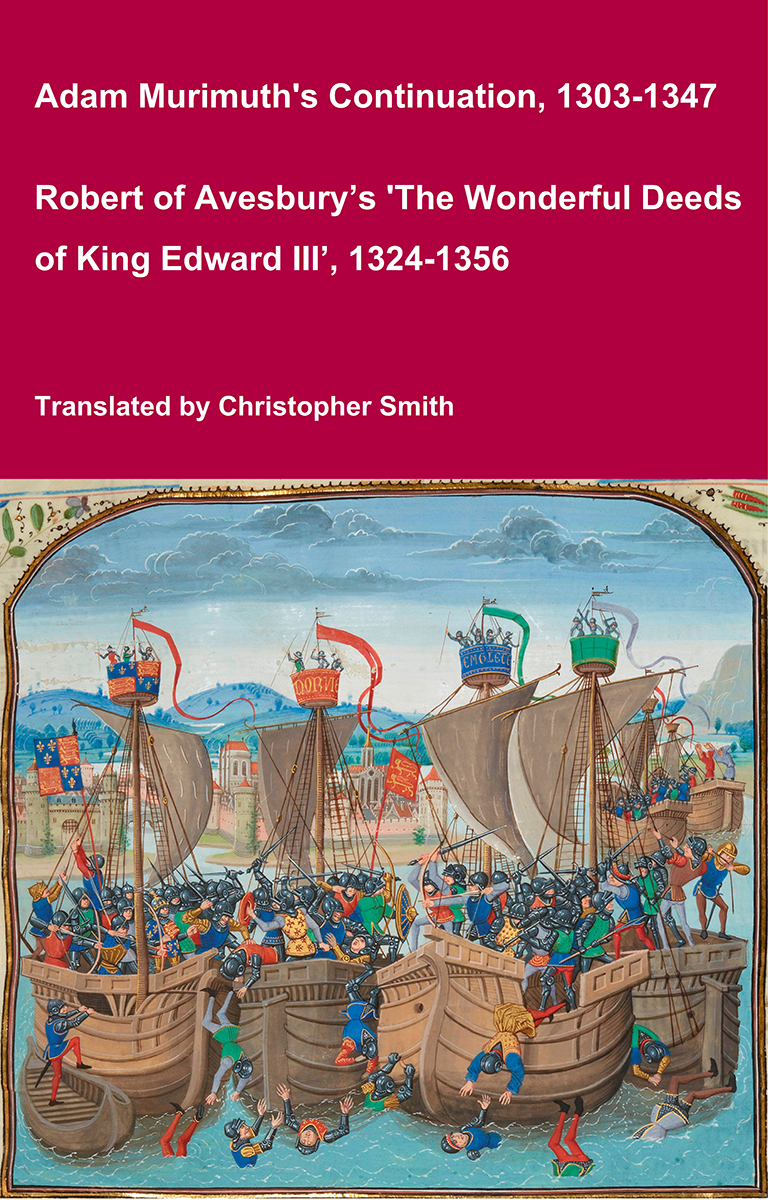
Adam Murimuth's Continuation and Robert of Avesbury’s 'The Wonderful Deeds of King Edward III'
This volume brings together two of the most important contemporary chronicles for the reign of Edward III and the opening phases of the Hundred Years’ War. Written in Latin by English clerical observers, these texts provide a vivid and authoritative window into the political, diplomatic, and military history of fourteenth-century England and its continental ambitions. Adam Murimuth Continuatio's Chronicarum continues an earlier chronicle into the mid-fourteenth century, offering concise but valuable notices on royal policy, foreign relations, and ecclesiastical affairs. Its annalistic structure makes it especially useful for establishing chronology and tracing the development of events year by year. Complementing it, Robert of Avesbury’s De gestis mirabilibus regis Edwardi tertii is a rich documentary chronicle preserving letters, treaties, and official records alongside narrative passages. It is an indispensable source for understanding Edward III’s claim to the French crown, the conduct of war, and the mechanisms of medieval diplomacy. Together, these works offer scholars, students, and enthusiasts a reliable and unembellished account of a transformative period in English and European history. Essential for anyone interested in medieval chronicles, the Hundred Years’ War, or the reign of Edward III.
Available at Amazon in eBook and Paperback format.
Archaeologia Volume V32 1847 Section XXXIV is in Archaeologia Volume V32 1847.
The king landed at "Hok," or "Hogges," in Normandy, meaning the port of La Hogue, on Wednesday, the 12th July, and the daily operations of his kitchen proceed at the same place till the Tuesday following, when they are transferred to Valognes. The day's stages of the King's march were now. Saint Come du Mount, Carenton, Pount Herbert, and Saint Lo. He then appears to have changed his purpose, and to have directed his march towards Caen, arriving there on Wednes¬ day the 26th, the intermediate stages having been Sevance, Torteval, and Funtenay Paynel. He remained five days at Caen, and he left the place on the last day of July for Lisieux, at which place he arrived on the second of August, having passed through Treward and Leoperty. He was two days at Lisieux : on the 4th of August he was at Durenvile, on the 5th at Limburgh, the 7th at Oil de Boef, and the 8th at Pount Vadreel. The daily stages were now, Longvile, Frenose, Appone, Ferelaguillon, and Poissy, where he arrived on the 13th of August. He was then about 12 miles from Paris. He remained at Poissy till the 16th, on which day he had begun his march northward. The first day's march was to Grisy, the next to Anty, the next to Trussereux, then to Somerreux, Causeamyneux, and Asshen, where he arrived on the 21st of August. He spent the 22nd and 23rd at Asshen.
We then find him in this humble but authentic chronicle:
Thursday, August 24, "sub foresta de Cressy."
Friday, August 25, "in foresta de Cressy."
Saturday, August 26, "adhuc sub foresta de Cressy."
Sunday, August 27, "in campis sub foresta de Cressy."