


Text this colour links to Pages. Text this colour links to Family Trees. Text this colour are links that disabled for Guests.
Place the mouse over images to see a larger image. Click on paintings to see the painter's Biography Page.
Mouse over links for a preview. Move the mouse off the painting or link to close the popup.
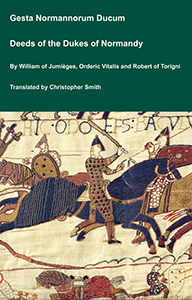
The Deeds of the Dukes of Normandy
The Gesta Normannorum Ducum [The Deeds of the Dukes of Normandy] is a landmark medieval chronicle tracing the rise and fall of the Norman dynasty from its early roots through the pivotal events surrounding the Norman Conquest of England. Originally penned in Latin by the monk William of Jumièges shortly before 1060 and later expanded at the behest of William the Conqueror, the work chronicles the deeds, politics, battles, and leadership of the Norman dukes, especially William’s own claim to the English throne. The narrative combines earlier historical sources with firsthand information and oral testimony to present an authoritative account of Normandy’s transformation from a Viking settlement into one of medieval Europe’s most powerful realms. William’s history emphasizes the legitimacy, military prowess, and governance of the Norman line, framing their expansion, including the conquest of England, as both divinely sanctioned and noble in purpose. Later chroniclers such as Orderic Vitalis and Robert of Torigni continued the history, extending the coverage into the 12th century, providing broader context on ducal rule and its impact. Today this classic work remains a foundational source for understanding Norman identity, medieval statesmanship, and the historical forces that reshaped England and Western Europe between 800AD and 1100AD.
Available at Amazon in eBook and Paperback format.
Caradoc and Severn Valley Field Club is in Prehistory.

CHIRBURY MEETING
On Thursday September 16th [1897], in beautiful weather, a good party set out from Minsterley, and drove up the Hope Valley. On the way they saw good sections of the Llandovery and Wenlock shale, in one instance very curiously contorted. They also noticed a large boulder lying in the middle of the stream, and looking quite out of place there; it had evidently been carried by ice from some distant hill. Near the Marsh Pool they were met by the Rev. W. Brewster, vicar of Middleton, and Mr. Jasper More. Under their able and agreeable guidance a very pleasant walk was taken over the hills. In a well-marked ring of stones, which Mr. Brewster pronounced to be older than the time of the Druids, Mr. More read the "Legend of the Fairy Cow," by Olive—
This poem relates not to the stone circle on which the party were standing, but to another called Mitchell's Fold [Map], nearer to Corndon.
Once through the land, the old folks say, a mighty famine spread,
Old age and tender infancy died out for lack of bread,
And brave, strong men grew pale with want, and hollow-eyed with grief,
To see their dear ones suffering when there was no relief.
No more the labourer's happy song woke with the summer's morn,
No more the farmer's wide-stretched fields stood thick with full-eared corn;
For cruel famine ruled the land, and want's relentless ire
Had long since hushed the children's laugh, and damped the cottage fire.
But there were fairies in those days (I wish there were some now),
And one came through the country then, and brought with her a cow—
A snow-white cow, whose shape and size old people speak of still,
And closed her in a circle of stones on Stapeley Hill,
And bade the starving peasant wives each night and morning go
With one pail each, and milk, she said, should never cease to flow.
What words could tell the joy with which this bounty was received!
What weakly lives grew strong again!what misery was relieved!
And how they bless'd the fairy cow, who had such ample store,
And e'en where crowds were satisfied would yield one pailful more.
Now, in this country dwelt a witch, an ill-disposed old crone,
Who practised not the good advice of "letting well alone;"
Besides, it grieved her that, alone she had in sorcery dealt,
The people had not sought her aid when this distress was felt.
So for their harm she wrought her spells, but vainly tried them o'er,
Till she recalled the fairy's words, "One pailful each, no more."
Then with full glee she took her pail, the bottom broke away,
And placed a sieve where it had been, and started off, they say.
Before the sunrise lit the earth, or anyone was near,
To see that she so drew the milk that it might disappear;
And by this means the spell was loosed, the white cow sank away,
Down through the ground, but in the stones the witch was forced to stay;
And when the thronging people came they found the woman there,
With her false pail—the much loved cow they saw not anywhere.
They saw the wasted milk, and then knew what the witch had done,
So walled her up and left her in that living tomb of stone.
The famine passed; but still this tale is in the country told,
Of how the witch was starved to death, walled up in Mitchell's Fold.
