

Henrici Quinti, Angliæ Regis, Gesta, is a first-hand account of the Agincourt Campaign, and subsequent events to his death in 1422. The author of the first part was a Chaplain in King Henry's retinue who was present from King Henry's departure at Southampton in 1415, at the siege of Harfleur, the battle of Agincourt, and the celebrations on King Henry's return to London. The second part, by another writer, relates the events that took place including the negotiations at Troye, Henry's marriage and his death in 1422.
Available at Amazon in eBook and Paperback format.
Chester Archaeological and History Society 1856 Page 48 is in Chester Archaeological and History Society 1856.
Denbigh Castle by William Ayrton.
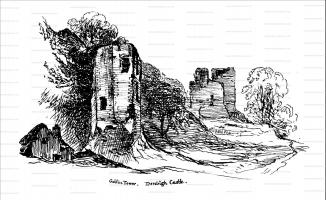
The Goblin Tower [Map]. Denbigh Castle.
One of the most amusing, if not always the most instructive, provinces of the Archaeologist, has ever been the etymology of names,—both of things, people, and places; and perhaps in no country is there such a field for tracing real or fancied derivations as in Wales, where almost every hill, valley, river or ruin, possesses a title referable to either a British, Saxon, or sometimes a Roman origin.
Denbigh is certainly no exception to this rule; but from the mass of conflicting opinions as to the origin 6f its name, we may select that of Archdeacon Newcome, who in his History of Denbigh says, "The first syllable of the name is without doubt Dinas, a city; and perhaps the last is a proper name." Walters' Dictionary makes it Dinas buck, i.e the desirable city.
While searching the Welsh language for the etymology of the word, it has been remarked by our Historic Secretary, Mr. Wynne Ffoulkes, that the name of Denbigh is nowhere to be found as the title of the place before the Conquest. Previous to that time the inhabitants of the neighbourhood are mentioned in every authentic record as " the men of Rhos Rhyfoniog;" so that Denbigh is, in all probability, a name of English origin. Henry Lacy, first Lord of Denbigh, was Earl of Lincoln, and possessed, among others, a manor in Yorkshire called Deneby, which name, he (Mr. Ffoulkes) thinks may probably have been bestowed by the Earl on his new possession in Wales.
It appears doubtful whether any Castle (in the present sense of the term) preceded the ruin now under notice. That the site was, long before this time, an important fortified post we have abuudant evidence, but that it possessed anything we should recognize as a complete garrisoned town and Castle is not so clear.
Continues ...
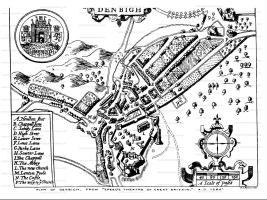
1606. Plan of Denbigh Castle and Town Walls [Map] from Speed's Theatre of Great Britain.

Plan of Denbigh Castle from a Survey by James Harrison.
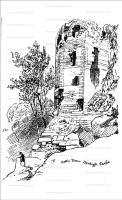
Goblin Tower [Map] at Denbigh Castle.
Annals of the six Kings of England by Nicholas Trivet
Translation of the Annals of the Six Kings of England by that traces the rise and rule of the Angevin aka Plantagenet dynasty from the mid-12th to early 14th century. Written by the Dominican scholar Nicholas Trivet, the work offers a vivid account of English history from the reign of King Stephen through to the death of King Edward I, blending political narrative with moral reflection. Covering the reigns of six monarchs—from Stephen to Edward I—the chronicle explores royal authority, rebellion, war, and the shifting balance between crown, church, and nobility. Trivet provides detailed insight into defining moments such as baronial conflicts, Anglo-French rivalry, and the consolidation of royal power under Edward I, whose reign he describes with particular immediacy. The Annals combines careful year-by-year reporting with thoughtful interpretation, presenting history not merely as a sequence of events but as a moral and political lesson. Ideal for readers interested in medieval history, kingship, and the origins of the English state, this chronicle remains a valuable and accessible window into the turbulent world of the Plantagenet kings.
Available at Amazon in eBook and Paperback format.

Part of the South Wall of Denbigh Castle [looking toward the Treasure House Tower [Map]]
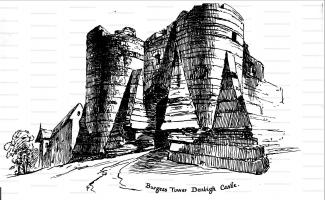
Burgess Gate [Map] at Denbigh Castle.