

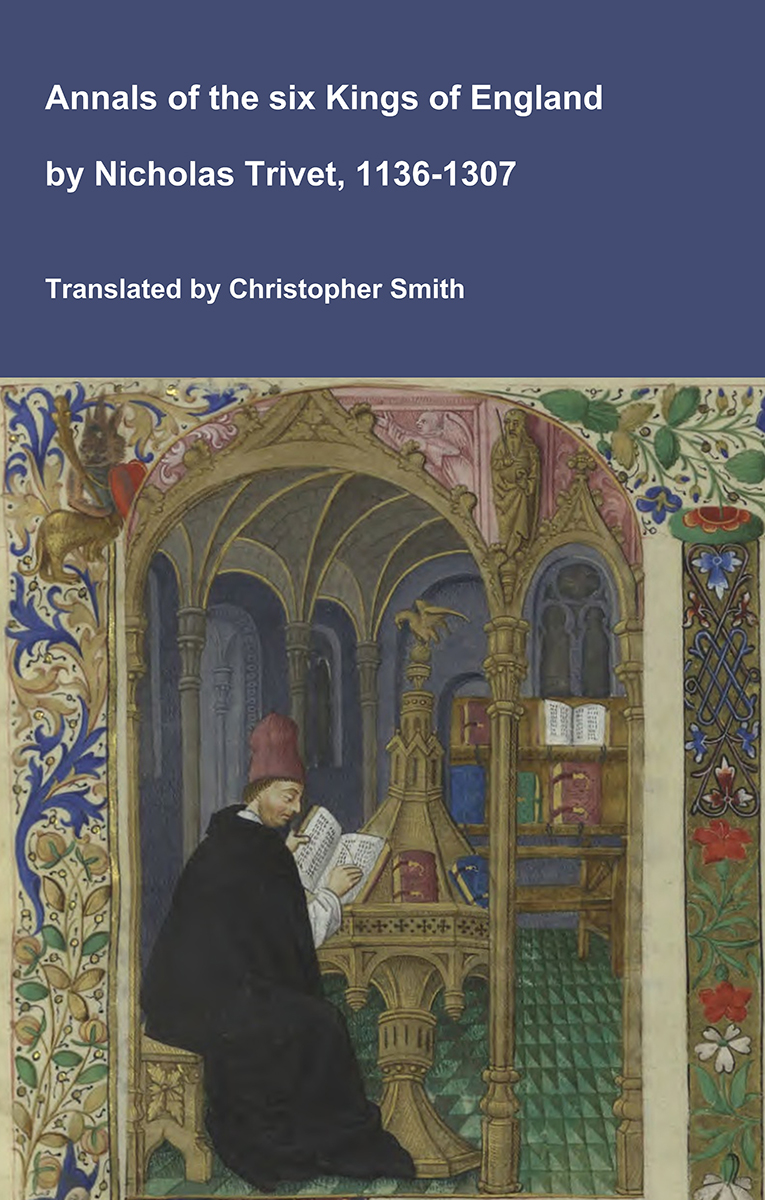
Annals of the six Kings of England by Nicholas Trivet
Translation of the Annals of the Six Kings of England by that traces the rise and rule of the Angevin aka Plantagenet dynasty from the mid-12th to early 14th century. Written by the Dominican scholar Nicholas Trivet, the work offers a vivid account of English history from the reign of King Stephen through to the death of King Edward I, blending political narrative with moral reflection. Covering the reigns of six monarchs—from Stephen to Edward I—the chronicle explores royal authority, rebellion, war, and the shifting balance between crown, church, and nobility. Trivet provides detailed insight into defining moments such as baronial conflicts, Anglo-French rivalry, and the consolidation of royal power under Edward I, whose reign he describes with particular immediacy. The Annals combines careful year-by-year reporting with thoughtful interpretation, presenting history not merely as a sequence of events but as a moral and political lesson. Ideal for readers interested in medieval history, kingship, and the origins of the English state, this chronicle remains a valuable and accessible window into the turbulent world of the Plantagenet kings.
Available at Amazon in eBook and Paperback format.
Chester Chronicle, and Cheshire and North Wales General Advertiser is in Newspapers.
30th April 1892. The Duchess Of Westminster [aged 35] At Wybunbury.
Laying The Foundation Stone Of A New Church.
A new epoch in the church history at Wybunbury [St Chad's Church, Wybunbury [Map]] was celebrated on Monday afternoon, when the Duchess of Westminster, in the presence of a large gathering of churchpeople, formally laid the foundation stone of a new church.
The ceremony was one which the Duke of Westminster had promised to perform, but owing to unavoidable circumstances, His Grace was unable to attend.
A procession of church choirs, consisting of Nantwich, Wisaston, Audlem, and Wybunbury (surpliced for the first time) was formed at the Wybunbury Girls' School, and, headed by the bishop [aged 47], the Rev. C.A. Stolterforth (Vicar), the Rev. F.G. Blackburne (Nantwich), the Rev. W.C. Reid, and the ministers of neighbouring parishes, marched, singing an appropriate processional hymn, to the site whereon the new church is to be erected.
The service here was in keeping with hearty church worship. The words of the hymns and psalms had special significance to the occasion, and the voices all sang with one accord the praises of the hour.
Upon the raised platforms were gathered some of the best county families. The Duchess of Westminster was supported by Lord Arthur Grosvenor [aged 31], and there were also on the platform showing the same interest in the founding of the new church which his ancestors, who lie in the tombs of old Wybunbury churches, are reputed to have evinced in church work in the parish, Mr Louis Delves Broughton [aged 34] and Mrs Broughton [aged 27]. Mr Twemlow, of Betley Court, was also an interested spectator, as was Judge Hughes who came over from Chester and mingled amongst the crowd.
The Duchess very gracefully performed the foundation stone laying, after which Lord Arthur Grosvenor apologised for the absence of His Grace, who said that he had been laid up with a cold for two or three days. In conclusion he wished every success to the building of the new church.
The Bishop, in the course of some remarks, said that they were refounding the old Church of St Chad's upon St Mark's Day, and St Mark's Day was peculiarly appropriate for such a work because the very keynote of St Mark's Day, as the character and life of the apostle was set before them in Holy Scripture, and in the service of their prayer book, was stability and recovered stability. He was sure that everyone here hoped that the work started today would be carried on with all that thoroughness or workmanship could bestow upon it, and that future generations would look back to the work begun today as worthy of both man and God. In conclusion the bishop gave hearty expression to the thanks of the congregation to the Duchess of Westmnister, to Sir Henry Bristowe and Miss Bristowe to whose energy and zeal he alluded, as also to the active work of the late Mr Acton, who was one of the churchwardens, and to whose memory he paid a tribute of respect, and to those who by their presence and support had assisted in the progress of the movement.
After the ceremony, tea was provided in a tent, and an organ recital was given in the evening.
The site of the new church is the site upon which the old church was built, and upon which, in fact, at least four Wybunbury churches have stood. The church at Wybunbury has a grand history. The records of the parish, although incomplete, prove that so far back as 1290 Wybunbury had its church and also its vicar. The identification of the latter is somewhat scanty, but the church records clearly set forth that Roberts was the name of the vicar at this early period. But there are forthcoming fragments of early church architecture which the workmen in digging up the foundations have come upon, that prove there was a church esxisting here even before 1290. They unearthed in a well-preserved state a stone so distinctly shaped and chiselled that the architect, Mr Spooner (Charles Sydney Spooner, 1862-1938 - Stu), who has had 20 years of experience of architecture, was persuaded that it belonged to the Norman style of architecture, or First Pointed or Transitional period. The stone was discovered in the rubble of the church, and had probably lain there for hundreds of years. The date is from 1130 to 1150, and it suggested that at some time it formed part of a circular doorway. Other stones have been discovered, several of which are of the 15th Century style of architecture, and it is supopsed that these once formed part of an arch. The fabric of the church of 1838, which in architectural phraseology was of the Churchwarden Gothic Style, has been demolished, with the exception of a good part of the south wall. The foundations of the demolished were very building were unsound, and the beams which supported this structure has shifted several inches. The builder of 50 years ago succeeded in restoring to the tower the perpendicular, a gigantic work, as in that day the tower had got out of position to the extent of 5 feet 6 inches.
The new church will be built central with the tower, and will be as near as possible a facsimile of the fifteenth-century church. There will be no galleries which formed part of the old church. The organ and vestry will be built in the south chancel aisle, and in the north chancel aisle there will be a Morning Chapel.
The foundation will consist of monolithic slabs of Portland Cement. The concrete for the foundation will be a thickness of 3 feet six inches, and the whole will be bound together by a network of inter-ties. The stones which have been unearthed will again be utilised for building up the new church, and a number of brass plates, which bear the names of long since dead parishioners who lie within the tombs of the church, will be carefully put back again. One of these plates is of great antiquity and is one of half a dozen similar plates in the county.
The cost of the new church will be about £6,000. Towards this amount a considerable sum has already been raised. The Duke of Westminster sent a donation of £100, and a collection on the ground realised a considerable sum. The work will be completed in about 12 months.
The architect is Mr James Brookes, the well-known church architect, of Wellington Street, Strand, London, and the clerk of the works is Mr Spooner. Messrs Treasure & Son, of Shrewsbury, are the contractors; and Mr John Bebbington is foreman of the works.
5th August 1893. Church Consecration By Bishop Jayne.
The consecration of Wynbunbury Church [Map] was performed by the Lord Bishop of Chester (Dr Jayne) [aged 48] on Thursday. This interesting event proved a red-latter day in the church life of the district, this being evidenced by the general display of bunting, flags etc.
The vicar (the Rev. C.H. Stolterforth), and the churchwardens Messrs E.R. Bellyse and Charles Edwads, together with the building committee, have worked hard to bring about the present state of affairs, and assisted by the liberal response of all those connected with the church, and the assistance of the neighbouring parishes, the work will ere long be completed, and Wybunbury Chruch will then form one of the most beautiful in this part of Cheshire.
The consecration took place in the morning when there was a large congregation present.
In the course of his sermon the bishop said that their service was not unmixed with sorrow, and feelingly referred to the death of Sir Henry Fox Bristowe, and Mr Samuel Acton, who had taken a very active part in the erection of the church, and who had very liberally contributed towards it. He also touched upon the death of Miss Turner (daughter of the late vicar), who had lived in the parish a good many years, and had taken much interest in the building of the church.
At the close of the consecration service a public luncheon was provided in the Delves Schoolroom, at which there was a large attendance. In the afternoon there was an organ recital by the Rev. C.H.H. Stewart, Vicar of New Brighton, and the late precentor of Chester Cathedral.
At 5.30 a public tea was given in the Delves School. In the evening, the Very Rev. S.R. Hole DD [aged 73], Dean of Rochester, preached to a crowded congregation.
The offertories in the morning amounted to £38 13s 9 1/2 d'.