

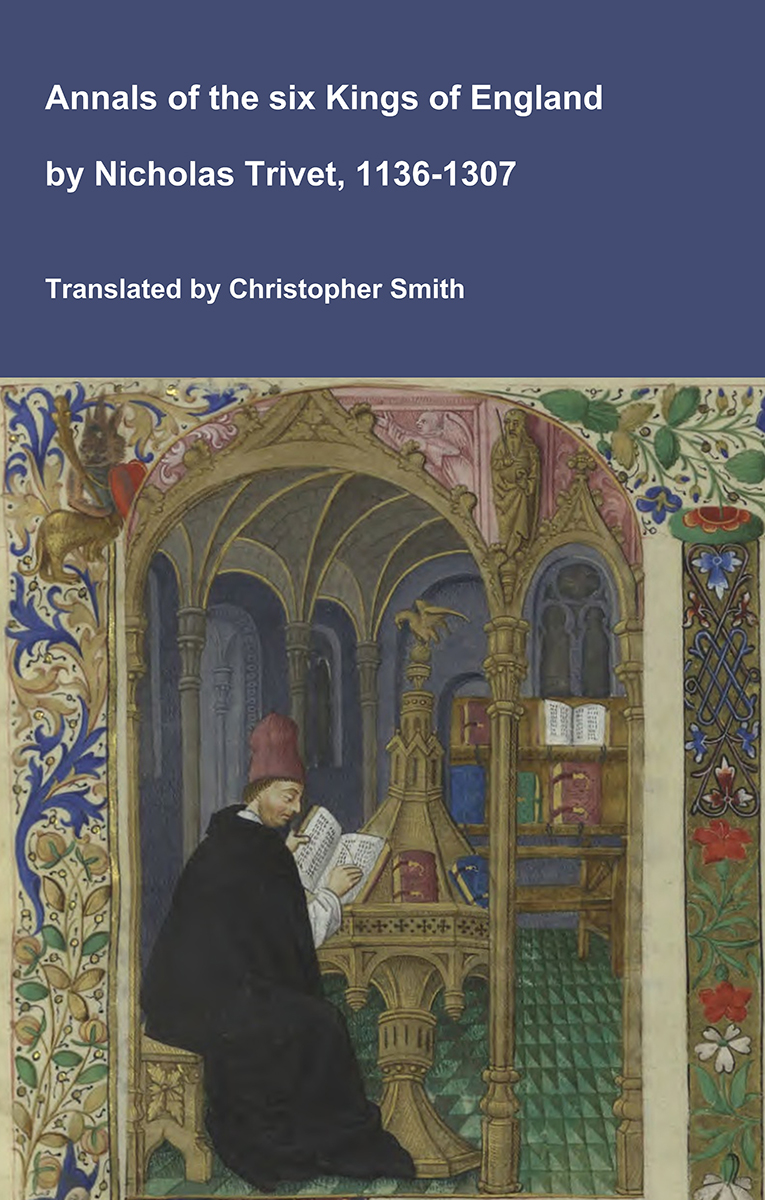
Annals of the six Kings of England by Nicholas Trivet
Translation of the Annals of the Six Kings of England by that traces the rise and rule of the Angevin aka Plantagenet dynasty from the mid-12th to early 14th century. Written by the Dominican scholar Nicholas Trivet, the work offers a vivid account of English history from the reign of King Stephen through to the death of King Edward I, blending political narrative with moral reflection. Covering the reigns of six monarchs—from Stephen to Edward I—the chronicle explores royal authority, rebellion, war, and the shifting balance between crown, church, and nobility. Trivet provides detailed insight into defining moments such as baronial conflicts, Anglo-French rivalry, and the consolidation of royal power under Edward I, whose reign he describes with particular immediacy. The Annals combines careful year-by-year reporting with thoughtful interpretation, presenting history not merely as a sequence of events but as a moral and political lesson. Ideal for readers interested in medieval history, kingship, and the origins of the English state, this chronicle remains a valuable and accessible window into the turbulent world of the Plantagenet kings.
Available at Amazon in eBook and Paperback format.
Chronicle of Enguerrand de Monstrelet Volume 5 is in Chronicle of Enguerrand de Monstrelet.
Chapter 80. — The Dauphin Lays Siege to Cône-Sur-Loire. — The Expedition of the Duke of Burgundy for its Relief. — The Death of the King of England.
We must now speak of the duke of Touraine, dauphin, who had assembled from divers parts an army of twenty thousand men, the greater number of which he had marched to Sancerre, where he had fixed his residence. During his stay there, he had won the town of La Charite-sur-Loire, which he regarrisoned; and had so closely besieged Cône-sur-Loire, that the garrison were constrained to capitulate with the commissaries of the dauphin for its surrender on the 6th day of August, unless the duke of Burgundy should come or send a force sufficient to combat his enemies; and for the due performance of this they gave sufficient hostages. The two dukes of Touraine and Burgundy mutually promised each other, by their heralds, to meet on the appointed day in battle array for the combat.
The duke of Bedford received intelligence on the march, that his brother the king was so ill that his life was despaired of: on which the duke, and some of the most faithful of the king's household, quitted the army, and hastened to the castle of Vincennes, where they found him worse than had been told them. The duke of Burgundy hearing this, despatched sir Hugh de Lannoy to visit him, and inquire into the state of his health.
King Henry finding himself mortally ill, called to him his brother the duke of Bedford, his uncle of Exeter, the earl of Warwick, sir Louis de Robesart, and others, to the number of six or eight of those in whom he had the greatest confidence, and said, that he saw with grief it was the pleasure of his Creator that he should quit this world. He then addressed the duke of Bedford. — "John, my good brother, I beseech you, on the loyalty and love you have ever expressed for me, that you show the same loyalty and affection to my son Henry, your nephew; and that, so long as you shall live, you do not suffer him to conclude any treaty with our adversary Charles, and that on no account whatever the duchy of Normandy be wholly restored to him. Should our good brother of Burgundy be desirous of the regency of the kingdom of France, I would advise that you let him have it; but should he refuse, then take it yourself. My good uncle of Exeter, I nominate you sole regent of the kingdom of England, for that you well know how to govern it; and I entreat that you do not, on any pretence whatever, return to France; and I likewise nominate you as guardian to my son; and I insist, on your love to me, that you do very often personally visit and see him. My dear cousin of Warwick, I will that you be his governor, and that you teach him all things becoming his rank, for I cannot provide a fitter person for the purpose.
"I entreat you as earnestly as I can, that you avoid all quarrels and dissentions with our fair brother of Burgundy; and this I particularly recommend to the consideration of my fair brother Humphrey, — for should any coolness subsist between you, which God forbid, the affairs of this realm, which are now in a very promising state, would soon be ruined. You will be careful not to set at liberty our cousin of Orleans, the count d'Eu, the lord de Gaucourt and sir Guichart de Sisay, until our dear son shall be of a proper age; and in all other things you will act as you shall judge for the best."
The king having said these words and some others, the lords replied, with grief and respect, that all he had ordered, and whatever they should think would be agreeable to him, they would execute to the utmost of their power, without altering any one thing. They were greatly affected at seeing the melancholy state he was in; and some of them left the apartment.
31st August 1422. Sir Hugh de Lannoy having accomplished the business he had been sent on by the duke of Burgundy, and having had some conversation with the king, returned to the duke. The king then sent for his physicians, and earnestly demanded of them how long they thought he had to live. They delayed answering the question directly; but, not to discourage hope, they said that it depended solely on the will of God whether he would be restored to health. He was dissatisfied with this answer, and repeated his request, begging of them to tell him the truth. Upon this they consulted together, and one of them, as spokesman, falling on his knees, said, "Sire, you must think on your soul; for, unless it be the will of God to decree otherwise, it is impossible that you should live more than two hours." The king, hearing this, sent for his confessor, some of his household, and his chaplains, whom he ordered to chant the seven penitential psalms. When they came to "Benigne fac, Domine," where mention is made "muri Hierusalem," he stopped them, and said aloud, that he had fully mtended, after he had wholly subdued the realm of France to his obedience, and restored it to peace, to have gone to conquer the kingdom of Jerusalem, if it had pleased his Creator to have granted him longer life. Having said this, he allowed the priests to proceed, and, shortly after, according to the prediction of his physicians, gave up the ghost the last day of August.
The duke of Bedford, the other princes, and in general all the English, made loud lamentations for his death, and were truly sorry for it. Shortly after, his bowels were buried in the church of the monastery of Saint Maur des Fosses [Map], and his body embalmed and put into a leaden coffin. During this time, the duke of Burgundy came from Braye-Comte-Robert to Vincennes, to visit the duke of Bedford and the other princes; and having had a short conference with them went to Paris, where he was lodged in his hotel of Artois.
The body of king Henry was carried in great funeral pomp, attended by the English princes, his household, and a multitude of other people, to the church of Notre-Dame, in Paris where a solemn service was performed; after which it was conveyed to Rouen in the same state, where it remained a considerable time.
In the mean time the princes, namely, the duke of Bedford, the duke of Burgundy, and the duke of Exeter, with other great lords, assembled in council at Paris, to deliberate on the future government of France, when it was resolved, that what had been formerly agreed to and settled between the two kings at Troyes in Champagne, for the establishment of peace, should be the ground-work of the future government. It was now publicly known, that the disorder king Henry died of was a heat in his fundament, very similar to what is called the disorder of St. Anthony1. After the princes had agreed on the future government of the kingdom, the duke of Burgundy quitted Paris, and returned with his Picards to Artois and Flanders; and the duke of Bedford, with the English lords, to Rouen, to regulate the affairs of that duchy. The queen of England was conducted to Rouen in great state; for she had been kept in ignorance how dangerously ill the king was, and knew not of his death until some time after it had happened.
Note 1. The parliamentary history says that he died of a dysentery.
Jean de Waurin's Chronicle of England Volume 6 Books 3-6: The Wars of the Roses
Jean de Waurin was a French Chronicler, from the Artois region, who was born around 1400, and died around 1474. Waurin’s Chronicle of England, Volume 6, covering the period 1450 to 1471, from which we have selected and translated Chapters relating to the Wars of the Roses, provides a vivid, original, contemporary description of key events some of which he witnessed first-hand, some of which he was told by the key people involved with whom Waurin had a personal relationship.
Available at Amazon in eBook and Paperback format.
When the funeral approached London, fifteen bishops dressed in pontificalibus, several mitred abbots and churchmen, with a multitude of persons of all ranks, came out to meet it. The churchmen chanted the service for the dead as it passed over London-bridge, through Lombard Street to St. Paul's cathedral. Near the car were the relations of the late king uttering loud lamentations. On the collar of the first horse that drew the car were emblazoned the ancient arms of England: on that of the second, the arms of France and England quartered, the same as he bore during his lifetime: on that of the third, the arms of France simply. On that of the fourth horse were painted the arms of the noble king Arthur, whom no one could conquer: there were three crowns or, on a shield azure. When the funeral service had been royally performed in the cathedral, the body was carried to be interred at Westminster abbey with the kings his ancestors. At this funeral, and in regard to everything concerning it, greater pomp and expense were made than had been done for two hundred years at the interment of any king of England; and even now, as much honour and reverence is daily paid to his tomb, as if it were certain he was a saint in paradise.
Thus ended the life of king Henry in the flower of his age, for when he died he was but forty years old1. He was very wise and able in every business he undertook, and of a determined character. During the seven or eight years he ruled in France, he made greater conquests than any of his predecessors had ever done. It is true, he was so feared by his princes and captains that none dared to disobey his orders, h-owever nearly related to him, more especially his English subjects. In this state of obedience were his subjects of France and England in general; and the principal cause was, that if any person transgressed his ordinances he had him instantly punished without favour or mercy.
Note 1. The authors of "L'Art de Verifier les Dates" say, he was but thirty-six years old when he died. According to Hume, he died in the thirty-fourth year of his age.
When this ceremony was over, the three estates of England assembled to consider the present state of the realm, when they unanimously elected the young son of their departed monarch king, although he was but sixteen months old, and submitted themselves to his will notwithstanding his youth. They instantly granted him a royal establishment, and agreed that he should be under the governance of the earl of Warwick.
While these things were passing, a noble knight of Picardy used a joking expression to his herald respecting king Henry, which was afterward often repeated. Sir Sarrasin d'Arly, uncle to the vidame of Amiens, who might be about sixty years of age, resided in the castle of Achere, which he had had with his wife, sister to the lord d'Offemont, near to Pas in Artois. He was laid up with the gout, but very eager in his inquiries after news of what was going on. One day his poursuivant, named Haurenas, of the same age as himself, and who had long served him, returned from making the usual inquiries; and on sir Sarrasin questioning him, and asking him if he had heard any particulars of the death of the king of England, he said that he had, and had even seen his corpse at Abbeville, in the church of St. Ulfran, and then related.how he was attired, nearly as has been before described. The knight then asked him, on his faith, if he had diligently observed him. On his answering that he had, — " Now, on thy oath, tell me," added sir Sarrasin, " if he had his boots on." " No, my lord, by my faith, he had not." The knight then cried out, " Haurenas, my good friend, never believe me if he has not left them in France 1" This expression set the company a laughing, and then they talked of other matters.
How the count of Salisbury besieged the city of Orleans, where he was killed.
Comment le conte de Salseberi asséga la cité d'Orliens, où il fut occis.
Also, after the count of Salisbury had conquered and put under the obedience of King Henry of Lancaster Yenville, Meun, and several other towns and fortresses or surrounding lands, he prepared very diligently to go besiege the noble city of Orleans. And in fact, around the month of October, with all his power, he arrived before the said city. In which, those inside, a long time before, waiting for his arrival, had prepared their works, both fortifications, war equipment, as well as provisions, and selected and trained men in arms, to resist against the said count and his power and defend themselves. And likewise, in order that he might not lodge around it with his men at their ease, nor could they fortify themselves, those of Orleans had made to demolish and bring down all around in their suburbs good and notable buildings. Among which were destroyed and brought down up to twelve churches and more, of which were the four ordained of the Mendicants, and with them many other beautiful and solemn pleasure houses that the burghers of that city had. And so much did they continue in that work that in the suburbs and all around, one could fully see and throw cannons and other instruments of war, openly. However, it did not remain that the said count of Salisbury, with all his English, did not lodge quite close to the said city, even though those inside with all their power put themselves vigorously to defence, making several sallies, drawing cannons, culverins, and other artillery, killing and putting in trouble several Englishmen. Nevertheless, the said Englishmen, very valiantly and rudely drove them back, and approached several times, so that those defending had marvels at their bold and courageous enterprises. During which, the said count of Salisbury made the tower at the end of the bridge that crosses over the water of the Loire be assaulted. Which, in quite a short time, was taken by the English and conquered, along with a small bulwark that was quite close, notwithstanding the defence of the French.
Item, après ce que le conte de Salsebery eust conquis et mis en l'obéyssance du roy Henry de Lancastre Yenville, Meun et plusieurs autres villes et forteresces ou pays environ, il se disposa très diligamment pour aler asségier la noble cité d'Orliens. Et de fait, environ le mois d'octobre, à tout sa puissance, arriva devant ladicte cité. En laquelle, ceulx de dedens, long temps par avant, attendans sa venue, avoient préparé leurs besongnes, tant de fortificacions, habillemens de guerre, comme de vivres, et de gens esleuz exercités et excités en armes, pour résister contre ledit conte et sa puissance et eulx deffendre. Et meismement, adfin qu'il ne se peuyst loger autour d'ycelle lui et ses gens à leur aise, ne eulx fortifier, yceulx d'Orliens avoient fait abbatre et démolir à tous costés en. leurs faulxbourgs bons et notables édifices. Entre lesquelz furent destruis et abatus jusques à douze églises et au dessus, esquelles estoient les quatre ordonnées des Mendians, et avec ce moult d'autres belles et sollempneles maisons de plaisance que avoient les bourgois d'ycelle ville. Et tant en ycelle oeuvre continuèrent, que és faulxbourgs et tout à l'environ on povoit plainement veoir et jetter de canons et autres instrumens de guerre, tout à plain. Toutefois ne demoura mie que ledit conte de Salsebéry, à tout ses Anglois, ne se logast assez près de ladicte ville, jà soit ce que ceulx de dedens de tout leur povoir se meyssent viguereusement à deffense, en faisant plusieurs saillies, en traiant de canons, coulevrines et autres artilleries, occiant et metant à meschief plusieurs Anglois. Nient mains lesditz Anglois, très vaillamment et radement les reboutèrent, et approchèrent par plusieurs fois, tant que yceulx deffendans avoient merveilles de leurs hardies et courageuses entreprinses. Durant lesquelles, ledit conte de Salsebéry fist assaillir la tour du bout du pont qui passe par dessus l'yaue de Loire. Laquelle, en assez brief temps, fut prinse par les Anglois et conquise, avec un petit bolevert qui estoit assez près, non obstant la deffence des François.
And the said count made several of his men lodge inside the said tower, so that those of the city could not sally forth against his host. And on the other hand, he and his captains lodged with all his men quite near the city in some old houses there, in which, as those English are accustomed, they made several lodgings within the land, shelters, and other war equipment, to avoid the shots from those of the city, from which they were very well served. During this time, the said count of Salisbury, on the third day after he had come before the said city, entered into the above-mentioned tower of the bridge where his men were lodged, and there within it went up high, to the second story, and positioned himself at a window facing the city, watching very attentively the movements around it, to see and imagine how and in what manner he could take and subjugate the city.
Et fist ycelui conte dedens ladicte tour loger plusieurs de ses gens, adfin que ceulx de la ville ne peussent par là saillir sur son ost. Et d'autre part se loga, lui et ses capitaines avec tous les siens, assez près de la ville en aucunes vièses masures là estans, ès quelles, comme ont acoustumé yceulx Anglois, firent plusieurs logis dedens terre, taudis, et autres habillemens de guerre, pour eschever le trait de ceulx de la ville, dont ils estoient très largement servis. Ouquel terme ledit conte de Salsebéry, le troisiesme jour qu'il estoit venu devant ladicte cité, entra en la dessusdicte tour du pont où estoient logez ses gens, et là dedens ycelle monta hault, ou second estage, et se mist à une fenestre vers la ville, regardant moult ententivement les marches autour d'ycelle, pour veoir et ymaginer comment et quelle manière il pourroit prendre et subjuguer ycelle cité.
[3rd November 1428]. And then, while he [Thomas Montagu 1st Count Perche 4th Earl Salisbury [aged 40]] was at the said window, suddenly from the said city, with a rush, came the stone of a cannon1, which struck the window where the said count was, who, already withdrawing inside from the noise of the shot, nevertheless was struck very grievously and mortally by the said stone, and had a large part of his face carried away completely, and a gentleman who was nearby was killed outright by the same shot. For which wound of the said count, all his men generally had great sadness in their hearts, for he was greatly esteemed and loved by them, and they held him to be the most subtle, experienced, and fortunate in arms of all the other princes and captains of the kingdom of England. However, he, thus wounded, lived the space of eight days, and after he had summoned all his captains and admonished them on behalf of the King of England that they should continue to bring the city of Orleans into obedience without any dissimulation, he had himself carried to Meun, and there died after eight days from the said wound.
Et lors, luy estant à ladicte fenestre, vint soudainement de ladite cité, à volant, la pierre d'ung veuglaire1, qui féri la fenestre où estoit ledit conte, lequel, desjà pour le bruit du cop se retiroit dedens, nient mains il fut aconsuy très griefment et mortellement de ladicte fenestre, et eut grant partie de son visage emporté tout jus, et ung gentil homme qui estoit d'alès luy fut d'ycelui cop tué tout mort. Pour laquelle bléceure dudit conte, tous ses gens généralment eurent au cuer grand tristesce, car d'eulx il estoit moult crému et amé, et le tenoit pour le plus subtil, expert et eureux en armes de tous les autres princes et capitaines du royaume d'Angleterre. Toutefois, il, ainsy blécié, vesqui l'espace de huit jours, et après ce qu'il eust mandé tous ses capitaines et à yceulx admonesté de par le roy d'Angleterre qu'ilz continuassent à mettre en obéyssance ycelle ville d'Orliens sans quelque dissimulacion, il se fist porter à Meun, et là morut au bout de huit jours de sadicte bléceure.
Note 1. veuglaire i.e. cannon. The Veuglaire, after a gun manufacturer named Vögler, was a wrought iron cannon, and part of the artillery of France in the Middle Ages.
In his place, the general captain of the besieging English remained, the count of Suffolk, and below him the lords of Escailles and Thalabot, Lanselot of Lille, Classedas, and some others. They, notwithstanding the loss they had suffered from the above-mentioned count of Salisbury, who, as has been said, was their chief and sovereign constable, regained vigor, and by common agreement, with all diligence, prepared by all possible means to continue their siege and what they had begun. And in fact, they made bastions and fortifications in several places, within which they lodged themselves, so that they could not be surprised or invaded by their enemies.
On lieu duquel demoura général capitaine des Anglois asségans, le conte de Suffort, et au desoubz de luy les seigneurs d'Escailles et de Thalabot, Lanselot de Lille, Classedas et aulcuns autres. Lesquelx, non obstant la perte qu'ilz avoient faite du dessusdit conte de Salsebéry, qui, comme dit est, estoit leur chief et souverain connestable, reprinrent en eulx vigueur, et d'un commun accord, en toute diligence, se disposèrent par toutes voies et manières à eulx possibles de continuer leur siège, et ce qu'ilz avoient encoinmencé. Et de fait firent en plusieurs lieux bastilles et fortificacions, dedens lesquelles ilz se logèrent, adfin que de leurs ennemis ne peussent estre souspris ne envays.
Also, King Charles of France, knowing that the English, his old enemies and adversaries, wanted to subjugate and put the very noble city of Orléans in their obedience, had concluded with those of his council, before their arrival, that with all his power he would defend that city, believing that if it were placed in the hands of his enemies, it would be the total destruction of his marches and lands, and of him as well. And for that reason, he sent a large part of his best and most trustworthy captains, namely Boussac and the lord of....1 and with them the bastard of Orléans, knight, the lords of Gaucourt and Granville, the lord of Wilan, Pothon de Sainte Treille, La Hire, sir Theolde de Walerghe, sir Loys de Waucourt and several other very valiant men renowned in arms and of great authority. With whom there were daily from twelve to fourteen hundred combatants, chosen men well experienced in arms. It often happened that there was once more, at another time less. For the siege was never closed so that those besieged could not refresh themselves with men and provisions and go about their business when it seemed good to them and they had the will to do so. During this siege, several skirmishes and sorties of those besieged against the besiegers were made. To recount each of which, who suffered loss or gain, would be too long and tiresome to write.
Item, le roy Charles de France, sachant que les Anglois, ses anciens ennemis et adversaires, vouloient subjuguer et mettre en leur obéyssance la très noble cité d'Orliens, s'estoit conclud avec ceulx de son conseil, avant la venue d'yceulx, que de tout son povoir il deffenderoit ycelle ville, créant que se elle estoit mise entre les mains de ses ennemis, ce seroit la destruction totale de ses marches et pays, et de luy aussy. Et pour tant, il envoia grand partie de ses meilleurs et plus féables capitaines, est assavoir Boussac et le seigneur de....1 et avec eulx le bastard d'Orliens, chevalier, les seigneurs de Gaucourt et Granville, le seigneur de Wilan, Pothon de Sainte Treille, La Hire, messire Theolde de Walerghe, messire Loys de Waucourt et plusieurs autres très vaillans hommes renommés en armes et de grande auctorité. Avec lesquelz estoient journèlement de douze à quatorze cens combatans, gens d'eslite bien esprouvés en armes. Si advenoit souvent qu'il en y avoit une fois plus, l'autre fois mains. Car le siège ne fut oncques fermé pår quoy yceulx asségiés ne se peussent rafraischir de gens et de vivres et aler en leurs besongnes, quand bon leur sambloit et ilz avoient voulenté de ce faire. Durant lequel siège furent faites plusieurs escarmuches et saillies d'yceulx asségiés sur les asségans. Desquelles racompter chascune à par luy, qui y fist perte ou gaing, seroient trop longues et ennuyables à escripre.
Note 1. Here a word in blank in the manuscript 8346. Vérard puts the lord of Eu.
But for the reports that have been made to me by some notable persons from both parties, I have not known that the said besieged in all those sorties inflicted great damage on their enemies, except by the cannons and other engines throwing from their city. Of which engines, in one of those skirmishes, a very valiant English knight and renowned in arms, named sir Lanselot de Lille, was killed.
Mais pour les rappors qui m'en ont esté fais d'aucuns notables des deux parties, n'ay point sceu que lesdiz asségiés en toutes ycelles saillies feyssent à leurs ennemis grand dommage, sinon par les canons et autres engiens getans de leur ville. Desquelx engiens, à une d'ycelles escarmuches, fut occis ung très vaillant chevalier anglois et renommé en armes, nommé messire Lanselot de Lille.