

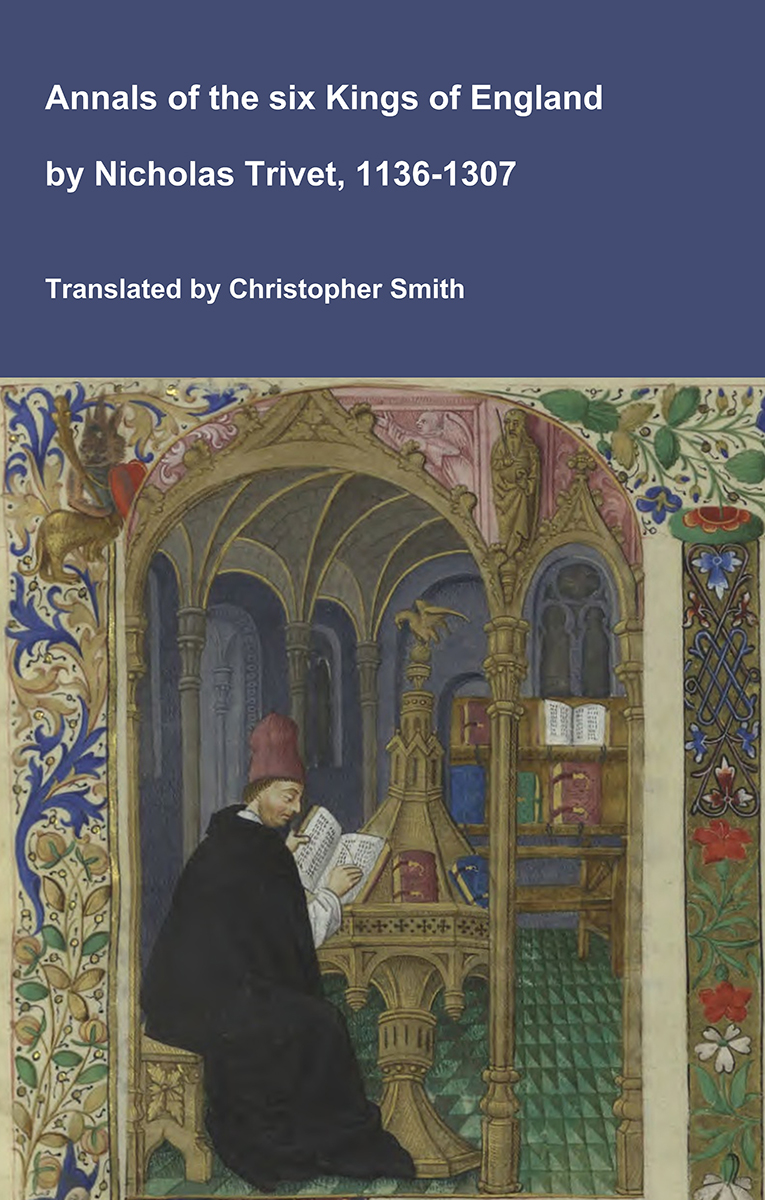
Annals of the six Kings of England by Nicholas Trivet
Translation of the Annals of the Six Kings of England by that traces the rise and rule of the Angevin aka Plantagenet dynasty from the mid-12th to early 14th century. Written by the Dominican scholar Nicholas Trivet, the work offers a vivid account of English history from the reign of King Stephen through to the death of King Edward I, blending political narrative with moral reflection. Covering the reigns of six monarchs—from Stephen to Edward I—the chronicle explores royal authority, rebellion, war, and the shifting balance between crown, church, and nobility. Trivet provides detailed insight into defining moments such as baronial conflicts, Anglo-French rivalry, and the consolidation of royal power under Edward I, whose reign he describes with particular immediacy. The Annals combines careful year-by-year reporting with thoughtful interpretation, presenting history not merely as a sequence of events but as a moral and political lesson. Ideal for readers interested in medieval history, kingship, and the origins of the English state, this chronicle remains a valuable and accessible window into the turbulent world of the Plantagenet kings.
Available at Amazon in eBook and Paperback format.
Chronicle of Gregory 1442 is in Chronicle of Gregory.
30th January 1442. Ande the xxx day of Janyver was certayne poyntys of armys done in Smethefylde [Map] by twyne a knyght of Catelan and a Engelysche squyer, i-callyde Syr John Ascheley; of the whiche tyme the son of the said knyght, in presens of alle the pepylle there, was made knyght opynly by the kyngys (age 20) owne hondys. And the said John Ayschelay also was made knyght att the same tyme.
25th May 1442. Ande the xxv day of May my Lord Talbot (age 59) toke his way towarde the see, for to passe yn to Fraunce whythe his retenowe.
After 7th June 1442. Ande in that same year deyde John Wellys, the nobylle Aldyrman, and some tyme Mayre of London.
1442. Ande in that same year there was a pynner hyngge him sylfe on a Palme Sondaye. And he was alle nakyd save his breche; and then he was caryd in a carte out of the cytte.