

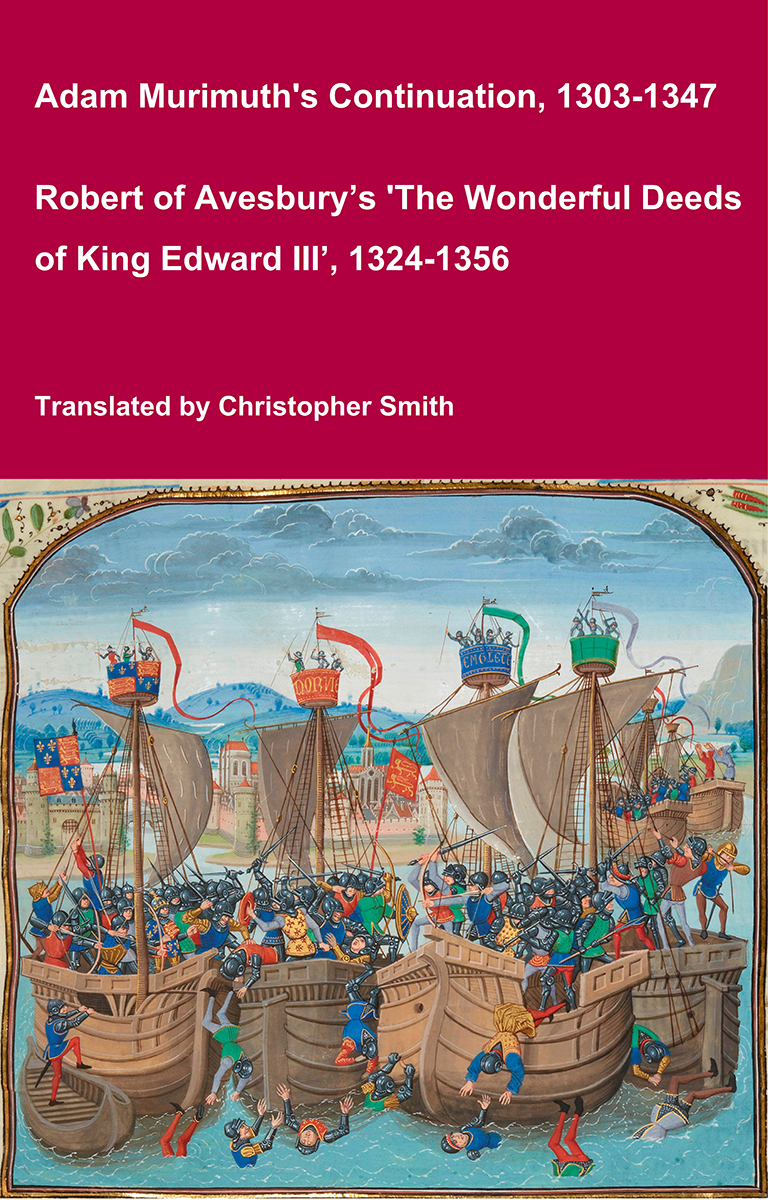
Adam Murimuth's Continuation and Robert of Avesbury’s 'The Wonderful Deeds of King Edward III'
This volume brings together two of the most important contemporary chronicles for the reign of Edward III and the opening phases of the Hundred Years’ War. Written in Latin by English clerical observers, these texts provide a vivid and authoritative window into the political, diplomatic, and military history of fourteenth-century England and its continental ambitions. Adam Murimuth Continuatio's Chronicarum continues an earlier chronicle into the mid-fourteenth century, offering concise but valuable notices on royal policy, foreign relations, and ecclesiastical affairs. Its annalistic structure makes it especially useful for establishing chronology and tracing the development of events year by year. Complementing it, Robert of Avesbury’s De gestis mirabilibus regis Edwardi tertii is a rich documentary chronicle preserving letters, treaties, and official records alongside narrative passages. It is an indispensable source for understanding Edward III’s claim to the French crown, the conduct of war, and the mechanisms of medieval diplomacy. Together, these works offer scholars, students, and enthusiasts a reliable and unembellished account of a transformative period in English and European history. Essential for anyone interested in medieval chronicles, the Hundred Years’ War, or the reign of Edward III.
Available at Amazon in eBook and Paperback format.
Chronicle of Queen Jane and Two Years of Queen Mary Preface is in Chronicle of Queen Jane and Two Years of Queen Mary.
THE Harleian MS. 194 is a pocket diary, extending from July 1553 to October 1554. It is written, or rather scribbled, in so bad a hand that even Stowe, who printed some passages from it, has mistaken several words; and to this circumstance perhaps may be partly attributed the neglect it has hitherto received.*
It is the authority for the interesting account given by Stowe, and Holinshed, of the execution of Lord Guilford Dudley and Lady Jane Grey, as well as for the greater part of their narrative of the progress of events whilst the council administered the government of the realm in the name of "JANE THE QUENE."
In the Harleian Catalogue it is stated, that "This book formerly belonged to Mr. John Stowe, who took from thence many passages which may be found in his Annals, at the reign of Queen Mary, and more yet remain by him untouched."
Mr. Tytler has remarked, "The account given by Holinshed of Northumberland's consent to lead the army, and of his speech to the nobles before leaving the Tower, is interesting, and has some fine touches which seem to stamp its authenticity." Holinshed says in his margin that it was derived "from the report of an eye-witness;" he really received it, through Stowe, from the present Diary.
* The only modern author who has made any use of it is Sir Frederick Madden, who quoted a short passage In his Introduction to the Privy Purse accounts of Queen Mary.
Stowe affords us no intimation of the name of the writer, except that at one place, the account of the decapitation of Wyat, he has printed in his margin the name of Row. Lea.
Rowland Lea was the name of a Bishop of Lichfield and Coventry, who died lord president of Wales in the year 1543: and the same baptismal name was very probably continued in his family.
That the diarist was a man of no mean condition may be inferred from the fact of his having been admitted to dine at the same table with the lady Jane Grey when in the Tower. The passage describing this incident, which is one of the most interesting in the book, has been unknown to all the lady Jane's biographers, although it was once printed, in the seventeenth century, by sir Simonds D'Ewes, who was then the owner of the manuscript.
It was in master Partridge's house that the lady Jane was lodged, and at his table that this memorable interview took place. Who was master Partridge? was he "Affabel Partriche," goldsmith to queen Mary, to whom the lord treasurer was directed by royal warrant* dated 25th July, 1554, to deliver certain jewels then remaining in the Tower? or in what other capacity had he a residence within that fortress?
* MS. Cotton. Titus B. iv. f. 130.
But the more important question is, Who was his guest, whom we would now desire to commemorate as the sole chronicler of the Reign of Queen Jane? It may be supposed a person of higher rank or better education than Partridge, as he was invited to enter into familiar conversation with the illustrious prisoner. One of the sheets of paper which form his pocket-book had been previously used for another purpose, and retains this fragment of writing:
To the righ Peckham quenes ma
Yt maie please your good as I have (as it is not v vertue of the kinges ma hande and previe Sign
This is not in the same handwriting as the Diary itself, but in the formal hand of a clerk. The person to whom it was addressed was doubtless sir Edmund Peckham, who was cofferer of the household at the death of Henry the eighth, who retained that office during the reign of Edward the sixth, and was afterwards treasurer of the mint to queen Mary and queen Elizabeth.
That the diarist was not sir Edmund Peckham himself is shown by the passages in pp. 8 and 12, where the knight, in his capacity of sheriff of Oxfordshire, is mentioned as exerting himself on behalf of the lady Mary in that county, the news of which came to the writer in the Tower of London. But, again, an entry in p. 33 testifies the interest taken by the writer in sir Edmund Peckham's official pre- ferment to be keeper of her majesty's treasure; and other passages in pp. 26, 82, 83, show his acquaintance with the affairs of the mint. It may therefore be conjectured that he was himself an officer of that department of the royal service, which was then con- ducted within the Tower of London; and if any such person bearing the name of "Rowland Lea" should hereafter be discovered, that name may be safely placed in the title-page.
William of Worcester's Chronicle of England
William of Worcester, born around 1415, and died around 1482 was secretary to John Fastolf, the renowned soldier of the Hundred Years War, during which time he collected documents, letters, and wrote a record of events. Following their return to England in 1440 William was witness to major events. Twice in his chronicle he uses the first person: 1. when writing about the murder of Thomas, 7th Baron Scales, in 1460, he writes '… and I saw him lying naked in the cemetery near the porch of the church of St. Mary Overie in Southwark …' and 2. describing King Edward IV's entry into London in 1461 he writes '… proclaimed that all the people themselves were to recognize and acknowledge Edward as king. I was present and heard this, and immediately went down with them into the city'. William’s Chronicle is rich in detail. It is the source of much information about the Wars of the Roses, including the term 'Diabolical Marriage' to describe the marriage of Queen Elizabeth Woodville’s brother John’s marriage to Katherine, Dowager Duchess of Norfolk, he aged twenty, she sixty-five or more, and the story about a paper crown being placed in mockery on the severed head of Richard, 3rd Duke of York.
Available at Amazon in eBook and Paperback format.
The documents which form the appendices to this volume are for the most part printed for the first time. Those which relate to the lady Jane's title to the crown are more carefully edited than before, on account of their very great importance, the only previous copy having been made for bishop Burnet, without that strict accuracy which is now thought desirable. For the privilege of making the present transcripts the Editor is indebted to the Hon. Society of the Inner Temple.
A recent visit to the State Paper Office has been rewarded by the discovery of the true history (given in the Addenda) of the last outbreak of the duke of Suffolk, which was the final cause of the sacrifice of his daughter's life.
The tract of John Elder, forming the Xth Appendix, is one nearly as rare as a manuscript. Its details of the early proceedings of the reign of queen Mary are the more valuable because the protestant chroniclers of the next reign abridged them very materially, in ac- cordance with the altered spirit of the times; and the ecclesiastical historian Foxe describes the same transactions in different terms, as viewed in a totally different light.
In conclusion, the Editor may remark that there still remains inedited in the British Museum a valuable chronicle of this period from which he has made a quotation in Appendix IV. It was kept by one of the ancient faith who lingered about the dissolved house of the Grey Friars in London. As respects religious matters its con- tents are of much interest, and he looks forward to its being regarded by the Camden Society as an appropriate sequel to the two he has now had the pleasure to present to their perusal.
Parliament Street, April 3, 1850.