

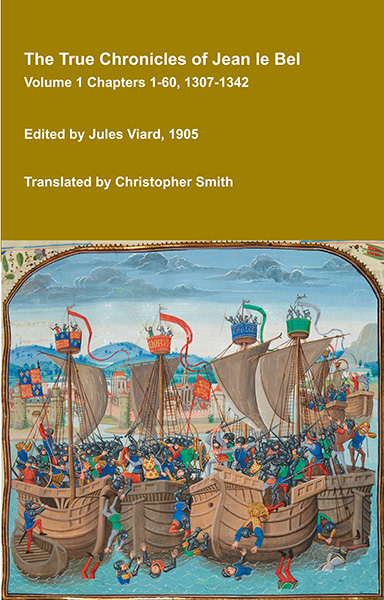
The True Chronicles of Jean le Bel Volume 1 Chapters 1-60 1307-1342
The True Chronicles of Jean le Bel offer one of the most vivid and immediate accounts of 14th-century Europe, written by a knight who lived through the events he describes, and experienced some of them first hand. Covering the early decades of the Hundred Years’ War, this remarkable chronicle follows the campaigns of Edward III of England, the politics of France and the Low Countries, and the shifting alliances that shaped medieval warfare. Unlike later historians, Jean le Bel writes with a strong sense of eyewitness authenticity, drawing on personal experience and the testimony of fellow soldiers. His narrative captures not only battles and sieges, but also the realities of military life, diplomacy, and the ideals of chivalry that governed noble society. A key source for Jean Froissart, Le Bel’s chronicle stands on its own as a compelling and insightful work, at once historical record and literary achievement. This translation builds on the 1905 edition published in French by Jules Viard, adding extensive translations from other sources Rymer's Fœdera, the Chronicles of Adam Murimuth, William Nangis, Walter of Guisborough, a Bourgeois of Valenciennes, Geoffrey le Baker of Swinbroke and Richard Lescot to enrich the original text and Viard's notes.
Available at Amazon in eBook and Paperback format.
Chronicle of the Princes of Wales is in Late Medieval Books.
Brut y Tywysogion aka Chronicle of the Princes of Wales. Edited by the Reverend John Williams ab Ithel, M.A. Rector of Llanymowddy, Merionethshire. 1860.
Immediately after that, Seisyll, son of Dyvnwal, was slain, through the treachery of the lord of Brecheiniog [William de Braose 4th Baron Bramber [aged 31]], in the castle of Abergavenny [Map] and with him Gruffudd his son, and many of the chieftains of Gwent. And then the French repaired to the court of Seisyll, son of Dyvnwal; and after seizing Gwladus his wife, they killed his son Cadwalader [aged 7]. And on that day there was the most miserable slaughter of the good people of Gwent. And after that most open and ílagitious treachery, none of the Welsh dared trust to the French
1230. One thousand two hundred and thirty was the year of Christ, when king Henry, having with him a vast armed host, sailed for France, with the intention of obtaining his right as to Normandy and Anjou and Poictou. And soon after that, on account of a storm and mortality, being disappointed of his purpose, he returned to England. That year, William Canton of Cemaes died. Then young Llywelyn, son of Maelgwn, died, on his estate in Gwynedd, and was honourably buried at Aberconway [Map].
1230. That year, William Bruse [aged 26] was hanged by Llywelyn [aged 58], son of Iorwerth, having been caught in the chamber of the prince, with the princess Jannet [aged 39], daughter of king John, and wife of the prince.