

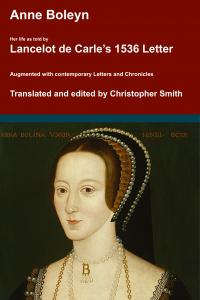
Anne Boleyn. Her Life as told by Lancelot de Carle's 1536 Letter.
In 1536, two weeks after the execution of Anne Boleyn, her brother George and four others, Lancelot du Carle, wrote an extraordinary letter that described Anne's life, and her trial and execution, to which he was a witness. This book presents a new translation of that letter, with additional material from other contemporary sources such as Letters, Hall's and Wriothesley's Chronicles, the pamphlets of Wynkyn the Worde, the Memorial of George Constantyne, the Portuguese Letter and the Baga de Secrets, all of which are provided in Appendices.
Available at Amazon in eBook and Paperback format.
Coventry Leet Book is in Late Medieval Books.
[24th July 1469] Lord Herbert (Earl of Pembroke) was taken in a battle by Banbury with Robin of Redesdale and his fellows on S. James' Eve (Jul 24) 1469, and was taken to Northampton, and there beheaded, and Lord Richard Herbert likewise with others.
Memorandum, quod dominnus Herbert fuit captus in bello juxta Banbery cum Robarto Ryddesdale & sociis suis in vigilia S. Jacobi apostoli, a. r. Edwardi ixo & fuit ductus ad villam de Northehampton & ibi erat decollatus, & dominus Ric. Herber similiter cum aliis.
On Aug. 12 [1469] in the same year Lord Rivers then Treasurer of England was beheaded at Gosford Green [Map], and Lord John Woodville, his son, likewise; they had been taken at Chepstow.
Item, xijo die Augusti eodem anno dominus le Revers tunc thesaurarius Anglie fuit decollattus apud Gosfordgrene & dominus Joh. Wodvyle, filius eius similiter, qui capti fuerunt apud Chapstowe.