

William of Worcester's Chronicle of England
William of Worcester, born around 1415, and died around 1482 was secretary to John Fastolf, the renowned soldier of the Hundred Years War, during which time he collected documents, letters, and wrote a record of events. Following their return to England in 1440 William was witness to major events. Twice in his chronicle he uses the first person: 1. when writing about the murder of Thomas, 7th Baron Scales, in 1460, he writes '… and I saw him lying naked in the cemetery near the porch of the church of St. Mary Overie in Southwark …' and 2. describing King Edward IV's entry into London in 1461 he writes '… proclaimed that all the people themselves were to recognize and acknowledge Edward as king. I was present and heard this, and immediately went down with them into the city'. William’s Chronicle is rich in detail. It is the source of much information about the Wars of the Roses, including the term 'Diabolical Marriage' to describe the marriage of Queen Elizabeth Woodville’s brother John’s marriage to Katherine, Dowager Duchess of Norfolk, he aged twenty, she sixty-five or more, and the story about a paper crown being placed in mockery on the severed head of Richard, 3rd Duke of York.
Available at Amazon in eBook and Paperback format.
Effigy in Temple Church is in Monumental Effigies of Great Britain.
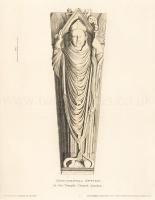
THIS unappropriated bgure of an ecclesiastic lies under the south wall of the Temple Church, London [Map]. It is sculptured in a hard stone, in very sharp relief. He wears the pontifical mitre, gloves, and in his left hand is the pastoral staff which is swathed by an ornamental banda. He treads on a winged dragon. At the top of the Gothic niche in which he is placed are two supporting angels.
Note a. These bandages are represented as attached to the pastoral staves of Bishops, in the MSS. and monuments of this and the following periods of the middle age. The pastoral staff and the crosier, although often confounded, are distinct appendages. The crosier, or cross, is borne by the Archbishop; the pastoral staff, or shepherd's crook, by the Bishop, &c. "Next before the chariot went two men, bare-headed, in linen garments down to the foot, girt and shoes of blue velvet, who carried, the one a crosier, the other a pastoral staff^ like a sheep-hook." Bacon, New Atlantis.