

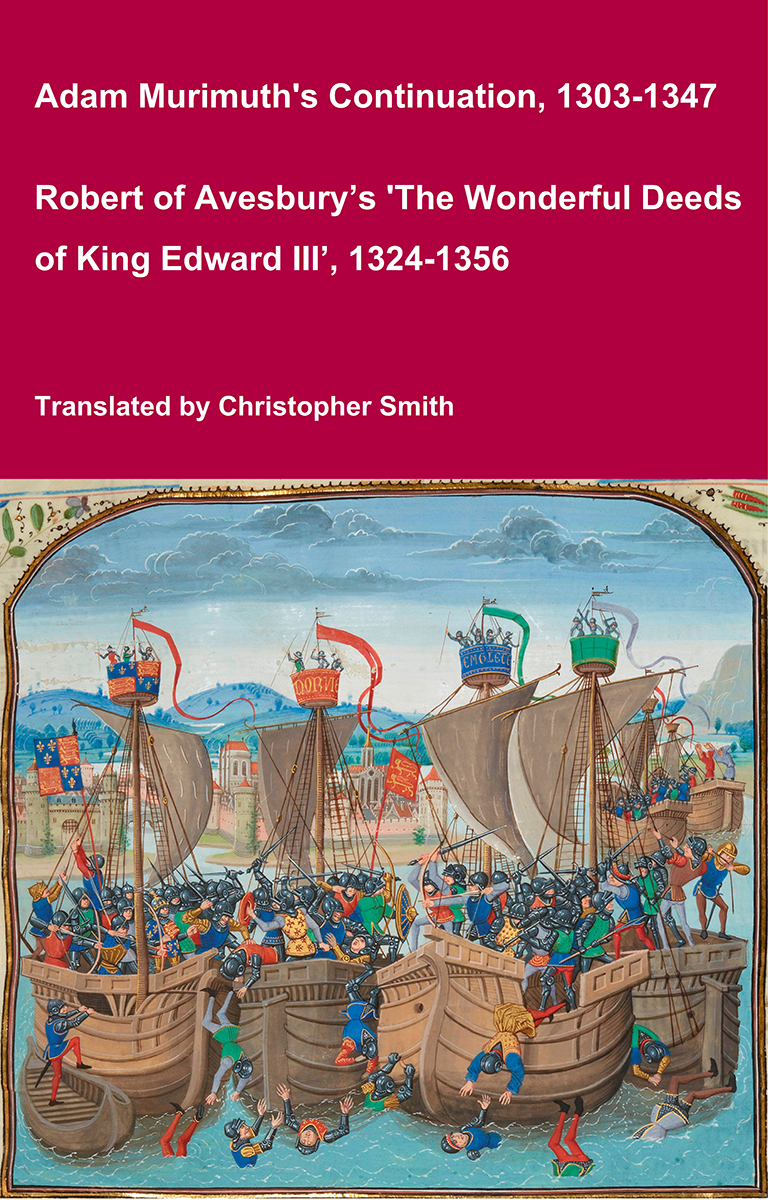
Adam Murimuth's Continuation and Robert of Avesbury’s 'The Wonderful Deeds of King Edward III'
This volume brings together two of the most important contemporary chronicles for the reign of Edward III and the opening phases of the Hundred Years’ War. Written in Latin by English clerical observers, these texts provide a vivid and authoritative window into the political, diplomatic, and military history of fourteenth-century England and its continental ambitions. Adam Murimuth Continuatio's Chronicarum continues an earlier chronicle into the mid-fourteenth century, offering concise but valuable notices on royal policy, foreign relations, and ecclesiastical affairs. Its annalistic structure makes it especially useful for establishing chronology and tracing the development of events year by year. Complementing it, Robert of Avesbury’s De gestis mirabilibus regis Edwardi tertii is a rich documentary chronicle preserving letters, treaties, and official records alongside narrative passages. It is an indispensable source for understanding Edward III’s claim to the French crown, the conduct of war, and the mechanisms of medieval diplomacy. Together, these works offer scholars, students, and enthusiasts a reliable and unembellished account of a transformative period in English and European history. Essential for anyone interested in medieval chronicles, the Hundred Years’ War, or the reign of Edward III.
Available at Amazon in eBook and Paperback format.
Effigy of Archbishop John Stratford is in Monumental Effigies of Great Britain.

John Stratford was born at Stratford-upon-Avon, in Warwickshire [Map], and was educated at Oxford. Being well read in the canon and the civil law, he became Archdeacon of Lincoln. Shortly after, Edward the Second made him his Secretary, and one of his Privy Council. Walter Reynolds, Archbishop of Canterbury, constituted him his principal official, and Dean of the Arches. On the deposition and death of Edward the Second, his ability stood so high in the estimation of the Queen and her son, that he was appointed Lord Chancellor of England. On the death of Mepham, in 1333, he was, at the King's special recommendation to the Pope, elevated to the Archbishopric of Canterbury. The King going abroad to prosecute his pretensions to the Crown of France, constituted the Archbishop Custos of the Realm in his absence, a circumstance which eventually drew on Stratford a severe persecution; for, Edward having disbursed vast sums of money to his followers and friends in the expedition, applied to the Archbishop for more, who seeing that it was impossible to make further levies on the King's subjects, who had lately so liberally supplied him, advised him to return home. Edward is said to have made his creditors in Flanders believe that Stratford was entrusted with large sums sufficient for paying their demands, and Stratford was charged, on the King's return, with having embezzled money which had really never been in his possession. If so noble-minded a monarch as Edward could have acted advisedly in such a matter, we should pronounce him at once the bravest and the meanest of his race; hut the mysteries of court intrigue cannot at this period be unravelled, so as to extenuate or confirm the imputation. The circumstances of the case are, however, highly in favour of Stratford's innocence; for, a Committee of Bishops and Lords being appointed to examine the accusation against him, their inquiry was never prosecuted, and Stratford was pardoned at the solicitation of the entire parliament. Little, indeed, did Stratford deserve a charge of peculation. So disinterested and indefatigable was his character, that he crossed the channel two-and-thirty times on various public missions, besides making many journeys to the Scottish border, yet received altogether for his pains not more than £300 from the King's Exchequer. Restored to the King's favour, he was permitted to pass the fifteen following years of his life in tranquillity, and died at his palace at Mayfield, in Sussex, in 1348. Stratford's character was strongly imbued with the mild virtues of the Gospel, so often obliterated by the temptations incident on high station. Gentle and merciful, rather lenient than rigorous to offenders, bountiful to the poor, he endeavoured to win men's hearts by that charity which considers every human being suffering from error or misfortune, as a brother. He munificently founded a college at Stratford-upon- Avon, his native place, and was interred in a tomb of alabaster in Canterbury cathedral, on the south side of the high altar. The effigy of Stratford is a beautiful work of art, although it has suffered some mutilation. He is habited in his mitre, cope, and gloves (the hands are fractured). Under his right arm is the staff of his crosier, or archiepis- copal cross (the head broken off). Over his left hangs the jewelled maniple for wiping any defilement from the sacramental cup. Under the cope appears the border of his dalmatic, and beneath the dalmatic a richly edged tunic. Fastened to his breast and shoulders by pins (of gold), is the consecrated pall with which the archbishops were invested by the Holy See, and for which it exacted a heavy pecuniary acknowledgment.
Details. 1. Crocheted edge of the mitre. 3. Cape of the cope. 3. One of the pins fastening the paH.