

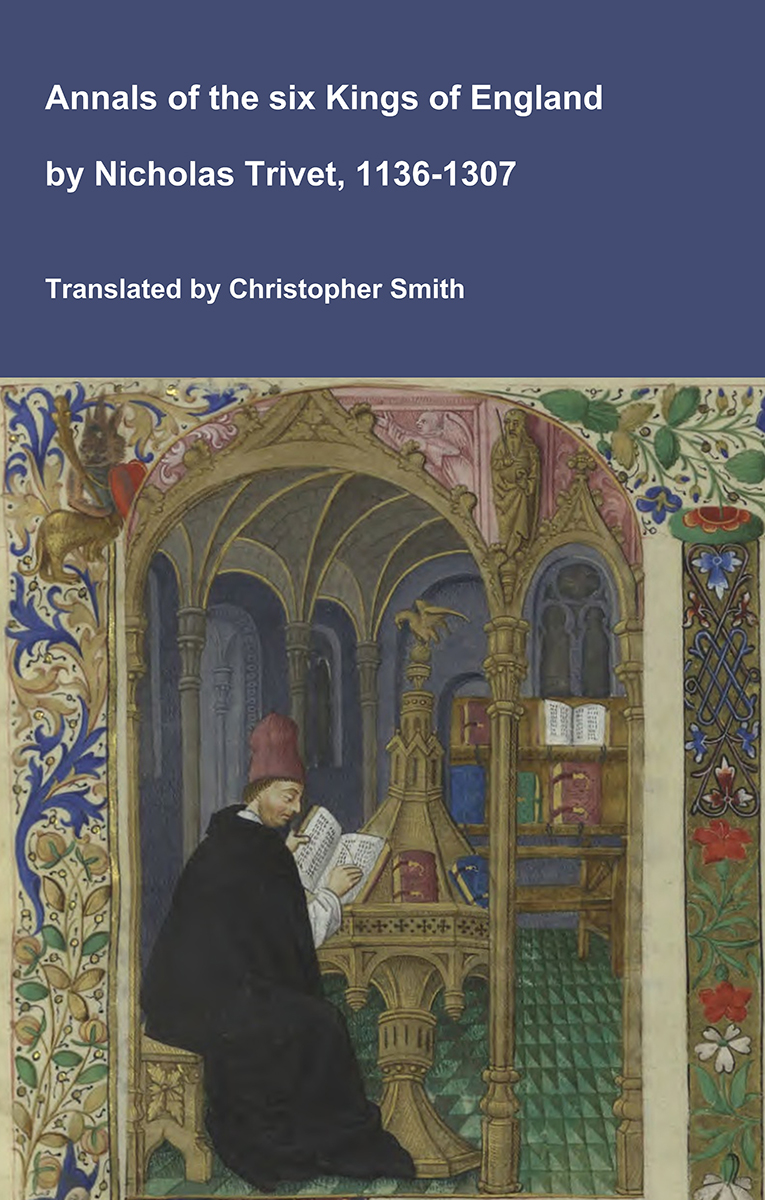
Annals of the six Kings of England by Nicholas Trivet
Translation of the Annals of the Six Kings of England by that traces the rise and rule of the Angevin aka Plantagenet dynasty from the mid-12th to early 14th century. Written by the Dominican scholar Nicholas Trivet, the work offers a vivid account of English history from the reign of King Stephen through to the death of King Edward I, blending political narrative with moral reflection. Covering the reigns of six monarchs—from Stephen to Edward I—the chronicle explores royal authority, rebellion, war, and the shifting balance between crown, church, and nobility. Trivet provides detailed insight into defining moments such as baronial conflicts, Anglo-French rivalry, and the consolidation of royal power under Edward I, whose reign he describes with particular immediacy. The Annals combines careful year-by-year reporting with thoughtful interpretation, presenting history not merely as a sequence of events but as a moral and political lesson. Ideal for readers interested in medieval history, kingship, and the origins of the English state, this chronicle remains a valuable and accessible window into the turbulent world of the Plantagenet kings.
Available at Amazon in eBook and Paperback format.
Effigy of Robert de Vere, Earl of Oxford is in Monumental Effigies of Great Britain.
ROBERT, son of Aubrey de Vere, Earl of Oxford, succeeded his brother Aubrey in the honours and possessions of his family in 1214. He was one of the principal Barons who took up arms against King John, for which he was excommunicated by Pope Innocent the Third. On the accession of Henry the Third (age 14) he was received into favour, and became a Judge in the King's Courts. He married Isabella (age 48), the sister and inheritrix of Hugh de Bolebec, by whom he had a son and heir, Hugh. He died in the fifth year of the reign of Henry the Third, and was buried in the chancel of the Priory Church of Hatfield Broad Oak, in Essex. At the dissolution, Weever says, his tomb was removed into the parish church, and thus transcribes his epitaph:
Sire Robert de Veere le premier, Count de Oxenford ie tierz, git ci; Dieu de l'alme si luy plest face merci. Qi pur l'ame priera xl jors de pardonn avera. Pater Nostera.
This figure lies cross-legged, and is represented in the act of drawing his sword. The loose fit of the hauberk about the right-arm and neck is admirably expressed, and the mails are sculptured with great accuracy. The thighs appear to be covered with a gamboised or quilted defence, which reaches to the knees, the caps of which are defended by octangular pieces of plate-armour. The shield is curiously diapered with fleurs-de-lys and roses. The ground of the held in ancient bearings is often enriched with fanciful ornaments which have no relation whatever to the coat itself. De Vere bore, quarterly Or and Gules, in the first quarter a mullet Argent. This monument, from the costume, appears to have been erected about fifty years after the Earls decease.
Details. Diaper work on the shield enlarged. Band on the hood enlarged.

