The True Chronicles of Jean le Bel Volume 1 Chapters 1-60 1307-1342
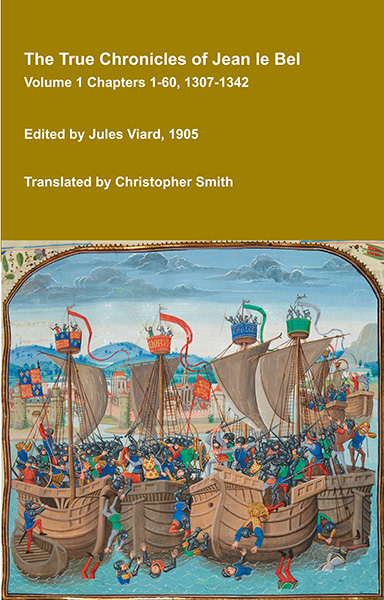
The True Chronicles of Jean le Bel offer one of the most vivid and immediate accounts of 14th-century Europe, written by a knight who lived through the events he describes, and experienced some of them first hand. Covering the early decades of the Hundred Years’ War, this remarkable chronicle follows the campaigns of Edward III of England, the politics of France and the Low Countries, and the shifting alliances that shaped medieval warfare. Unlike later historians, Jean le Bel writes with a strong sense of eyewitness authenticity, drawing on personal experience and the testimony of fellow soldiers. His narrative captures not only battles and sieges, but also the realities of military life, diplomacy, and the ideals of chivalry that governed noble society. A key source for Jean Froissart, Le Bel’s chronicle stands on its own as a compelling and insightful work, at once historical record and literary achievement. This translation builds on the 1905 edition published in French by Jules Viard, adding extensive translations from other sources Rymer's Fœdera, the Chronicles of Adam Murimuth, William Nangis, Walter of Guisborough, a Bourgeois of Valenciennes, Geoffrey le Baker of Swinbroke and Richard Lescot to enrich the original text and Viard's notes.
Available at Amazon in eBook and Paperback format.
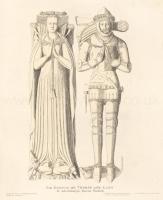
Effigy of Sir Edmund de Thorpe and Lady is in Monumental Effigies of Great Britain.
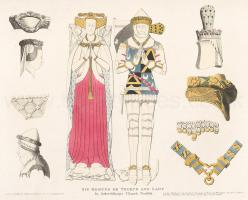
THESE effigies are in Ashwell Thorp church, Norfolk [Map]. We have in the ancestry of Sir Edmund de Thorpe a striking instance of the mutability of surnames in some families until the thirteenth century. William de Norwich lived about the time of the Conquest, and possessed the manor of Thorpe. From him came Roger, whose son Robert was distinguished by the surname of Fitz-Roger; Fitz-Roger's child Hugh, from some local circumstance, took the surname of de Messingham; and his child John assumed the cognomen of Fitz-Robert, in allusion to his grandfather. In the time of Henry the Third, we hnd the heir of John entitled Robert Fitz-John de Thorpe; and in Edmund, his heir, the surname became hxed and inheritable. Sir Edmund, his son by his wife Joan, daughter of Robert Baynard, is represented by the male effigy- Joan, widow of Lord Scales, his second wife, is the subject of the female figure. In 1417 Sir Edmund de Thorpe was associated with John Nevill and John Kempe, LL.D. (afterwards the Cardinal Archbishop, son of Sir Thomas Kempe, of Wye,) to compose all differences between Henry the Fifth and the Duke of Burgundy. He is considered to be the per- son designated by the Chronicles as Lord Thorpe, who in 1418 was killed at the siege of the Castle of Louviers, in Normandy. He was buried in the church of Ashwell Thorp, in the new aisle erected at his expense. The figures of Sir Edmund de Thorpe and his Lady are of alabaster, and are described by Bloomfield in his time as lying under a canopy of wood. The costume of the figures is elegantly and elaborately detailed. The lady lies at the right side of her lord; her hair is confined by a rich fret; the cordon of her mantle is attached by two clasps, apparently formed as eagles with expanded wings. The same ornament appears near the gusset of the armour on the knight's left shoulder. The front of his basinet is engraved with elegant tracery of foliage; and he wears a splendid wreath, studded, we may suppose, with pearls, and enamelled with leaves of laurel. The surcoat bears, quarterly, the arms of Thorpe and Baynard; the three crescents Argent in the Azure held, in the dexter quarter, being for Thorpe. At the lady's feet are two little dogs with collars and bells; at the knight's a greyhound. The joints of the brassarts, cuisses, genouillieres, and greaves of his armour, are ornamentally engraven. Under his head is a beautiful specimen of the helmet of his time: it is covered with a scallopped mantelet, or lambrequin, surmounted by a rich coronet, and has a panache of peacock's feathers. Details. P!ate 11. Upper part of the lady's coiffure. Profile of her head. Portion of the fret. Profile of the knight's head and shoulders. The figure as originally painted and gilt. The helmet. Portion of the basinet and wreath. Portion of the mailles enlarged. The collar of SS enlarged.