


Text this colour links to Pages. Text this colour links to Family Trees. Text this colour are links that disabled for Guests.
Place the mouse over images to see a larger image. Click on paintings to see the painter's Biography Page.
Mouse over links for a preview. Move the mouse off the painting or link to close the popup.
Jean de Waurin's Chronicle of England Volume 6 Books 3-6: The Wars of the Roses
Jean de Waurin was a French Chronicler, from the Artois region, who was born around 1400, and died around 1474. Waurin’s Chronicle of England, Volume 6, covering the period 1450 to 1471, from which we have selected and translated Chapters relating to the Wars of the Roses, provides a vivid, original, contemporary description of key events some of which he witnessed first-hand, some of which he was told by the key people involved with whom Waurin had a personal relationship.
Available at Amazon in eBook and Paperback format.
Effigy of Sir Miles Stapleton and his Lady is in Monumental Effigies of Great Britain.
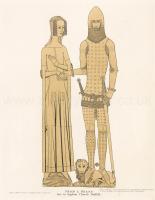
ONE of those engraved plates familiarly termed brasses. It is on the floor of the chancel of Ingham church, Norfolk, and commemorates Sir Miles Stapleton, Knight of the Garter, and his wife, Joan, daughter of Sir Oliver Ingham, and widow of Lord Strange, of Knockyn. He died on Wednesday before the feast of St. Nicholas, 38 Edward III. (December 4,1364.) The lady, perhaps from courtesy as a coheiress, is placed on the knight's right hand. An elegant crocketed gothic canopy and pinnacles surmount the figures. These have suffered some mutilation. Into the verge of the stone has been inserted a fillet of brass, with this inscription:
Priez pour les almes de Monseur Miles de Stapleton, et Dame Johanne, sa femme, fille de Monseur Oliver de Ingham, fondours de ceste maison; qe dieu de jour almes eit pitie.
[Pray for the alms of Sir Miles of Stapleton, and Dame Johanne, his wife, daughter of Sir Oliver of Ingham, founders of this house; may god of day almes have mercy]
That portion printed in the black letter alone now remains, the rest is supplied from Bloomfield.