Chronicle of Abbot Ralph of Coggeshall
The Chronicle of Abbot Ralph of Coggeshall (Chronicon Anglicanum) is an indispensable medieval history that brings to life centuries of English and European affairs through the eyes of a learned Cistercian monk. Ralph of Coggeshall, abbot of the Abbey of Coggeshall in Essex in the early 13th century, continued and expanded his community’s chronicle, documenting events from the Norman Conquest of 1066 into the tumultuous reign of King Henry III. Blending eyewitness testimony, careful compilation, and the monastic commitment to record-keeping, this chronicle offers a rare narrative of political intrigue, royal power struggles, and social upheaval in England and beyond. Ralph’s work captures the reigns of pivotal figures such as Richard I and King John, providing invaluable insights into their characters, decisions, and the forces that shaped medieval rule. More than a simple annal, Chronicon Anglicanum conveys the texture of medieval life and governance, making it a rich source for scholars and readers fascinated by English history, monastic authorship, and the shaping of the medieval world.
Available at Amazon in eBook and Paperback format.
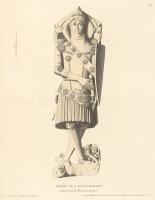
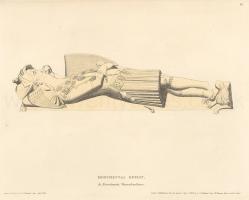
Effigy of a Blanchfront is in Monumental Effigies of Great Britain.
In Alvechurch, Worcestershire [Map]. This figure is termed by Nash "a knight of the holy voyage adopting the very probable conjecture, that the crossed legs indicated a vow of pilgrimage to the Holy Land. The inhabitants of the neighbourhood call it the Knight of the Green, who they say resided on Wetherock-hill; where they still show the site of his moated house.
A grant is extant, of the time of Edward the Third, of certain lands in the tenure of Thomas Kempe and John Kempe, to Thomas Blanchfront. Sir John Blanchfront, his descendant, is mentioned in an instrument A. D. 1346, the 21st of the reign of Edward the Third. This personage, therefore, the effigy may be conjectured to represent.
As a specimen of an elegant variety of the costume of a knight in the fourteenth century, the beautiful and spirited etching before us possesses great interest. The basinet assumes the form of the double curved gothic arch, and the heavy close helmet of the tourney is supplied by the aventaille, or ventaille, attached to the basinet, and thrown back to show the face; roundels, tastefully filled up with roses, are affixed to the armour at the shoulders, the elbows, and on the belt. From each of the two roundels on the paps descends a chain, fastening the handle of the sword. The lower part of the surcoat is gathered into numerous folds, and is closed in the front by a row of studs or buttons. Plate No. 2 exhibits the profile of the figure, the lacing of the surcoat clearly and sharply defined. The rowel of one of the spurs, a rare exception, is fortunately unbroken.