

Annals of the six Kings of England by Nicholas Trivet
Translation of the Annals of the Six Kings of England by that traces the rise and rule of the Angevin aka Plantagenet dynasty from the mid-12th to early 14th century. Written by the Dominican scholar Nicholas Trivet, the work offers a vivid account of English history from the reign of King Stephen through to the death of King Edward I, blending political narrative with moral reflection. Covering the reigns of six monarchs—from Stephen to Edward I—the chronicle explores royal authority, rebellion, war, and the shifting balance between crown, church, and nobility. Trivet provides detailed insight into defining moments such as baronial conflicts, Anglo-French rivalry, and the consolidation of royal power under Edward I, whose reign he describes with particular immediacy. The Annals combines careful year-by-year reporting with thoughtful interpretation, presenting history not merely as a sequence of events but as a moral and political lesson. Ideal for readers interested in medieval history, kingship, and the origins of the English state, this chronicle remains a valuable and accessible window into the turbulent world of the Plantagenet kings.
Available at Amazon in eBook and Paperback format.
First Book of Samuel is in Old Testament.
King James: And when Samuel saw Saul, the Lord said unto him, Behold the man whom I spake to thee of! this same shall reign over my people.
New International Version: When Samuel caught sight of Saul, the Lord said to him, "This is the man I spoke to you about; he will govern my people."
NIV. But be sure to fear the LORD and serve him faithfully with all your heart; consider what great things he has done for you.
KJB. Only fear the LORD, and serve him in truth with all your heart: for consider how great things he hath done for you.
Samuel Pepys' Diary. 23rd April 1665. Thence to the Chappell and heard the famous young Stillingfleete [aged 30], whom I knew at Cambridge, and is now newly admitted one of the King's chaplains; and was presented, they say, to my Lord Treasurer [aged 58] for St. Andrew's, Holborne [Map], where he is now minister, with these words: that they (the Bishops of Canterbury, London, and another) believed he is the ablest young man to preach the Gospel of any since the Apostles. He did make the most plain, honest, good, grave sermon, in the most unconcerned and easy yet substantial manner, that ever I heard in my life, upon the words of Samuell to the people, "Fear the Lord in truth with all your heart, and remember the great things that he hath done for you". It being proper to this day, the day of the King's Coronation.


KJB. And it came to pass afterward, that David's heart smote him, because he had cut off Saul's skirt.
Samuel Pepys' Diary. 30th January 1663. A solemn fast for the King's murther, and we were forced to keep it more than we would have done, having forgot to take any victuals into the house. I to church in the forenoon, and Mr. Mills made a good sermon upon David's heart smiting him for cutting off the garment of Saul1.
Note 1. Samuel, chap. xxiv. v. 5, "And it came to pass afterward, that David's heart smote him, because he had cut off Saul's skirt"..
And thus you shall say to him who lives in prosperity: "Peace be to you, peace to your house, and peace to all that you have! ..."
NIV. David then asked Ahimelek the Hittite and Abishai son of Zeruiah, Joab's brother, "Who will go down into the camp with me to Saul?" "I'll go with you," said Abishai.
John Evelyn's Diary. 30th January 1688. Being the Martyrdom day of King Charles I, our curate made a florid oration against the murder of that excellent Prince, with an exhortation to obedience from the example of David; 1 Samuel xxvi. 6.
The Deeds of the Dukes of Normandy
The Gesta Normannorum Ducum [The Deeds of the Dukes of Normandy] is a landmark medieval chronicle tracing the rise and fall of the Norman dynasty from its early roots through the pivotal events surrounding the Norman Conquest of England. Originally penned in Latin by the monk William of Jumièges shortly before 1060 and later expanded at the behest of William the Conqueror, the work chronicles the deeds, politics, battles, and leadership of the Norman dukes, especially William’s own claim to the English throne. The narrative combines earlier historical sources with firsthand information and oral testimony to present an authoritative account of Normandy’s transformation from a Viking settlement into one of medieval Europe’s most powerful realms. William’s history emphasizes the legitimacy, military prowess, and governance of the Norman line, framing their expansion, including the conquest of England, as both divinely sanctioned and noble in purpose. Later chroniclers such as Orderic Vitalis and Robert of Torigni continued the history, extending the coverage into the 12th century, providing broader context on ducal rule and its impact. Today this classic work remains a foundational source for understanding Norman identity, medieval statesmanship, and the historical forces that reshaped England and Western Europe between 800AD and 1100AD.
Available at Amazon in eBook and Paperback format.
NIV. So David and Abishai went to the army by night, and there was Saul, lying asleep inside the camp with his spear stuck in the ground near his head. Abner and the soldiers were lying around him.
KJV. So David and Abishai came to the people by night: and, behold, Saul lay sleeping within the trench, and his spear stuck in the ground at his bolster: but Abner and the people lay round about him.
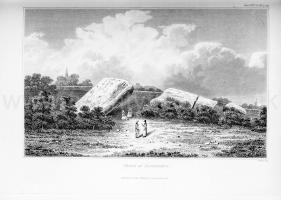
Archaeologia Volume 25 Section XIII. 3. The third species of monument remaining at Locmariaker is the round Obelisk [Menhir Er Grah [Map]]. A beautiful one stood at the head of Caesar's tumulus; and it was sixty-three feet in length and fourteen feet in diameter at the thickest part, which is at about twenty feet from the base. From this point it tapers gradually both ways. Another obelisk, about thirty-five feet in length, lies at the entrance of the village; its tumulus was perhaps removed to make room for a house. Each of these is cut out of a single stone.
These obelisks probably denoted the burial-places of warriors of the first rank: and may have originated in the well-known custom still prevalent in the East, of planting an upright spear at the head of a Chief as he slept upon the ground. It was thus that David found Saul on the hill of Hachilah: "Behold Saul lay sleeping within the trench, and his spear stuck in the ground at his bolster."a This custom was universal in the East. Homer mentions it, and it has been repeatedly observed by travellers in Persia and Hindustan. The spear at the head, thus planted, always denotes a warrior of the highest rank.
Some mighty Celtic chief may in like manner be supposed to be sleeping at Locmariaker, under the tumulus of Caesar, "with his spear stuck in the ground at his bolster: "only the sleep being that of death, the spear is of a material of corresponding duration; it is an obelisk of stone cut out of a single block.
The evangelizers of Britany, for they probably were the destroyers, suffered not the warrior's spear to mark his last resting-place. The obelisk was overthrown, as an object of superstitious veneration, and now lies broken in four pieces. The tomb also has been rifled of its sacred deposit; and the whole is but a variety of the continual work of ruin which in every country records the mutability of man, and the vanity of his earthly hopes.
The original weight of this column must have been about 260 tons! and the labour required to remove it from the quarry and to plant it at the head of the tumulus of Caesar may be imagined, by calling to our recollection the power employed by Fontana to place the obelisk of the Vatican in its present site at Rome. The latter column was only fifteen feet longer than the obelisk before us; and, although it weighed only 150 tons, whereas that of Locmariaker weighed 26 0, yet it required the united efforts of eight hundred men and sixty horses, complex machinery, and the expenditure of ^*5000, to remove it for a short distance, and erect it as it now stands! We should also recollect that the erection of the obelisk of Locmariaker was the work of a rude age, ignorant, probably, of the mechanical powers, and mainly effected by human strength.
Note a. 1 Samuel, xxvi. 7.
NIV. But David said to Abishai, "Don't destroy him! Who can lay a hand on the LORD's anointed and be guiltless?
KJB. And David said to Abishai, Destroy him not: for who can stretch forth his hand against the LORD'S anointed, and be guiltless?