

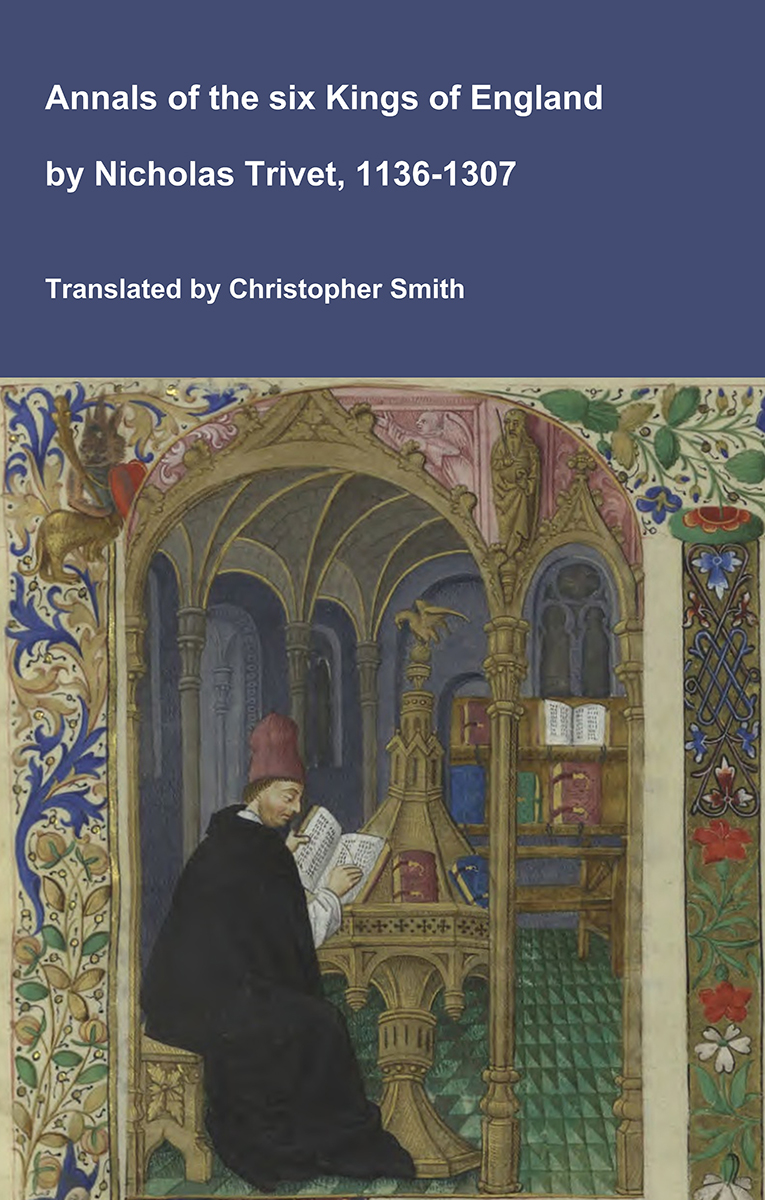
Annals of the six Kings of England by Nicholas Trivet
Translation of the Annals of the Six Kings of England by that traces the rise and rule of the Angevin aka Plantagenet dynasty from the mid-12th to early 14th century. Written by the Dominican scholar Nicholas Trivet, the work offers a vivid account of English history from the reign of King Stephen through to the death of King Edward I, blending political narrative with moral reflection. Covering the reigns of six monarchs—from Stephen to Edward I—the chronicle explores royal authority, rebellion, war, and the shifting balance between crown, church, and nobility. Trivet provides detailed insight into defining moments such as baronial conflicts, Anglo-French rivalry, and the consolidation of royal power under Edward I, whose reign he describes with particular immediacy. The Annals combines careful year-by-year reporting with thoughtful interpretation, presenting history not merely as a sequence of events but as a moral and political lesson. Ideal for readers interested in medieval history, kingship, and the origins of the English state, this chronicle remains a valuable and accessible window into the turbulent world of the Plantagenet kings.
Available at Amazon in eBook and Paperback format.
Gospel of St John is in Gospels.
NIV. He is the one who comes after me, the straps of whose sandals I am not worthy to untie.
KJV. He it is, who coming after me is preferred before me, whose shoe's latchet I am not worthy to unloose.
John Evelyn's Diary. 6th February 1670. Dr. John Breton, Master of Emmanuel College, in Cambridge (uncle to our vicar), preached on John i. 27; "whose shoe-latchet I am not worthy to unloose", etc. [Note. This is the King [age 39] James Bible translation], describing the various fashions of shoes, or sandals, worn by the Jews, and other nations: of the ornaments of the feet: how great persons had servants that took them off when they came to their houses, and bore them after them: by which pointing the dignity of our Savior, when such a person as St. John Baptist acknowledged his unworthiness even of that mean office. The lawfulness, decentness, and necessity, of subordinate degrees and ranks of men and servants, as well in the Church as State: against the late levelers, and others of that dangerous rabble, who would have all alike.
KJB. Behold, what manner of love the Father hath bestowed upon us, that we should be called the sons of God: therefore the world knoweth us not, because it knew him not.
NIV. See what great love the Father has lavished on us, that we should be called children of God! And that is what we are! The reason the world does not know us is that it did not know him.
NIV. It gave me great joy when some believers came and testified about your faithfulness to the truth, telling how you continue to walk in it.

John Evelyn's Diary. 3rd December 1657. Mr. Gunning [age 43] preached on John iii. 3, against the Anabaptists, showing the effect and necessity of the sacrament of baptism. This sect was now wonderfully spread.
NIV. Dear friends, do not believe every spirit, but test the spirits to see whether they are from God, because many false prophets have gone out into the world.
John Evelyn's Diary. 4th February 1679. Dr. Pierce, Dean of Salisbury, preached on 1 John, iv. 1, "Try the Spirits, there being so many delusory ones gone forth of late into the world"; he inveighed against the pernicious doctrines of Mr. Hobbes.
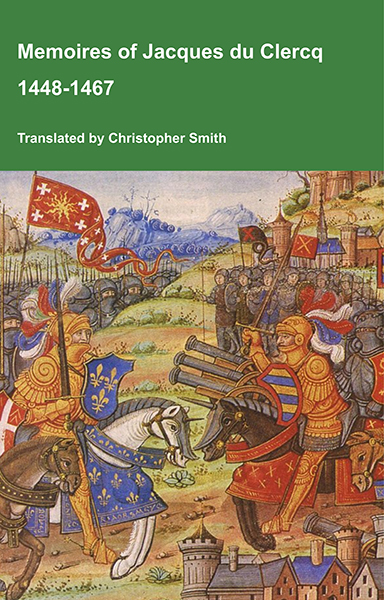
This is a translation of the 'Memoires of Jacques du Clercq', published in 1823 in two volumes, edited by Frederic, Baron de Reissenberg. In his introduction Reissenberg writes: 'Jacques du Clercq tells us that he was born in 1424, and that he was a licentiate in law and a counsellor to Philip the Good, Duke of Burgundy, in the castellany of Douai, Lille, and Orchies. It appears that he established his residence at Arras. In 1446, he married the daughter of Baldwin de la Lacherie, a gentleman who lived in Lille. We read in the fifth book of his Memoirs that his father, also named Jacques du Clercq, had married a lady of the Le Camelin family, from Compiègne. His ancestors, always attached to the counts of Flanders, had constantly served them, whether in their councils or in their armies.' The Memoires cover a period of nineteen years beginning in in 1448, ending in in 1467. It appears that the author had intended to extend the Memoirs beyond that date; no doubt illness or death prevented him from carrying out this plan. As Reissenberg writes the 'merit of this work lies in the simplicity of its narrative, in its tone of good faith, and in a certain air of frankness which naturally wins the reader’s confidence.' Du Clercq ranges from events of national and international importance, including events of the Wars of the Roses in England, to simple, everyday local events such as marriages, robberies, murders, trials and deaths, including that of his own father in Book 5; one of his last entries.
Available at Amazon in eBook and Paperback format.
But he said to them, "I have food to eat that you don't know about.".
John Evelyn's Diary. 1st January 1653. I set apart in preparation for the Blessed Sacrament, which the next day Mr. Owen administered to me and all my family in Sayes Court [Map], preaching on John vi. 32, 33, showing the exceeding benefits of our blessed Savior taking our nature upon him. He had christened my son and churched my wife [age 18] in our own house as before noticed.
The disciples therefore said one to another, "Has anyone brought him something to eat?".
John Evelyn's Diary. 1st January 1653. I set apart in preparation for the Blessed Sacrament, which the next day Mr. Owen administered to me and all my family in Sayes Court [Map], preaching on John vi. 32, 33, showing the exceeding benefits of our blessed Savior taking our nature upon him. He had christened my son and churched my wife [age 18] in our own house as before noticed.
NIV. where they got into a boat and set off across the lake for Capernaum. By now it was dark, and Jesus had not yet joined them.
KJB. And entered into a ship, and went over the sea toward Capernaum. And it was now dark, and Jesus was not come to them.
John Evelyn's Diary. 14th March 1686. The Bp. of Bath and Wells [age 48] preach'd on 6 John 17, a most excellent and pathetic discourse: after he had recommended the duty of fasting and other penitential duties, he exhorted to constancy in the Protestant religion, detestation of the unheard-of cruelties of the French, and stirring up to a liberal contribution. This Sermon was the more acceptable, as it was unexpected from a Bishop who had undergon the censure of being inclin'd to Popery, the contrary whereof no man could shew more. This indeede did all our Bishops, to the disabusing and reproch of all their delators; for none were more zealous against Popery than they were.
NIV. For my flesh is real food and my blood is real drink.
KJB. For my flesh is meat indeed, and my blood is drink indeed.
NIV. Can any of you prove me guilty of sin? If I am telling the truth, why don't you believe me?.
NIV. You are my friends if you do what I command.
KJB. Ye are my friends, if ye do whatsoever I command you.
Samuel Pepys' Diary. 2nd August 1663. Then to the parish church, and there heard a poor sermon with a great deal of false Greek in it, upon these words, "Ye are my friends, if ye do these things which I command you".
NIV. They will put you out of the synagogue; in fact, the time is coming when anyone who kills you will think they are offering a service to God.
Chronicle of Walter of Guisborough
A canon regular of the Augustinian Guisborough Priory, Yorkshire, formerly known as The Chronicle of Walter of Hemingburgh, describes the period from 1066 to 1346. Before 1274 the Chronicle is based on other works. Thereafter, the Chronicle is original, and a remarkable source for the events of the time. This book provides a translation of the Chronicle from that date. The Latin source for our translation is the 1849 work edited by Hans Claude Hamilton. Hamilton, in his preface, says: 'In the present work we behold perhaps one of the finest samples of our early chronicles, both as regards the value of the events recorded, and the correctness with which they are detailed; Nor will the pleasing style of composition be lightly passed over by those capable of seeing reflected from it the tokens of a vigorous and cultivated mind, and a favourable specimen of the learning and taste of the age in which it was framed.'
Available at Amazon in eBook and Paperback format.

John Evelyn's Diary. 5th November 1686. I went to St. Martin's [Map] in the morning, where Dr. Birch preached very boldly against the Papists, from John xvi. 2. In the afternoon I heard Dr. Tillotson [age 56] in Lincoln's Inn chapel, on the of same text, but more cautiously.
NIV. All I have is yours, and all you have is mine. And glory has come to me through them.
KJB. And all mine are thine, and thine are mine; and I am glorified in them.
NIV. Jesus said, "My kingdom is not of this world. If it were, my servants would fight to prevent my arrest by the Jewish leaders. But now my kingdom is from another place.".
John Evelyn's Diary. 10th August 1657. Our vicar, from John xviii. 36, declaimed against the folly of a sort of enthusiasts and desperate zealots, called the Fifth-Monarchy-Men, pretending to set up the kingdom of Christ with the sword. To this pass was this age arrived when we had no King in Israel.
NIV. Jesus said, "Do not hold on to me, for I have not yet ascended to the Father. Go instead to my brothers and tell them, 'I am ascending to my Father and your Father, to my God and your God.'".
KJB. Jesus saith unto her, Touch me not; for I am not yet ascended to my Father: but go to my brethren, and say unto them, I ascend unto my Father, and your Father; and to my God, and your God.
Noli me tangere means "Touch me not". Best known from the Gospel of John Chapter 20 Verse 17 for being what Jesus says to Mary Magdelene after his resurrection.
NIV. 21 So Jesus said to them again, "Peace to you! As the Father has sent Me, I also send you." 22 And when He had said this, He breathed on them, and said to them, "Receive the Holy Spirit. 23 If you forgive the sins of any, they are forgiven them; if you retain the sins of any, they are retained.".
John Evelyn's Diary. 20th February 1676. Dr. Gunning [age 62], Bishop of Ely, preached before the King [age 45] from St. John xx. 21, 22, 23, chiefly against an anonymous book, called "Naked Truth", a famous and popular treatise against the corruption in the Clergy, but not sound as to its quotations, supposed to have been the Bishop of Hereford and was answered by Dr. Turner, it endeavoring to prove an equality of order of Bishop and Presbyter.