

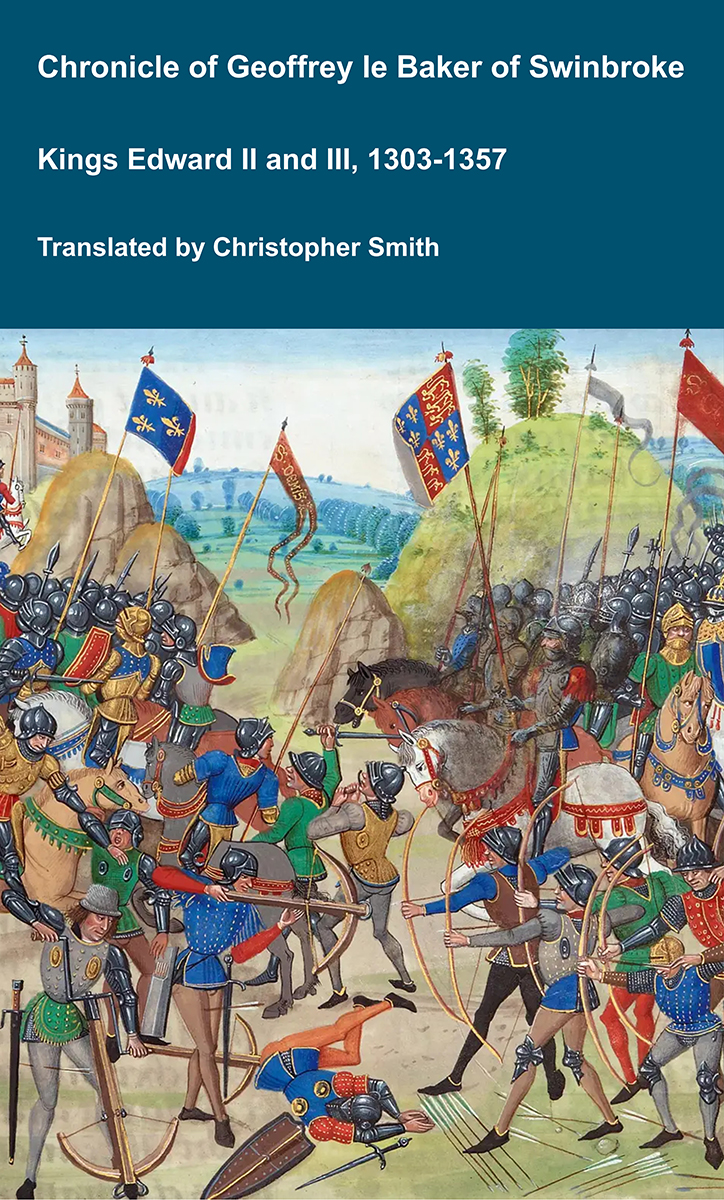
Chronicle of Geoffrey le Baker of Swinbroke
Baker was a secular clerk from Swinbroke, now Swinbrook, an Oxfordshire village two miles east of Burford. His Chronicle describes the events of the period 1303-1356: Gaveston, Bannockburn, Boroughbridge, the murder of King Edward II, the Scottish Wars, Sluys, Crécy, the Black Death, Winchelsea and Poitiers. To quote Herbert Bruce 'it possesses a vigorous and characteristic style, and its value for particular events between 1303 and 1356 has been recognised by its editor and by subsequent writers'. The book provides remarkable detail about the events it describes. Baker's text has been augmented with hundreds of notes, including extracts from other contemporary chronicles, such as the Annales Londonienses, Annales Paulini, Murimuth, Lanercost, Avesbury, Guisborough and Froissart to enrich the reader's understanding. The translation takes as its source the 'Chronicon Galfridi le Baker de Swynebroke' published in 1889, edited by Edward Maunde Thompson.
Available at Amazon in eBook and Paperback format.
Il Novellino aka Le Cento Novelle Antiche is in Late Medieval Books.
Il Novellino, or Le Cento Novelle Antiche, i.e. The One Hundred Ancient Tales, is an anonymous collection of short stories written in the Tuscan vernacular between 1280 and 1300.[1] It was first published in 1525 by Carlo Gualteruzzi
Il Novellino aka Le Cento Novelle Antiche 82nd. Here it is told how the damsel of Shalott died, for love of Lancelot of the Lake."
Qui conta come la damigella di scalot morì, per amore di lancialotto del lac.
A daughter of a great vassal loved Lancelot of the Lake beyond measure, but he did not want to give her his love, because he had already given it to Queen Guinevere. This lady loved Lancelot so much that she came to her death from it, and she commanded that, when her soul had left her body, a rich little boat be prepared, covered with a crimson silk cloth, with a rich bed inside, adorned with rich and noble silk covers, and decorated with precious jewels. Her body was to be laid on this bed, dressed in her most noble garments, with a beautiful crown on her head, rich with gold and many precious stones, and with a rich belt and purse. In that purse, there was a letter, which contained the following message. But first, let us speak of what happened before the letter.
Una figliuola d'un grande varvassore si amò Lancialotto del Lac, oltre misura; ma elli non le voleva donare suo amore, imperciò che elli l'avea donato alla reina Ginevra. Tanto amò costei Lancialotto, ch'ella ne venne alla morte e comandò che, quando sua anima fosse partita dal corpo, che fosse arredata una ricca navicella, coperta d'uno vermiglio sciamito, con un ricco letto ivi entro, con ricche e nobili coverture di seta, ornato di ricche pietre preziose: e fosse il suo corpo messo in questo letto, vestita di suoi più nobili vestimenti e con bella corona in capo, ricca di molto oro e di molte pietre preziose, e con ricca cintura e borsa. Ed in quella borsa avea una lettera, che era dello infrascritto tenore. Ma, in prima, diciamo di ciò, che va innanzi la lettera.
The lady died of love's sickness, and what she had requested was done for her. The boat, without a sail, without oars, and without anyone steering it, was set to sea with the lady aboard. The sea carried it to Camelot, and it came to rest on the shore. The news spread throughout the court. The knights and barons dismounted from the palace, and the noble King Arthur came as well, marveling greatly that there was no guide. The King entered the boat and saw the lady and the furnishings. He ordered the purse to be opened, and they found that letter. They had it read, and it said this:
La damigella morì di mal d'amore, e fu fatto di lei, ciò che disse. La navicella, sanza vela, e sanza remi e sanza neuno sopra sagliente, fu messa in mare, con la donna. Il mare la guidò a Camalot, e ristette alla riva. Il grido andò per la corte. I cavalieri e baroni dismontaro de' palazzi, e lo nobile re Artù vi venne, e maravigliavasi forte, ch'era sanza niuna guida. Il Re intrò dentro: vide la damigella e l'arnese. Fe' aprire la borsa: trovaro quella lettera. Fecela leggere, e dicea così:
"To all the knights of the Round Table, this damsel of Shalott sends her greetings, as to the best people in the world. And if you wish to know why I have come to my end, it is because of the best knight in the world and also the most unkind, that is, my lord Sir Lancelot of the Lake, who I could not beg enough for love, so that he might have mercy on me. And so, alas, I have died for loving well, as you can see!"
"A tutti i cavalieri della Tavola ritonda manda salute questa damigella di Scalot, sì come alla miglior gente del mondo. E se voi volete sapere perch'io a mia fine sono venuta, sì è per lo migliore cavaliere del mondo, e per lo più villano; cioè monsignore messer Lancialotto del Lac, che già nol seppi tanto pregare d'amore, ch'elli avesse di me mercede. E così, lassa, sono morta, per ben amare, come voi potete vedere!"