

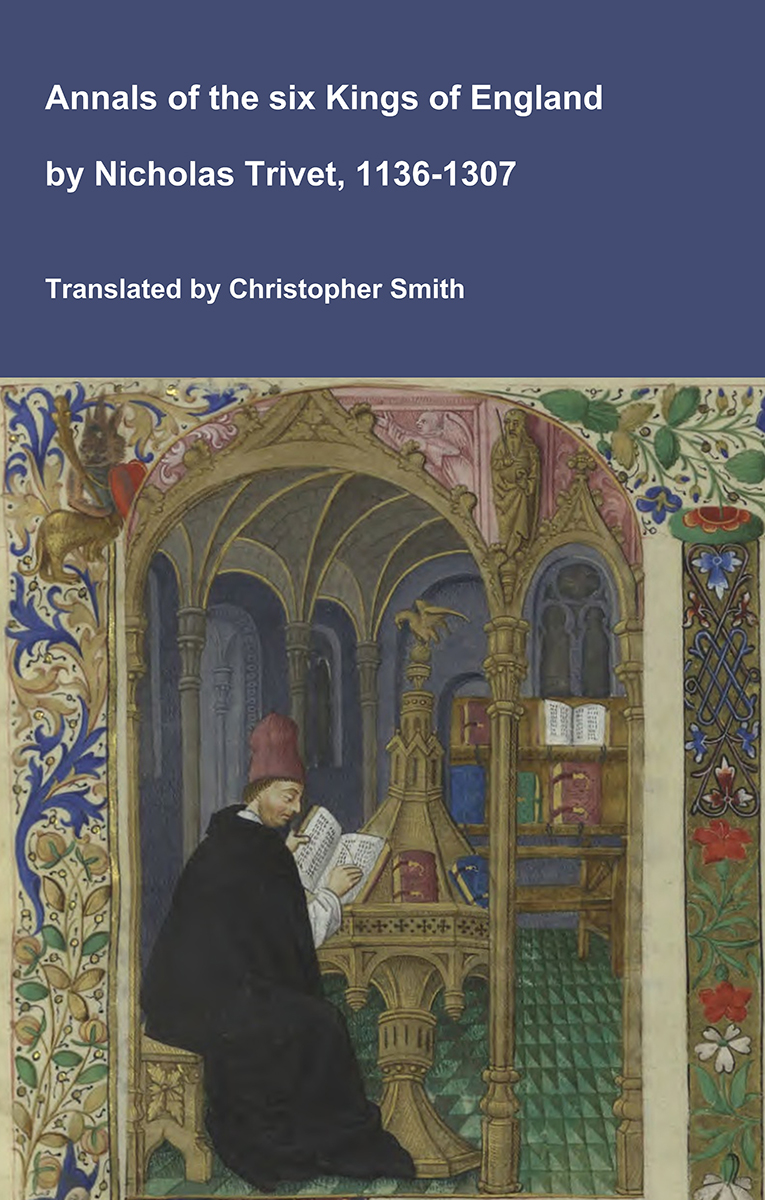
Annals of the six Kings of England by Nicholas Trivet
Translation of the Annals of the Six Kings of England by that traces the rise and rule of the Angevin aka Plantagenet dynasty from the mid-12th to early 14th century. Written by the Dominican scholar Nicholas Trivet, the work offers a vivid account of English history from the reign of King Stephen through to the death of King Edward I, blending political narrative with moral reflection. Covering the reigns of six monarchs—from Stephen to Edward I—the chronicle explores royal authority, rebellion, war, and the shifting balance between crown, church, and nobility. Trivet provides detailed insight into defining moments such as baronial conflicts, Anglo-French rivalry, and the consolidation of royal power under Edward I, whose reign he describes with particular immediacy. The Annals combines careful year-by-year reporting with thoughtful interpretation, presenting history not merely as a sequence of events but as a moral and political lesson. Ideal for readers interested in medieval history, kingship, and the origins of the English state, this chronicle remains a valuable and accessible window into the turbulent world of the Plantagenet kings.
Available at Amazon in eBook and Paperback format.
 John Evelyn's Diary February 1657
 John Evelyn's Diary April 1657
 John Evelyn's Diary June 1657
 John Evelyn's Diary July 1657
 John Evelyn's Diary September 1657
 John Evelyn's Diary November 1657
 John Evelyn's Diary December 1657
John Evelyn's Diary 1657 is in John Evelyn's Diary 1650s.
1st January 1657. Having prayed with my family, and celebrated the anniversary, I spent some time in imploring God's blessing the year I was entered into.
7th January 1657. Came Mr. Matthew Wren [aged 28] (since secretary to the Duke [aged 23]), slain in the Dutch war, eldest son to the Bishop of Ely [aged 71], now a prisoner in the Tower [Map]; a most worthy and honored gentleman.


10th January 1657. Came Dr. Joyliffe [aged 36], that famous physician and anatomist, first detector of the lymphatic veins; also the old Marquis of Argyle [aged 49], and another Scotch Earl.
5th February 1657. Dined at the Holland Ambassador's; he told me the East India Company of Holland had constantly a stock of £400,000 in India, and forty-eight men-of-war there: he spoke of their exact and just keeping their books and correspondence, so as no adventurer's stock could possibly be lost, or defeated; that it was a vulgar error that the Hollanders furnished their enemies with powder and ammunition for their money, though engaged in a cruel war, but that they used to merchandise indifferently, and were permitted to sell to the friends of their enemies. He laughed at our Committee of Trade, as composed of men wholly ignorant of it, and how they were the ruin of commerce, by gratifying some for private ends.

10th February 1657. I went to visit the governor of Havannah, a brave, sober, valiant Spanish gentleman, taken by Captain Young, of Deptford, when, after twenty years being in the Indies, and amassing great wealth, his lady and whole family, except two sons, were burned, destroyed, and taken within sight of Spain, his eldest son, daughter, and wife, perishing with immense treasure. One son, of about seventeen years old, with his brother of one year old, were the only ones saved. The young gentleman, about seventeen, was a well-complexioned youth, not olive-colored; he spoke Latin handsomely, was extremely well-bred, and born in the Caraccas, 1,000 miles south of the equinoctial, near the mountains of Potosi; he had never been in Europe before. The Governor was an ancient gentleman of great courage, of the order of St. Jago, sorely wounded in his arm, and his ribs broken; he lost for his own share £100,000 sterling, which he seemed to bear with exceeding indifference, and nothing dejected. After some discourse, I went with them to Arundel House [Map], where they dined. They were now going back into Spain, having obtained their liberty from Cromwell [aged 57]. An example of human vicissitude!
14th February 1657. To London, where I found Mrs. Cary; next day came Mr. Mordaunt [aged 30] (since Viscount Mordaunt), younger son to the Countess of Peterborough [aged 54], to see his mistress, bringing with him two of my Lord of Dover's [aged 77] daughters: so, after dinner, they all departed.
5th March 1657. Dr. Rand, a learned physician, dedicated to me his version of Gassendi's "Vita Peiriskii"..
25th March 1657. Dr. Taylor [aged 44] showed me his MS. of "Cases of Conscience", or "Ductor Dubitantium", now fitted for the press.
25th March 1657. The Protector Oliver [aged 57], now affecting kingship, is petitioned to take the title on him by all his newly-made sycophant lords, etc.; but dares not, for fear of the fanatics, not thoroughly purged out of his rebel army.
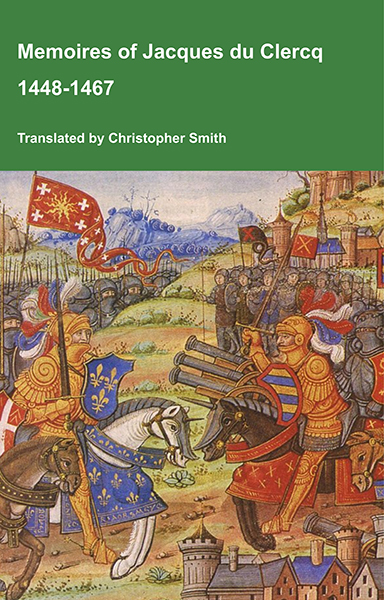
This is a translation of the 'Memoires of Jacques du Clercq', published in 1823 in two volumes, edited by Frederic, Baron de Reissenberg. In his introduction Reissenberg writes: 'Jacques du Clercq tells us that he was born in 1424, and that he was a licentiate in law and a counsellor to Philip the Good, Duke of Burgundy, in the castellany of Douai, Lille, and Orchies. It appears that he established his residence at Arras. In 1446, he married the daughter of Baldwin de la Lacherie, a gentleman who lived in Lille. We read in the fifth book of his Memoirs that his father, also named Jacques du Clercq, had married a lady of the Le Camelin family, from Compiègne. His ancestors, always attached to the counts of Flanders, had constantly served them, whether in their councils or in their armies.' The Memoires cover a period of nineteen years beginning in in 1448, ending in in 1467. It appears that the author had intended to extend the Memoirs beyond that date; no doubt illness or death prevented him from carrying out this plan. As Reissenberg writes the 'merit of this work lies in the simplicity of its narrative, in its tone of good faith, and in a certain air of frankness which naturally wins the reader’s confidence.' Du Clercq ranges from events of national and international importance, including events of the Wars of the Roses in England, to simple, everyday local events such as marriages, robberies, murders, trials and deaths, including that of his own father in Book 5; one of his last entries.
Available at Amazon in eBook and Paperback format.

21st April 1657. Came Sir Thomas Hanmer [aged 45], of Hamner, in Wales, to see me. I then waited on my Lord Hatton [aged 51], with whom I dined: at my return, I stepped into Bedlam, where I saw several poor, miserable creatures in chains; one of them was mad with making verses. I also visited the Charter House [Map], formerly belonging to the Carthusians, now an old, neat, fresh, solitary college for decayed gentlemen. It has a grove, bowling green, garden, chapel, and a hall where they eat in common. I likewise saw Christ Church and Hospital, a very good Gothic building; the hall, school, and lodgings in great order for bringing up many hundreds of poor children of both sexes; it is an exemplary charity. There is a large picture at one end of the hall, representing the governors, founders, and the institution.
25th April 1657. I had a dangerous fall out of the coach in Covent Garden [Map], going to my brother's [aged 39], but without harm; the Lord be praised!
1st May 1657. Divers soldiers were quartered at my house; but I thank God went away the next day toward Flanders.
5th May 1657. I went with my cousin, George Tuke, to see Baynard, in Surrey, a house of my brother Richard's [aged 34], which he would have hired. This is a very fair, noble residence, built in a park, and having one of the goodliest avenues of oaks up to it that ever I saw: there is a pond of 60 acres near it; the windows of the chief rooms are of very fine painted glass. The situation is excessively dirty and melancholy.
15th May 1657. Lawrence, President of Oliver's Council, and some other of his Court-Lords, came in the afternoon to see my garden and plantations.
7th June 1657. My fourth son was born, christened George (after my grandfather); Dr. Jeremy Taylor [aged 44] officiated in the drawing-room.
18th June 1657. At Greenwich, Kent [Map] I saw a sort of cat brought from the East Indies, shaped and snouted much like the Egyptian racoon, in the body like a monkey, and so footed; the ears and tail like a cat, only the tail much longer, and the skin variously ringed with black and white; with the tail it wound up its body like a serpent, and so got up into trees, and with it would wrap its whole body round. Its hair was woolly like a lamb; it was exceedingly nimble, gentle, and purred as does the cat.
16th July 1657. On Dr. Jeremy Taylor's [aged 44] recommendation, I went to Eltham, Greenwich, to help one Moody, a young man, to that living, by my interest with the patron.
6th August 1657. I went to see Colonel Blount [aged 53], who showed me the application of the waywiser to a coach, exactly measuring the miles, and showing them by an index as we went on. It had three circles, one pointing to the number of rods, another to the miles, by 10 to 1,000, with all the subdivisions of quarters; very pretty and useful.
10th August 1657. Our vicar, from John xviii. 36, declaimed against the folly of a sort of enthusiasts and desperate zealots, called the Fifth-Monarchy-Men, pretending to set up the kingdom of Christ with the sword. To this pass was this age arrived when we had no King in Israel.
21st August 1657. Fell a most prodigious rain in London, and the year was very sickly in the country.
The History of William Marshal was commissioned by his son shortly after William’s death in 1219 to celebrate the Marshal’s remarkable life; it is an authentic, contemporary voice. The manuscript was discovered in 1861 by French historian Paul Meyer. Meyer published the manuscript in its original Anglo-French in 1891 in two books. This book is a line by line translation of the first of Meyer’s books; lines 1-10152. Book 1 of the History begins in 1139 and ends in 1194. It describes the events of the Anarchy, the role of William’s father John, John’s marriages, William’s childhood, his role as a hostage at the siege of Newbury, his injury and imprisonment in Poitou where he met Eleanor of Aquitaine and his life as a knight errant. It continues with the accusation against him of an improper relationship with Margaret, wife of Henry the Young King, his exile, and return, the death of Henry the Young King, the rebellion of Richard, the future King Richard I, war with France, the death of King Henry II, and the capture of King Richard, and the rebellion of John, the future King John. It ends with the release of King Richard and the death of John Marshal.
Available at Amazon in eBook and Paperback format.
1st September 1657. I visited Sir Edmund Bowyer, at his melancholy seat at Camberwell, Surrey [Map]. He has a very pretty grove of oaks, and hedges of yew in his garden, and a handsome row of tall elms before his court.
15th September 1657. Going to London with some company, we stepped in to see a famous rope-dancer, called THE TURK. I saw even to astonishment the agility with which he performed. He walked barefooted, taking hold by his toes only of a rope almost perpendicular, and without so much as touching it with his hands; he danced blind-fold on the high rope, and with a boy of twelve years old tied to one of his feet about twenty feet beneath him, dangling as he danced, yet he moved as nimbly as if it had been but a feather. Lastly, he stood on his head, on the top of a very high mast, danced on a small rope that was very slack, and finally flew down the perpendicular, on his breast, his head foremost, his legs and arms extended, with divers other activities.-I saw the hairy woman, twenty years old, whom I had before seen when a child. She was born at Augsburg, in Germany. Her very eyebrows were combed upward, and all her forehead as thick and even as grows on any woman's head, neatly dressed; a very long lock of hair out of each ear; she had also a most prolix beard, and moustachios, with long locks growing on the middle of her nose, like an Iceland dog exactly, the color of a bright brown, fine as well-dressed flax. She was now married, and told me she had one child that was not hairy, nor were any of her parents, or relations. She was very well shaped, and played well on the harpsichord.
17th September 1657. To see Sir Robert Needham, at Lambeth, Surrey [Map], a relation of mine; and thence to John Tradescant's museum, in which the chiefest rarities were, in my opinion, the ancient Roman, Indian, and other nations' armour, shields, and weapons; some habits of curiously-colored and wrought feathers, one from the phœnix wing, as tradition goes. Other innumerable things there were printed in his catalogue by Mr. Ashmole [aged 40], to whom after the death of the widow they are bequeathed, and by him designed as a gift to Oxford [Map].


19th October 1657. I went to see divers gardens about London: returning, I saw at Dr. Joyliffe's [aged 36] two Virginian rattlesnakes alive, exceeding a yard in length, small heads, slender tails, but in the middle nearly the size of my leg; when vexed, swiftly vibrating and shaking their tails, as loud as a child's rattle; this, by the collision of certain gristly skins curiously jointed, yet loose, and transparent as parchment, by which they give warning; a providential caution for other creatures to avoid them. The Doctor tried their biting on rats and mice, which they immediately killed: but their vigor must needs be much exhausted here, in another climate, and kept only in a barrel of bran.
22nd October 1657. To town, to visit the Holland Ambassador, with whom I had now contracted much friendly correspondence, useful to the intelligence I constantly gave his Majesty [aged 27] abroad.
26th November 1657. I went to London, to a court of the East India Company on its new union, in Merchant-Taylors' Hall, where was much disorder by reason of the Anabaptists, who would have the adventurers obliged only by an engagement, without swearing, that they still might pursue their private trade; but it was carried against them. Wednesday was fixed on for a general court for election of officers, after a sermon and prayers for good success. The Stock resolved on was £800,000.
27th November 1657. I took the oath at the East India House, subscribing £500.
2nd December 1657. Dr. Raynolds [aged 58] (since Bishop of Norwich) preached before the company at St. Andrew Under-shaft [Map], on Nehemiah xiii. 31, showing, by the example of Nehemiah, all the perfections of a trusty person in public affairs, with many good precepts apposite to the occasion, ending with a prayer for God's blessing on the company and the undertaking.

3rd December 1657. Mr. Gunning [aged 43] preached on John iii. 3, against the Anabaptists, showing the effect and necessity of the sacrament of baptism. This sect was now wonderfully spread.
25th December 1657. I went to London with my wife [aged 22], to celebrate Christmas-day, Mr. Gunning [aged 43] preaching in Exeter chapel [Map], on Micah vii. 2. Sermon ended, as he was giving us the Holy Sacrament, the chapel was surrounded with soldiers, and all the communicants and assembly surprised and kept prisoners by them, some in the house, others carried away. It fell to my share to be confined to a room in the house, where yet I was permitted to dine with the master of it, the Countess of Dorset [aged 35], Baroness Hatton [aged 45], and some others of quality who invited me. In the afternoon, came Colonel Whalley, Goffe, and others, from Whitehall [Map], to examine us one by one; some they committed to the marshal [Map], some to prison. When I came before them, they took my name and abode, examined me why, contrary to the ordinance made, that none should any longer observe the superstitious time of the nativity (so esteemed by them), I durst offend, and particularly be at common prayers, which they told me was but the mass in English, and particularly pray for Charles Stuart [aged 27]; for which we had no Scripture. I told them we did not pray for Charles Stuart, but for all Christian kings, princes, and governors. They replied, in so doing we prayed for the king of Spain, too, who was their enemy and a Papist, with other frivolous and ensnaring questions, and much threatening; and, finding no color to detain me, they dismissed me with much pity of my ignorance. These were men of high flight and above ordinances, and spoke spiteful things of our Lord's nativity. As we went up to receive the Sacrament, the miscreants held their muskets against us, as if they would have shot us at the altar; but yet suffering us to finish the office of Communion, as perhaps not having instructions what to do, in case they found us in that action. So I got home late the next day; blessed be God!

