

Abbot John Whethamstede’s Chronicle of the Abbey of St Albans
Abbot John Whethamstede's Register aka Chronicle of his second term at the Abbey of St Albans, 1451-1461, is a remarkable text that describes his first-hand experience of the beginning of the Wars of the Roses including the First and Second Battles of St Albans, 1455 and 1461, respectively, their cause, and their consequences, not least on the Abbey itself. His text also includes Loveday, Blore Heath, Northampton, the Act of Accord, Wakefield, and Towton, and ends with the Coronation of King Edward IV. In addition to the events of the Wars of the Roses, Abbot John, or his scribes who wrote the Chronicle, include details in the life of the Abbey such as charters, letters, land exchanges, visits by legates, and disputes, which provide a rich insight into the day-to-day life of the Abbey, and the challenges faced by its Abbot.
Available at Amazon in eBook and Paperback format.
 John Evelyn's Diary January 1661
 John Evelyn's Diary February 1661
 John Evelyn's Diary March 1661
 John Evelyn's Diary April 1661
 John Evelyn's Diary May 1661
 John Evelyn's Diary July 1661
 John Evelyn's Diary August 1661
 John Evelyn's Diary October 1661
 John Evelyn's Diary November 1661
 John Evelyn's Diary December 1661
John Evelyn's Diary 1661 is in John Evelyn's Diary 1660s.
2nd January 1661. The Queen-Mother [aged 51], with the Princess Henrietta [aged 16], began her journey to Portsmouth, Hampshire [Map], in order to her return into France.


5th January 1661. I visited my Lord Chancellor Clarendon [aged 51], with whom I had been well acquainted abroad.


6th January 1661. Dr. Allestree [aged 39] preached at the Abbey [Map], after which four Bishops were consecrated, Hereford [aged 51], Norwich [aged 61], ...
6th January 1661. This night was suppressed a bloody insurrection of some Fifth-Monarchy enthusiasts. Some of them were examined at the Council the next day; but could say nothing to extenuate their madness and unwarrantable zeal.
6th January 1661. I was now chosen (and nominated by his Majesty [aged 30] for one of the Council), by suffrage of the rest of the members, a Fellow of the Philosophic Society now meeting at Gresham College, where was an assembly of divers learned gentlemen. This being the first meeting since the King's return; but it had been begun some years before at Oxford, and was continued with interruption here in London during the Rebellion.
6th January 1661. There was another rising of the fanatics, in which some were slain.
16th January 1661. I went to the Philosophic Club, where was examined the Torricellian experiment. I presented my Circle of Mechanical Trades, and had recommended to me the publishing what I had written of Chalcography.
25th January 1661. After divers years since I had seen any play, I went to see acted "The Scornful Lady", at a new theater in Lincoln's-Inn Fields.
30th January 1661. Was the first solemn fast and day of humiliation to deplore the sins which had so long provoked God against this afflicted church and people, ordered by Parliament to be annually celebrated to expiate the guilt of the execrable murder of the late King.
30th January 1661. This day (Oh, the stupendous and inscrutable judgments of God!) were the carcasses of those arch-rebels, Cromwell, Bradshawe (the judge who condemned his Majesty), and Ireton (son-in-law to the Usurper), dragged out of their superb tombs in Westminster [Map] among the Kings, to Tyburn [Map], and hanged on the gallows there from nine in the morning till six at night, and then buried under that fatal and ignominious monument in a deep pit; thousands of people who had seen them in all their pride being spectators. Look back at October 22 1658, and be astonished! and fear God and honour the King [aged 30]; but meddle not with them who are given to change!


6th February 1661. To London, to our Society, where I gave notice of the visit of the Danish Ambassador-Extraordinary, and was ordered to return him their acceptance of that honor, and to invite him the next meeting day.
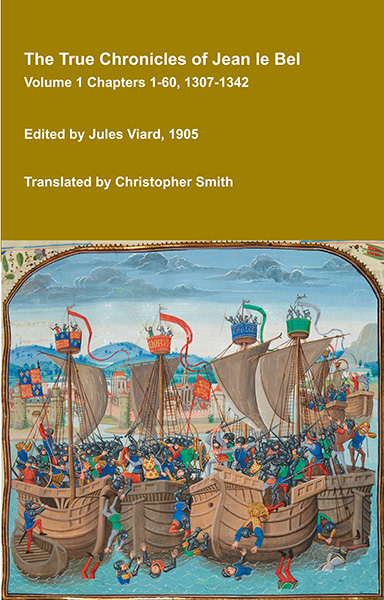
The True Chronicles of Jean le Bel Volume 1 Chapters 1-60 1307-1342
The True Chronicles of Jean le Bel offer one of the most vivid and immediate accounts of 14th-century Europe, written by a knight who lived through the events he describes, and experienced some of them first hand. Covering the early decades of the Hundred Years’ War, this remarkable chronicle follows the campaigns of Edward III of England, the politics of France and the Low Countries, and the shifting alliances that shaped medieval warfare. Unlike later historians, Jean le Bel writes with a strong sense of eyewitness authenticity, drawing on personal experience and the testimony of fellow soldiers. His narrative captures not only battles and sieges, but also the realities of military life, diplomacy, and the ideals of chivalry that governed noble society. A key source for Jean Froissart, Le Bel’s chronicle stands on its own as a compelling and insightful work, at once historical record and literary achievement. This translation builds on the 1905 edition published in French by Jules Viard, adding extensive translations from other sources Rymer's Fœdera, the Chronicles of Adam Murimuth, William Nangis, Walter of Guisborough, a Bourgeois of Valenciennes, Geoffrey le Baker of Swinbroke and Richard Lescot to enrich the original text and Viard's notes.
Available at Amazon in eBook and Paperback format.
10th February 1661. Dr. Baldero preached at Ely-house, on Matthew vi. 33, of seeking early the Kingdom of God; after sermon, the Bishop [aged 75] (Dr. Wren) gave us the blessing, very pontifically.
13th February 1661. I conducted the Danish Ambassador to our meeting at Gresham College, where were shown him various experiments in vacuo, and other curiosities.
21st February 1661. Prince Rupert [aged 41] first showed me how to grave in mezzo tinto.


26th February 1661. I went to Lord Mordaunt's [aged 34], at Parson's Green.
27th February 1661. Ash Wednesday. Preached before the King [aged 30] the Bishop of London (Dr. Sheldon [aged 62]) on Matthew xviii. 25, concerning charity and forgiveness.
8th March 1661. I went to my Lord Chancellor's [aged 52], and delivered to him the state of my concernment at Sayes Court [Map].

9th March 1661. I went with that excellent person and philosopher, Sir Robert Murray [aged 53], to visit Mr. Boyle [aged 34] at Chelsea, and saw divers effects of the eolipile for weighing air.
13th March 1661. I went to Lambeth, with Sir R. Browne's [aged 56] pretense to the Wardenship of Merton College, Oxford, to which, as having been about forty years before a student of that house, he was elected by the votes of every Fellow except one; but the statutes of the house being so that, unless every Fellow agree, the election devolves to the Visitor, who is the Archbishop of Canterbury (Dr. Juxon [aged 79]), his Grace gave his nomination to Sir T. Clayton, resident there, and the Physic Professor: for which I was not at all displeased, because, though Sir Richard missed it by much ingratitude and wrong of the Archbishop (Clayton being no Fellow), yet it would have hindered Sir Richard from attending at Court to settle his greater concerns, and so have prejudiced me, though he was much inclined to have passed his time in a collegiate life, very unfit for him at that time, for many reasons. So I took leave of his Grace, who was formerly Lord Treasurer in the reign of Charles I.
13th March 1661. This afternoon, Prince Rupert [aged 41] showed me, with his own hands, the new way of graving, called mezzo tinto, which afterward, by his permission, I published in my "History of Chalcography"; this set so many artists on work, that they soon arrived to the perfection it is since come to, emulating the tenderest miniatures.
13th March 1661. Our Society now gave in my relation of the Peak of Teneriffe, in the Great Canaries, to be added to more queries concerning divers natural things reported of that island.
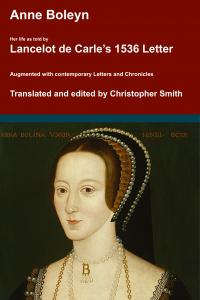
Anne Boleyn. Her Life as told by Lancelot de Carle's 1536 Letter.
In 1536, two weeks after the execution of Anne Boleyn, her brother George and four others, Lancelot du Carle, wrote an extraordinary letter that described Anne's life, and her trial and execution, to which he was a witness. This book presents a new translation of that letter, with additional material from other contemporary sources such as Letters, Hall's and Wriothesley's Chronicles, the pamphlets of Wynkyn the Worde, the Memorial of George Constantyne, the Portuguese Letter and the Baga de Secrets, all of which are provided in Appendices.
Available at Amazon in eBook and Paperback format.
13th March 1661. I returned home with my Cousin, Tuke, now going for France, as sent by his Majesty [aged 30] to condole the death of that great Minister and politician, Count Mazarine [deceased].
31st March 1661. This night, his Majesty [aged 30] promised to make my wife [aged 26] Lady of the Jewels (a very honorable charge) to the future Queen (but which he never performed).
19th April 1661. To London, and saw the bathing and rest of the ceremonies of the Knights of the Bath, preparatory to the coronation; it was in the Painted Chamber [Map], Westminster. I might have received this honor; but declined it. The rest of the ceremony was in the chapel at Whitehall, when their swords being laid on the altar, the Bishop delivered them.
22nd April 1661. Was the splendid cavalcade of his Majesty [aged 30] from the Tower of London to Whitehall, when I saw him in the Banqueting House, Whitehall Palace [Map] create six Earls, and as many Barons, viz:
Edward Lord Hyde, Lord Chancellor [aged 52], Earl of Clarendon; supported by the Earls of Northumberland [aged 58] and Sussex [aged 14]; the Earl of Bedford [aged 44] carried the cap and coronet, the Earl of Warwick [aged 46], the sword, the Earl of Newport [aged 64], the mantle.
Next, was Capel, created Earl of Essex.
Brudenell, Cardigan;.
Valentia, Anglesea;.
Greenvill, Bath;.
Howard, Earl of Carlisle.
The Barons were: Denzille Holles; Cornwallis; Booth; Townsend; Cooper; Crew; who were led up by several Peers, with Garter and officers of arms before them; when, after obedience on their several approaches to the throne, their patents were presented by Garter King-at-Arms, which being received by the Lord Chamberlain [aged 59], and delivered to his Majesty, and by him to the Secretary of State, were read, and then again delivered to his Majesty, and by him to the several Lords created; they were then robed, their coronets and collars put on by his Majesty, and they were placed in rank on both sides of the state and throne; but the Barons put off their caps and circles, and held them in their hands, the Earls keeping on their coronets, as cousins to the King.
I spent the rest of the evening in seeing the several archtriumphals built in the streets at several eminent places through which his Majesty was next day to pass, some of which, though temporary, and to stand but one year, were of good invention and architecture, with inscriptions.
Notes:
Arthur Capell 1st Earl Essex [aged 29] was created 1st Earl Essex. Elizabeth Percy Countess Essex [aged 25] by marriage Countess Essex.
Thomas Brudenell 1st Earl Cardigan [aged 78] was created 1st Earl Cardigan. Mary Tresham Countess Cardigan by marriage Countess Cardigan.
Arthur Annesley 1st Earl Annesley [aged 46] was created 1st Earl Anglesey, 1st Baron Annesley Newport Pagnell Buckinghamshire. Elizabeth Altham Countess Anglesey [aged 41] by marriage Countess Anglesey.
John Granville 1st Earl Bath [aged 32] was created 1st Earl Bath, 1st Baron Granville of Kilkhampton and Biddeford.
Charles Howard 1st Earl Carlisle [aged 32] was created 1st Earl Carlisle.
Denzil Holles 1st Baron Holles [aged 61] was created 1st Baron Holles. Jane Shirley Baroness Holles by marriage Baroness Holles.
Frederick Cornwallis 1st Baron Cornwallis [aged 50] was created 1st Baron Cornwallis.
George Booth 1st Baron Delamer [aged 38] was created 1st Baron Delamer. Elizabeth Grey Baroness Delamer [aged 39] by marriage Baroness Delamer.
Horatio Townshend 1st Viscount Townsend [aged 30] was created 1st Baron Townshend of Lynn Regis in Norfolk.
Anthony Ashley-Cooper 1st Earl Shaftesbury [aged 39] was created 1st Baron Ashley of Wimborne St Giles.
23rd April 1661. Was the coronation of his Majesty [aged 30] Charles II in the Abbey-Church of Westminster [Map]; at all which ceremony I was present. the King and his Nobility went to the Tower [Map], I accompanying my Lord Viscount Mordaunt [aged 34] part of the way; this was on Sunday, the 22d; but indeed his Majesty went not till early this morning, and proceeded from thence to Westminster in this order:
23rd April 1661. First went the Duke of York's Horse Guards. Messengers of the Chamber. 136 Esquires to the Knights of the Bath, each of whom had two, most richly habited. The Knight Harbinger. Sergeant Porter. Sewers of the Chamber. Quarter Waiters. Six Clerks of Chancery. Clerk of the Signet. Clerk of the Privy Seal. Clerks of the Council, of the Parliament, and of the Crown. Chaplains in ordinary having dignities, 10. King's Advocates and Remembrancer. Council at Law. Masters of the Chancery. Puisne Sergeants. King's Attorney and Solicitor. King's eldest Sergeant. Secretaries of the French and Latin tongue. Gentlemen Ushers. Daily Waiters, Sewers, Carvers, and Cupbearers in ordinary. Esquires of the body, 4. Masters of standing offices, being no Counsellors, viz, of the Tents, Revels, Ceremonies, Armory, Wardrobe, Ordnance, Requests. Chamberlain of the Exchequer. Barons of the Exchequer. Judges. Lord Chief-Baron. Lord Chief-Justice of the Common Pleas. Master of the Rolls. Lord Chief-Justice of England. Trumpets. Gentlemen of the Privy Chamber. Knights of the Bath, 68, in crimson robes, exceeding rich, and the noblest show of the whole cavalcade, his Majesty [aged 30] excepted. Knight Marshal. Treasurer of the Chamber. Master of the Jewels. Lords of the Privy Council. Comptroller of the Household. Treasurer of the Household. Trumpets. Sergeant Trumpet. Two Pursuivants at Arms. Barons. Two Pursuivants at Arms. Viscounts. Two Heralds. Earls. Lord Chamberlain of the Household [aged 59]. Two Heralds. Marquises. Dukes. Heralds Clarencieux and Norroy. Lord Chancellor [aged 52]. Lord High Steward of England. Two persons representing the Dukes of Normandy and Acquitaine, viz, Sir Richard Fanshawe and Sir Herbert Price, in fantastic habits of the time. Gentlemen Ushers. Garter. Lord Mayor of London. The Duke of York alone (the rest by twos). Lord High Constable of England. Lord Great Chamberlain of England. The sword borne by the Earl Marshal of England. the King, in royal robes and equipage. Afterward, followed equerries, footmen, gentlemen pensioners. Master of the Horse, leading a horse richly caparisoned. Vice-Chamberlain. Captain of the Pensioners. Captain of the Guard. The Guard. The Horse Guard. The troop of Volunteers, with many other officers and gentlemen.

23rd April 1661. This magnificent train on horseback, as rich as embroidery, velvet, cloth of gold and silver, and jewels, could make them and their prancing horses, proceeded through the streets strewed with flowers, houses hung with rich tapestry, windows and balconies full of ladies; the London militia lining the ways, and the several companies, with their banners and loud music, ranked in their orders; the fountains running wine, bells ringing, with speeches made at the several triumphal arches; at that of the Temple Bar (near which I stood) the Lord Mayor was received by the Bailiff of Westminster, who, in a scarlet robe, made a speech. Thence, with joyful acclamations, his Majesty [aged 30] passed to Whitehall. Bonfires at night.
23rd April 1661. The next day, being St. George's, he went by water to Westminster Abbey [Map]. When his Majesty [aged 30] was entered, the Dean and Prebendaries brought all the regalia, and delivered them to several noblemen to bear before the King, who met them at the west door of the church, singing an anthem, to the choir. Then, came the Peers, in their robes, and coronets in their hands, till his Majesty was placed on a throne elevated before the altar. Afterward, the Bishop of London (the Archbishop of Canterbury [aged 79] being sick) went to every side of the throne to present the King to the people, asking if they would have him for their King, and do him homage; at this, they shouted four times "God save King Charles II!" Then, an anthem was sung. His Majesty, attended by three Bishops, went up to the altar, and he offered a pall and a pound of gold. Afterward, he sat down in another chair during the sermon, which was preached by Dr. Morley [aged 63], Bishop of Worcester.
23rd April 1661. After sermon, the King [aged 30] took his oath before the altar to maintain the religion, Magna Charta, and laws of the land. The hymn Véni S. Sp. followed, and then the Litany by two Bishops. Then the Archbishop of Canterbury [aged 79], present, but much indisposed and weak, said "Lift up your hearts"; at which, the King rose up, and put off his robes and upper garments, and was in a waistcoat so opened in divers places, that the Archbishop might commodiously anoint him, first in the palms of his hands, when an anthem was sung, and a prayer read; then, his breast and between the shoulders, bending of both arms; and, lastly, on the crown of the head, with apposite hymns and prayers at each anointing; this done, the Dean closed and buttoned up the waistcoat. After which, was a coif put on, and the cobbium, sindon or dalmatic, and over this a super-tunic of cloth of gold, with buskins and sandals of the same, spurs, and the sword; a prayer being first said over it by the Archbishop on the altar, before it was girt on by the Lord Chamberlain [aged 59]. Then, the armill, mantle, etc. Then, the Archbishop placed the crown imperial on the altar, prayed over it, and set it on his Majesty's head, at which all the Peers put on their coronets. Anthems, and rare music, with lutes, viols, trumpets, organs, and voices, were then heard, and the Archbishop put a ring on his Majesty's finger. the King next offered his sword on the altar, which being redeemed, was drawn, and borne before him. Then, the Archbishop delivered him the sceptre, with the dove in one hand, and, in the other, the sceptre with the globe. the King kneeling, the Archbishop pronounced the blessing. His Majesty then ascending again his royal throne, while Te Deum was singing, all the Peers did their homage, by every one touching his crown. The Archbishop, and the rest of the Bishops, first kissing the King; who received the Holy Sacrament, and so disrobed, yet with the crown imperial on his head, and accompanied with all the nobility in the former order, he went on foot upon blue cloth, which was spread and reached from the west door of the Abbey [Map] to Westminster stairs, when he took water in a triumphal barge to Whitehall where was extraordinary feasting.
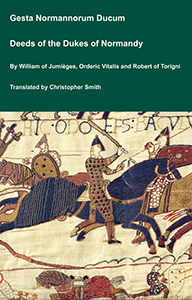
The Deeds of the Dukes of Normandy
The Gesta Normannorum Ducum [The Deeds of the Dukes of Normandy] is a landmark medieval chronicle tracing the rise and fall of the Norman dynasty from its early roots through the pivotal events surrounding the Norman Conquest of England. Originally penned in Latin by the monk William of Jumièges shortly before 1060 and later expanded at the behest of William the Conqueror, the work chronicles the deeds, politics, battles, and leadership of the Norman dukes, especially William’s own claim to the English throne. The narrative combines earlier historical sources with firsthand information and oral testimony to present an authoritative account of Normandy’s transformation from a Viking settlement into one of medieval Europe’s most powerful realms. William’s history emphasizes the legitimacy, military prowess, and governance of the Norman line, framing their expansion, including the conquest of England, as both divinely sanctioned and noble in purpose. Later chroniclers such as Orderic Vitalis and Robert of Torigni continued the history, extending the coverage into the 12th century, providing broader context on ducal rule and its impact. Today this classic work remains a foundational source for understanding Norman identity, medieval statesmanship, and the historical forces that reshaped England and Western Europe between 800AD and 1100AD.
Available at Amazon in eBook and Paperback format.
24th April 1661. I presented his Majesty [aged 30] with his "Panegyric" in the Privy Chamber, which he was pleased to accept most graciously; I gave copies to the Lord Chancellor [aged 52], and most of the noblemen who came to me for it. I dined at the Marquis of Ormond's [aged 50] where was a magnificent feast, and many great persons.


2nd May 1661. I had audience of my Lord Chancellor [aged 52] about my title to Sayes Court [Map].
3rd May 1661. I went to see the wonderful engine for weaving silk stockings, said to have been the invention of an Oxford scholar forty years since; and I returned by Fromantil's, the famous clockmaker, to see some pendules, Monsieur Zulichem being with us.
3rd May 1661. This evening, I was with my Lord Brouncker [aged 50], Sir Robert Murray [aged 53], Sir Patrick Neill, Monsieur Zulichem, and Bull (all of them of our Society, and excellent mathematicians), to show his Majesty [aged 30], who was present, Saturn's annulus, as some thought, but as Zulichem affirmed with his balteus (as that learned gentleman had published), very near eclipsed by the moon, near the Mons Porphyritis; also, Jupiter and satellites, through his Majesty's great telescope, drawing thirty-five feet; on which were divers discourses.
8th May 1661. His Majesty [aged 30] rode in state, with his imperial crown on, and all the peers in their robes, in great pomp to the Parliament now newly chosen (the old one being dissolved); and, that evening, declared in council his intention to marry the Infanta of Portugal [aged 22].
9th May 1661. At Sir Robert Murray's [aged 53], where I met Dr. Wallis, Professor of Geometry in Oxford, where was discourse of several mathematical subjects.
11th May 1661. my wife [aged 26] presented to his Majesty [aged 30] the Madonna she had copied in miniature from P. Oliver's painting, after Raphael, which she wrought with extraordinary pains and judgment. the King was infinitely pleased with it, and caused it to be placed in his cabinet among his best paintings.
13th May 1661. I heard and saw such exercises at the election of scholars at Westminster School [Map] to be sent to the University in Latin, Greek, Hebrew, and Arabic, in themes and extemporary verses, as wonderfully astonished me in such youths, with such readiness and wit, some of them not above twelve or thirteen years of age. Pity it is, that what they attain here so ripely, they either do not retain, or do not improve more considerably when they come to be men, though many of them do; and no less is to be blamed their odd pronouncing of Latin, so that out of England none were able to understand, or endure it. The examinants, or posers, were, Dr. Duport, Greek Professor at Cambridge; Dr. Fell, Dean of Christ Church, Oxford; Dr. Pierson; Dr. Allestree [aged 39], Dean of Westminster Abbey, and any that would.
16th May 1661. I dined with Mr. Garmus, the Resident from Hamburg, who continued his feast near nine whole hours, according to the custom of his country, though there was no great excess of drinking, no man being obliged to take more than he liked.
22nd May 1661. The Scotch Covenant was burnt by the common hangman in divers places in London. Oh, prodigious change!
29th May 1661. This was the first anniversary appointed by act of Parliament to be observed as a day of general thanksgiving for the miraculous restoration of his Majesty [aged 31]: our vicar preaching on Psalm cxviii. 24, requiring us to be thankful and rejoice, as indeed we had cause.
4th June 1661. Came Sir Charles Harbord [aged 21], his Majesty's [aged 31] surveyor, to take an account of what grounds I challenged at Sayes Court [Map].
27th June 1661. I saw the Portugal ambassador at dinner with his Majesty [aged 31] in state, where was excellent music.
2nd July 1661. I went to see the New Spring-Garden, at Lambeth, a prettily contrived plantation.
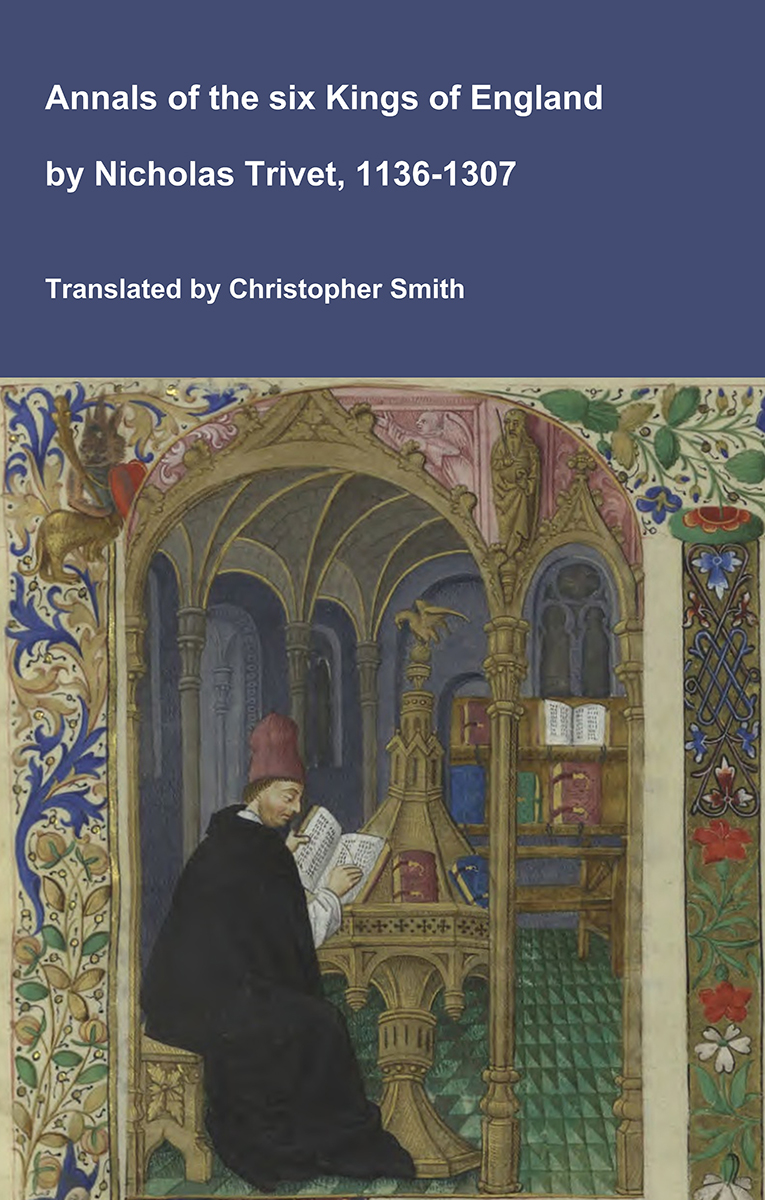
Annals of the six Kings of England by Nicholas Trivet
Translation of the Annals of the Six Kings of England by that traces the rise and rule of the Angevin aka Plantagenet dynasty from the mid-12th to early 14th century. Written by the Dominican scholar Nicholas Trivet, the work offers a vivid account of English history from the reign of King Stephen through to the death of King Edward I, blending political narrative with moral reflection. Covering the reigns of six monarchs—from Stephen to Edward I—the chronicle explores royal authority, rebellion, war, and the shifting balance between crown, church, and nobility. Trivet provides detailed insight into defining moments such as baronial conflicts, Anglo-French rivalry, and the consolidation of royal power under Edward I, whose reign he describes with particular immediacy. The Annals combines careful year-by-year reporting with thoughtful interpretation, presenting history not merely as a sequence of events but as a moral and political lesson. Ideal for readers interested in medieval history, kingship, and the origins of the English state, this chronicle remains a valuable and accessible window into the turbulent world of the Plantagenet kings.
Available at Amazon in eBook and Paperback format.
19th July 1661. We tried our Diving-Bell, or engine, in the water dock at Deptford, Kent [Map], in which our curator continued half an hour under water; it was made of cast lead, let down with a strong cable.
3rd August 1661. Came my Lord Hatton [aged 56], Comptroller of his Majesty's household to visit me.
9th August 1661. I tried several experiments on the sensitive plant and humilis, which contracted with the least touch of the sun through a burning glass, though it rises and opens only when it shines on it.
9th August 1661. I first saw the famous Queen Pine brought from Barbadoes, and presented to his Majesty [aged 31]; but the first that were ever seen in England were those sent to Cromwell four years since.
Note. An excellent print in the line manner, 13 inches by 12, was engraved, in 1823, by Robert Grave, from the picture at Strawberry-Hill, of King Charles II., receiving this species of fruit from Rose, his gardener, who is presenting it on his knees, at Dawney Court, Buckinghamshire, the seat of the celebrated Duchess of Cleveland, See hereafter, under 1668, August.
9th August 1661. I dined at Mr. Palmer's in Gray's Inn, whose curiosity excelled in clocks and pendules, especially one that had innumerable motions, and played nine or ten tunes on the bells very finely, some of them set in parts: which was very harmonious. It was wound up but once in a quarter. He had also good telescopes and mathematical instruments, choice pictures, and other curiosities. Thence, we went to that famous mountebank, Jo. Punteus.

9th August 1661. Sir Kenelm Digby [aged 58] presented every one of us his "Discourse of the Vegetation of Plants"; and Mr. Henshaw [aged 43], his "History of Saltpeter and Gunpowder". I assisted him to procure his place of French Secretary to the King [aged 31], which he purchased of Sir Henry De Vic [aged 62].
9th August 1661. I went to that famous physician, Sir Fr. Prujean [aged 68], who showed me his laboratory, his workhouse for turning, and other mechanics; also many excellent pictures, especially the Magdalen of Caracci; and some incomparable paysages done in distemper; he played to me likewise on the polythore, an instrument having something of the harp, lute, and theorbo; by none known in England, nor described by any author, nor used, but by this skillful and learned Doctor.
15th August 1661. I went to Tunbridge Wells, Kent [Map], my wife [aged 26] being there for the benefit of her health. Walking about the solitudes, I greatly admired the extravagant turnings, insinuations, and growth of certain birch trees among the rocks.
13th September 1661. I presented my "Fumifugium"67 dedicated to his Majesty [aged 31], who was pleased that I should publish it by his special commands, being much gratified with it.
18th September 1661. This day was read our petition to his Majesty [aged 31] for his royal grant, authorizing our Society to meet as a corporation, with several privileges.
18th September 1661. An exceedingly sickly, wet autumn.
1st October 1661. I sailed this morning with his Majesty [aged 31] in one of his yachts (or pleasure boats), vessels not known among us till the Dutch East India Company presented that curious piece to the King; being very excellent sailing vessels. It was on a wager between his other new pleasure boat, built frigate-like, and one of the Duke of York's [aged 27]; the wager £100; the race from Greenwich, Kent [Map] to Gravesend, Kent [Map] and back. The King lost it going, the wind being contrary, but saved stakes in returning. There were divers noble persons and lords on board, his Majesty sometimes steering himself. His barge and kitchen boat attended. I brake fast this morning with the King at return in his smaller vessel, he being pleased to take me and only four more, who were noblemen, with him; but dined in his yacht, where we all ate together with his Majesty. In this passage he was pleased to discourse to me about my book inveighing against the nuisance of the smoke of London, and proposing expedients how, by removing those particulars I mentioned, it might be reformed; commanding me to prepare a Bill against the next session of Parliament, being, as he said, resolved to have something done in it. Then he discoursed to me of the improvement of gardens and buildings, now very rare in England comparatively to other countries. He then commanded me to draw up the matter of fact happening at the bloody encounter which then had newly happened between the French and Spanish Ambassadors near the Tower, contending for precedency, at the reception of the Swedish Ambassador; giving me orders to consult Sir William Compton [aged 36], Master of the Ordnance, to inform me of what he knew of it, and with his favorite, Sir Charles Berkeley [aged 31], captain of the Duke's life guard, then present with his troop and three foot companies; with some other reflections and instructions, to be prepared with a declaration to take off the reports which went about of his Majesty's partiality in the affairs, and of his officers' and spectators' rudeness while the conflict lasted. So I came home that night, and went next morning to London, where from the officers of the Tower [Map], Sir William Compton, Sir Charles Berkeley, and others who were attending at this meeting of the Ambassadors three days before, having collected what I could, I drew up a Narrative in vindication of his Majesty, and the carriage of his officers and standers-by.


The History of William Marshal was commissioned by his son shortly after William’s death in 1219 to celebrate the Marshal’s remarkable life; it is an authentic, contemporary voice. The manuscript was discovered in 1861 by French historian Paul Meyer. Meyer published the manuscript in its original Anglo-French in 1891 in two books. This book is a line by line translation of the first of Meyer’s books; lines 1-10152. Book 1 of the History begins in 1139 and ends in 1194. It describes the events of the Anarchy, the role of William’s father John, John’s marriages, William’s childhood, his role as a hostage at the siege of Newbury, his injury and imprisonment in Poitou where he met Eleanor of Aquitaine and his life as a knight errant. It continues with the accusation against him of an improper relationship with Margaret, wife of Henry the Young King, his exile, and return, the death of Henry the Young King, the rebellion of Richard, the future King Richard I, war with France, the death of King Henry II, and the capture of King Richard, and the rebellion of John, the future King John. It ends with the release of King Richard and the death of John Marshal.
Available at Amazon in eBook and Paperback format.
1st October 1661. On Thursday his Majesty [aged 31] sent one of the pages of the back stairs for me to wait on him with my papers, in his cabinet where was present only Sir Henry Bennett [aged 43] (Privy-Purse), when beginning to read to his Majesty what I had drawn up, by the time I had read half a page, came in Mr. Secretary Morice [aged 58] with a large paper, desiring to speak with his Majesty, who told him he was now very busy, and therefore ordered him to come again some other time; the Secretary replied that what he had in his hand was of extraordinary importance. So the King rose up, and, commanding me to stay, went aside to a corner of the room with the Secretary; after a while, the Secretary being dispatched, his Majesty returning to me at the table, a letter was brought him from Madame out of France;68 this he read and then bid me proceed from where I left off. This I did till I had ended all the narrative, to his Majesty's great satisfaction; and, after I had inserted one or two more clauses, in which his Majesty instructed me, commanded that it should that night be sent to the posthouse, directed to the Lord Ambassador at Paris (the Earl of St. Alban's), and then at leisure to prepare him a copy, which he would publish. This I did, and immediately sent my papers to the Secretary of State, with his Majesty's express command of dispatching them that night for France. Before I went out of the King's closet, he called me back to show me some ivory statues, and other curiosities that I had not seen before.


3rd October 1661. Next evening, being in the withdrawing-room adjoining the bedchamber, his Majesty [aged 31] espying me came to me from a great crowd of noblemen standing near the fire, and asked me if I had done; and told me he feared it might be a little too sharp, on second thoughts, for he had that morning spoken with the French Ambassador, who it seems had palliated the matter, and was very tame; and therefore directed me where I should soften a period or two, before it was published (as afterward it was). This night also he spoke to me to give him a sight of what was sent, and to bring it to him in his bedchamber; which I did, and received it again from him at dinner, next day. By Saturday, having finished it with all his Majesty's notes, the King being gone abroad, I sent the papers to Sir Henry Bennett [aged 43] (Privy-Purse and a great favorite), and slipped home, being myself much indisposed and harassed with going about, and sitting up to write.
19th October 1661. I went to London to visit my Lord of Bristol [aged 48], having been with Sir John Denham [aged 46] his Majesty's [aged 31] surveyor) to consult with him about the placing of his palace at Greenwich, Kent [Map], which I would have had built between the river and the Queen's House, Greenwich, so as a large square cut should have let in the Thames like a bay; but Sir John was for setting it on piles at the very brink of the water, which I did not assent to; and so came away, knowing Sir John to be a better poet than architect, though he had Mr. Webb (Inigo Jones's man) to assist him.


29th October 1661. I saw the Lord Mayor pass in his water triumph to Westminster, being the first solemnity of this nature after twenty years.
2nd November 1661. Came Sir Henry Bennett [aged 43], since Lord Arlington, to visit me, and to acquaint me that his Majesty [aged 31] would do me the honor to come and see my garden; but, it being then late, it was deferred.
3rd November 1661. One Mr. Breton preached his probation sermon at our parish church, and indeed made a most excellent discourse on John i. 29, of God's free grace to penitents, so that I could not but recommend him to the patron.
10th November 1661. In the afternoon, preached at the Abbey [Map] Dr. Basire, that great traveler, or rather French Apostle, who had been planting the Church of England in divers parts of the Levant and Asia. He showed that the Church of England was, for purity of doctrine, substance, decency, and beauty, the most perfect under Heaven; that England was the very land of Goshen.
11th November 1661. I was so idle as to go to see a play called "Love and Honor". Dined at Arundel House [Map]; and that evening discoursed with his Majesty [aged 31] about shipping, in which he was exceedingly skillful.
15th November 1661. I dined with the Duke of Ormond [aged 51], who told me there were no moles in Ireland, nor any rats till of late, and that in but one county; but it was a mistake that spiders would not live there, only they were not poisonous. Also, that they frequently took Salmon with dogs.
16th November 1661. I presented my translation of "Naudæus concerning Libraries" to my Lord Chancellor [aged 52]; but it was miserably false printed.
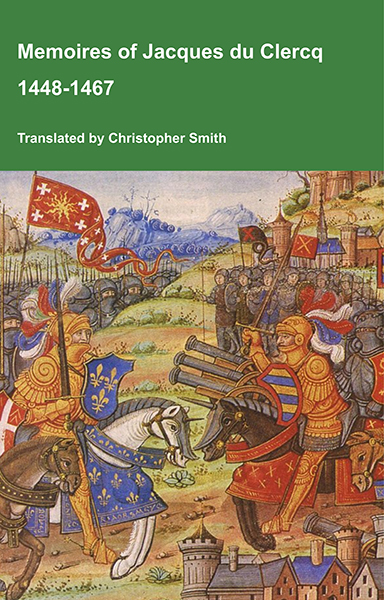
This is a translation of the 'Memoires of Jacques du Clercq', published in 1823 in two volumes, edited by Frederic, Baron de Reissenberg. In his introduction Reissenberg writes: 'Jacques du Clercq tells us that he was born in 1424, and that he was a licentiate in law and a counsellor to Philip the Good, Duke of Burgundy, in the castellany of Douai, Lille, and Orchies. It appears that he established his residence at Arras. In 1446, he married the daughter of Baldwin de la Lacherie, a gentleman who lived in Lille. We read in the fifth book of his Memoirs that his father, also named Jacques du Clercq, had married a lady of the Le Camelin family, from Compiègne. His ancestors, always attached to the counts of Flanders, had constantly served them, whether in their councils or in their armies.' The Memoires cover a period of nineteen years beginning in in 1448, ending in in 1467. It appears that the author had intended to extend the Memoirs beyond that date; no doubt illness or death prevented him from carrying out this plan. As Reissenberg writes the 'merit of this work lies in the simplicity of its narrative, in its tone of good faith, and in a certain air of frankness which naturally wins the reader’s confidence.' Du Clercq ranges from events of national and international importance, including events of the Wars of the Roses in England, to simple, everyday local events such as marriages, robberies, murders, trials and deaths, including that of his own father in Book 5; one of his last entries.
Available at Amazon in eBook and Paperback format.
17th November 1661. Dr. Creighton [aged 22], a Scot, author of the "Florentine Council", and a most eloquent man and admirable Grecian, preached on Cant. vi. 13, celebrating the return and restoration of the Church and King.
20th November 1661. At the Royal Society, Sir William Petty [aged 38] proposed divers things for the improvement of shipping; a versatile keel that should be on hinges and concerning sheathing ships with thin lead.
24th November 1661. This night his Majesty [aged 31] fell into discourse with me concerning bees, etc.
26th November 1661. I saw "Hamlet, Prince of Denmark" played; but now the old plays began to disgust this refined age, since his Majesty's [aged 31] being so long abroad.
28th November 1661. I dined at Chiffinch's house-warming, in St James' Park [Map]; he was his Majesty's [aged 31] closet-keeper, and had his new house full of good pictures, etc. There dined with us Russell, Popish Bishop of Cape Verd, who was sent out to negotiate his Majesty's match with the Infanta of Portugal [aged 23], after the Ambassador was returned.
29th November 1661. I dined at the Countess of Peterborough's [aged 39] and went that evening to Parson's Green with my Lord Mordaunt [aged 35], with whom I stayed that night.
1st December 1661. I took leave of my Lord Peterborough [aged 40], going now to Tangier [Map], which was to be delivered to the English on the match with Portugal.
3rd December 1661. By universal suffrage of our philosophic assembly, an order was made and registered that I should receive their public thanks for the honorable mention I made of them by the name of Royal Society, in my Epistle dedicatory to the Lord Chancellor [aged 52], before my Traduction of Naudæus. Too great an honor for a trifle.
4th December 1661. I had much discourse with the Duke of York [aged 28], concerning strange cures he affirmed of a woman who swallowed a whole ear of barley, which worked out at her side. I told him of the KNIFE SWALLOWED and the pins.
4th December 1661. I took leave of the Bishop of Cape Verd, now going in the fleet to bring over our new Queen [aged 23].
7th December 1661. I dined at Arundel House [Map], the day when the great contest in Parliament was concerning the restoring the Duke of Norfolk [aged 34]; however, it was carried for him. I also presented my little trifle of Sumptuary Laws, entitled "Tyrannus" [or "The Mode"].
14th December 1661. I saw otter hunting with the King [aged 31], and killed one.
Chronicle of a Bourgeois of Valenciennes
Récits d’un bourgeois de Valenciennes aka The Chronicle of a Bourgeois of Valenciennes is a vivid 14th-century vernacular chronicle written by an anonymous urban chronicler from Valenciennes in the County of Hainaut. It survives in a manuscript that describes local and regional history from about 1253 to 1366, blending chronology, narrative episodes, and eyewitness-style accounts of political, military, and social events in medieval France, Flanders, and the Low Countries. The work begins with a chronological framework of events affecting Valenciennes and its region under rulers such as King Philip VI of France and the shifting allegiances of local nobility. It includes accounts of conflicts, sieges, diplomatic manoeuvres, and the impact of broader struggles like the Hundred Years’ War on urban life in Hainaut. Written from the perspective of a burgher (bourgeois) rather than a monastery or royal court, the chronicle offers a rare lay viewpoint on high politics and warfare, reflecting how merchants, townspeople, and civic institutions experienced the turbulence of the 13th and 14th centuries. Its narrative style combines straightforward reporting of events with moral and civic observations, making it a valuable source for readers interested in medieval urban society, regional politics, and the lived experience of war and governance in pre-modern Europe.
Available at Amazon in eBook and Paperback format.
20th December 1661. The Bishop of Gloucester [aged 70] preached at the Abbey [Map] at the funeral of the Bishop of Hereford [deceased], brother to the Duke of Albemarle [aged 53]. It was a decent solemnity. There was a silver miter, with episcopal robes, borne by the herald before the hearse, which was followed by the Duke his brother, and all the bishops, with divers noblemen.


23rd December 1661. I heard an Italian play and sing to the guitar with extraordinary skill before the Duke [aged 28].