

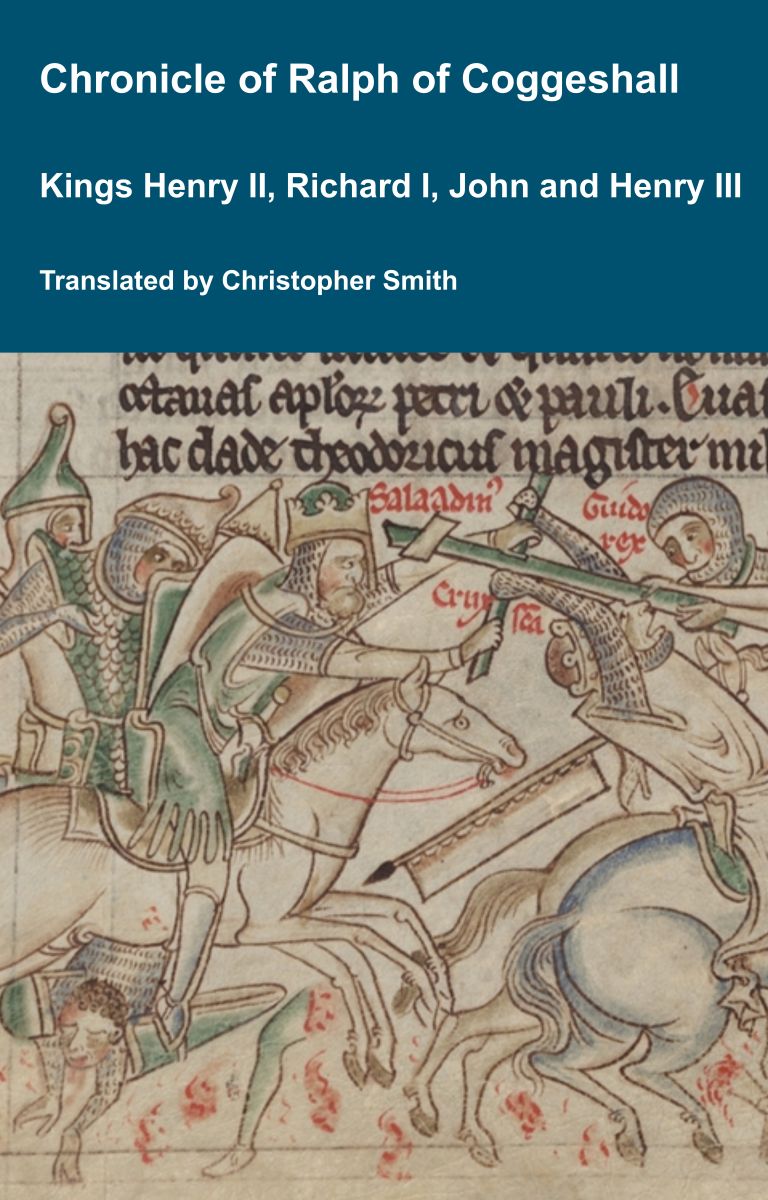
Chronicle of Abbot Ralph of Coggeshall
The Chronicle of Abbot Ralph of Coggeshall (Chronicon Anglicanum) is an indispensable medieval history that brings to life centuries of English and European affairs through the eyes of a learned Cistercian monk. Ralph of Coggeshall, abbot of the Abbey of Coggeshall in Essex in the early 13th century, continued and expanded his community’s chronicle, documenting events from the Norman Conquest of 1066 into the tumultuous reign of King Henry III. Blending eyewitness testimony, careful compilation, and the monastic commitment to record-keeping, this chronicle offers a rare narrative of political intrigue, royal power struggles, and social upheaval in England and beyond. Ralph’s work captures the reigns of pivotal figures such as Richard I and King John, providing invaluable insights into their characters, decisions, and the forces that shaped medieval rule. More than a simple annal, Chronicon Anglicanum conveys the texture of medieval life and governance, making it a rich source for scholars and readers fascinated by English history, monastic authorship, and the shaping of the medieval world.
Available at Amazon in eBook and Paperback format.
 John Evelyn's Diary January 1664
 John Evelyn's Diary February 1664
 John Evelyn's Diary March 1664
 John Evelyn's Diary May 1664
 John Evelyn's Diary June 1664
 John Evelyn's Diary July 1664
 John Evelyn's Diary August 1664
 John Evelyn's Diary October 1664
 John Evelyn's Diary December 1664
John Evelyn's Diary 1664 is in John Evelyn's Diary 1660s.

2nd January 1664. To Barn Elms, to see Abraham Cowley [aged 46] after his sickness; and returned that evening to London.
4th February 1664. Dined at Sir Philip Warwick's [aged 54]; thence, to Court, where I had discourse with the King [aged 33] about an invention of glass-grenades, and several other subjects.
5th February 1664. I saw "The Indian Queen" acted, a tragedy well written, so beautiful with rich scenes as the like had never been seen here, or haply (except rarely) elsewhere on a mercenary theater.
16th February 1664. I presented my "Sylva" to the Society; and next day to his Majesty [aged 33], to whom it was dedicated; also to the Lord Treasurer [aged 56] and the Lord Chancellor [aged 54].


24th February 1664. My Lord George Berkeley [aged 36], of Durdans, and Sir Samuel Tuke [aged 49] came to visit me. We went on board Sir William Petty's [aged 40] double-bottomed vessel, and so to London.
26th February 1664. Dined with my Lord Chancellor [aged 55]; and thence to Court, where I had great thanks for my "Sylva", and long discourse with the King [aged 33] of divers particulars.
2nd March 1664. Went to London to distribute some of my books among friends.
4th March 1664. Came to dine with me the Earl of Lauderdale [aged 47], his Majesty's [aged 33] great favorite, and Secretary of Scotland; the Earl of Teviot [aged 38]; my Lord Viscount Brouncker [aged 53], President of the Royal Society; Dr. Wilkins [aged 50], Dean of Ripon; Sir Robert Murray [aged 56], and Mr. Hooke [aged 28], Curator to the Society.


4th March 1664. This spring I planted the Home field and West field about Sayes Court [Map] with elms, being the same year that the elms were planted by his Majesty [aged 33] in Greenwich Park [Map].
26th March 1664. It pleased God to take away my son, Richard, now a month old, yet without any sickness of danger perceivably, being to all appearance a most likely child; we suspected much the nurse had overlain him; to our extreme sorrow, being now again reduced to one: but God's will be done.
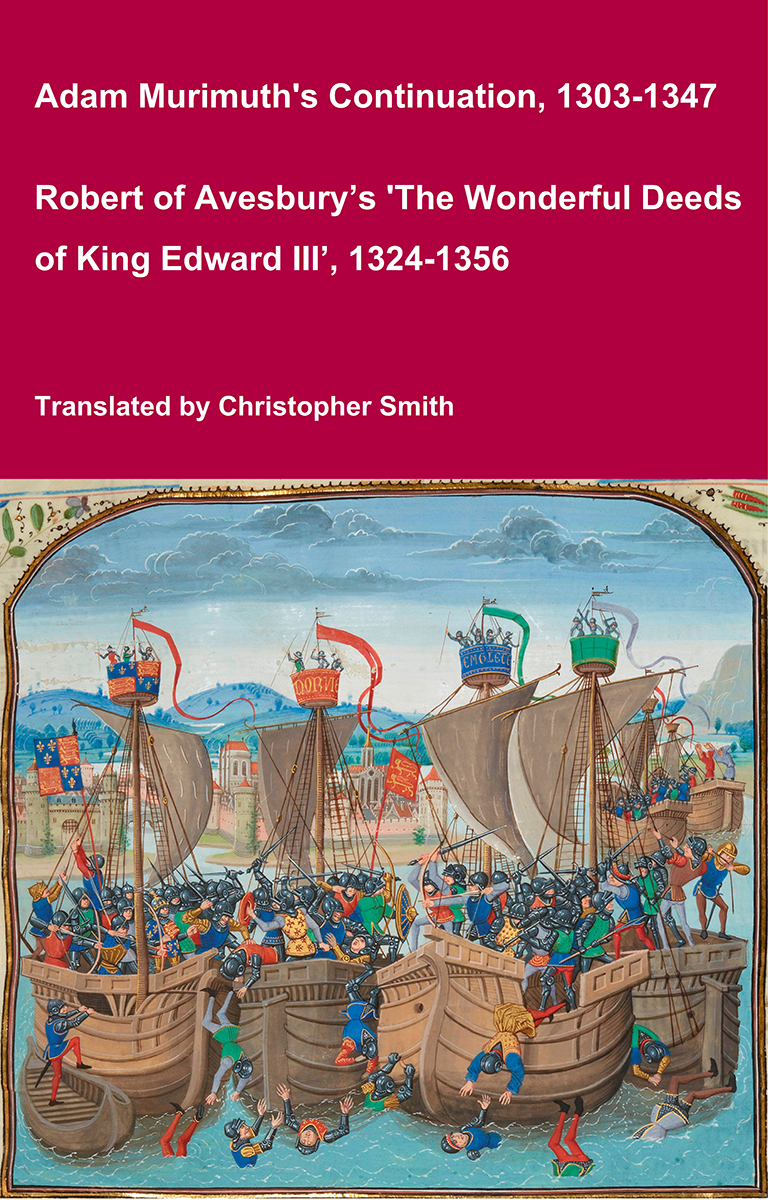
Adam Murimuth's Continuation and Robert of Avesbury’s 'The Wonderful Deeds of King Edward III'
This volume brings together two of the most important contemporary chronicles for the reign of Edward III and the opening phases of the Hundred Years’ War. Written in Latin by English clerical observers, these texts provide a vivid and authoritative window into the political, diplomatic, and military history of fourteenth-century England and its continental ambitions. Adam Murimuth Continuatio's Chronicarum continues an earlier chronicle into the mid-fourteenth century, offering concise but valuable notices on royal policy, foreign relations, and ecclesiastical affairs. Its annalistic structure makes it especially useful for establishing chronology and tracing the development of events year by year. Complementing it, Robert of Avesbury’s De gestis mirabilibus regis Edwardi tertii is a rich documentary chronicle preserving letters, treaties, and official records alongside narrative passages. It is an indispensable source for understanding Edward III’s claim to the French crown, the conduct of war, and the mechanisms of medieval diplomacy. Together, these works offer scholars, students, and enthusiasts a reliable and unembellished account of a transformative period in English and European history. Essential for anyone interested in medieval chronicles, the Hundred Years’ War, or the reign of Edward III.
Available at Amazon in eBook and Paperback format.
29th March 1664. After evening prayers, was my child buried near the rest of his brothers-my very dear children.
27th April 1664. Saw a facetious comedy, called "Love in a Tub"; and supped at Mr. Secretary Bennett's [aged 46].


3rd May 1664. Came the Earl of Kent [aged 18], my kinsman1, and his Lady [aged 20], to visit us.
Note 1. John Evelyn [aged 43] and Anthony Grey 11th Earl Kent were first cousin twice removed; Anthony Grey's maternal grandmother was Jane Evelyn [aged 76]. She and John Evelyn had the same grandfather George Evelyn of Long Ditton.


5th May 1664. Went with some company a journey of pleasure on the water, in a barge, with music, and at Mortlake had a great banquet, returning late. The occasion was, Sir Robert Carr [aged 27] now courting Mrs. Bennett, sister to the Secretary of State [aged 46].
6th May 1664. Went to see Mr. Wright [aged 47] the painter's collection of rare shells, etc.
9th June 1664. Sir Samuel Tuke [aged 49] being this morning married to a lady, kinswoman to my Lord Arundel of Wardour [aged 56], by the Queen's Lord Almoner, L. Aubigny [aged 44] in St. James's chapel, solemnized his wedding night at my house with much company.
22nd June 1664. One Tomson, a Jesuit, showed me such a collection of rarities, sent from the Jesuits of Japan and China to their Order at Paris, as a present to be reserved in their repository, but brought to London by the East India ships for them, as in my life I had not seen. The chief things were, rhinoceros's horns; glorious vests, wrought and embroidered on cloth of gold, but with such lively colors, that for splendor and vividness we have nothing in Europe that approaches it; a girdle studded with agates and rubies of great value and size; knives, of so keen an edge as one could not touch them, nor was the metal of our color, but more pale and livid; fans, like those our ladies use, but much larger, and with long handles curiously carved and filled with Chinese characters; a sort of paper very broad, thin, and fine, like abortive parchment, and exquisitely polished, of an amber yellow, exceedingly glorious and pretty to look on, and seeming to be like that which my Lord Verulam describes in his "Nova Atlantis"; several other sorts of paper, some written, others printed; prints of landscapes, their idols, saints, pagods, of most ugly serpentine monstrous and hideous shapes, to which they paid devotion; pictures of men and countries, rarely painted on a sort of gummed calico, transparent as glass; flowers, trees, beasts, birds, etc., excellently wrought in a kind of sleeve silk, very natural; divers drugs that our druggists and physicians could make nothing of, especially one which the Jesuit called Lac Tigridis: it looked like a fungus, but was weighty like metal, yet was a concretion, or coagulation, of some other matter; several book MSS.; a grammar of the language written in Spanish; with innumerable other rarities.


1st July 1664. Went to see Mr. Povey's [aged 50] elegant house in Lincoln's Inn Fields, where the perspective in his court, painted by Streeter [aged 43], is indeed excellent, with the vases in imitation of porphyry, and fountains; the inlaying of his closet; above all, his pretty cellar and ranging of his wine bottles.
7th July 1664. To Court, where I subscribed to Sir Arthur Slingsby's [aged 41] lottery, a desperate debt owing me long since in Paris.
14th July 1664. I went to take leave of the two Mr. Howards, now going to Paris, and brought them as far as Bromley, Kent; thence to Eltham, Greenwich, to see Sir John Shaw's [aged 49] new house, now building; the place is pleasant, if not too wet, but the house not well contrived; especially the roof and rooms too low pitched, and the kitchen where the cellars should be; the orangery and aviary handsome, and a very large plantation about it.
Chronicle of a Bourgeois of Valenciennes
Récits d’un bourgeois de Valenciennes aka The Chronicle of a Bourgeois of Valenciennes is a vivid 14th-century vernacular chronicle written by an anonymous urban chronicler from Valenciennes in the County of Hainaut. It survives in a manuscript that describes local and regional history from about 1253 to 1366, blending chronology, narrative episodes, and eyewitness-style accounts of political, military, and social events in medieval France, Flanders, and the Low Countries. The work begins with a chronological framework of events affecting Valenciennes and its region under rulers such as King Philip VI of France and the shifting allegiances of local nobility. It includes accounts of conflicts, sieges, diplomatic manoeuvres, and the impact of broader struggles like the Hundred Years’ War on urban life in Hainaut. Written from the perspective of a burgher (bourgeois) rather than a monastery or royal court, the chronicle offers a rare lay viewpoint on high politics and warfare, reflecting how merchants, townspeople, and civic institutions experienced the turbulence of the 13th and 14th centuries. Its narrative style combines straightforward reporting of events with moral and civic observations, making it a valuable source for readers interested in medieval urban society, regional politics, and the lived experience of war and governance in pre-modern Europe.
Available at Amazon in eBook and Paperback format.
19th July 1664. To London, to see the event of the lottery which his Majesty [aged 34] had permitted Sir Arthur Slingsby [aged 41] to set up for one day in the Banqueting House, Whitehall Palace [Map], at Whitehall; I gaining only a trifle, as well as did the King, Queen-Consort [aged 25], and Queen-Mother [aged 54], for near thirty lots; which was thought to be contrived very unhandsomely by the master of it, who was, in truth, a mere shark.


21st July 1664. I dined with my Lord Treasurer [aged 57] at Southampton House, where his Lordship used me with singular humanity. I went in the afternoon to Chelsea, to wait on the Duke of Ormond [aged 53], and returned to London.
28th July 1664. Came to see me Monsieur Zuylichen [aged 67], Secretary to the Prince of Orange, an excellent Latin poet, a rare lutinist, with Monsieur Oudart.


3rd August 1664. To London; a concert of excellent musicians, especially one Mr. Berkenshaw, that rare artist, who invented a mathematical way of composure very extraordinary, true as to the exact rules of art, but without much harmony.
8th August 1664. Came the sad and unexpected news of the death of Lady Cotton, wife to my brother George [aged 47], a most excellent lady.
9th August 1664. Went with my brother Richard [aged 41] to Wotton, Surrey [Map], to visit and comfort my disconsolate brother [aged 47]; and on the 13th saw my friend, Mr. Charles Howard, at Dipden, near Dorking.
16th August 1664. I went to see Sir William Ducie's house at Charlton; which he purchased of my excellent friend, Sir Henry Newton [aged 46], now nobly furnished.
22nd August 1664. I went from London to Wotton, Surrey [Map], to assist at the funeral of my sister-in-law, the Lady Cotton, buried in our dormitory there, she being put up in lead. Dr. Owen made a profitable and pathetic discourse, concluding with an eulogy of that virtuous, pious, and deserving lady. It was a very solemn funeral, with about fifty mourners. I came back next day with my wife [aged 29] to London.
2nd September 1664. Came Constantine Huygens, Signor de Zuylichen [aged 67], Sir Robert Morris, Mr. Oudart, Mr. Carew, and other friends, to spend the day with us.
5th October 1664. To our Society. There was brought a newly-invented instrument of music, being a harpsichord with gut-strings, sounding like a concert of viols with an organ, made vocal by a wheel, and a zone of parchment that rubbed horizontally against the strings.
Anne Boleyn. Her Life as told by Lancelot de Carle's 1536 Letter.
In 1536, two weeks after the execution of Anne Boleyn, her brother George and four others, Lancelot du Carle, wrote an extraordinary letter that described Anne's life, and her trial and execution, to which he was a witness. This book presents a new translation of that letter, with additional material from other contemporary sources such as Letters, Hall's and Wriothesley's Chronicles, the pamphlets of Wynkyn the Worde, the Memorial of George Constantyne, the Portuguese Letter and the Baga de Secrets, all of which are provided in Appendices.
Available at Amazon in eBook and Paperback format.
6th October 1664. I heard the anniversary oration in praise of Dr. Harvey, in the Anatomy Theatre in the Royal College of Physicians; after which I was invited by Dr. Alston, the President, to a magnificent feast.
8th October 1664. Sir William Curtius, his Majesty's [aged 34] Resident in Germany, came to visit me; he was a wise and learned gentleman, and, as he told me, scholar to Henry Alstedius, the Encyclopedist.
15th October 1664. Dined at the Lord Chancellor's [aged 55], where was the Duke of Ormond [aged 53], Earl of Cork, and Bishop of Winchester [aged 66]. After dinner, my Lord Chancellor and his lady [aged 47] carried me in their coach to see their palace (for he now lived at Worcester-House in the Strand), building at the upper end of St. James's street, and to project the garden. In the evening, I presented him with my book on Architecture, as before I had done to his Majesty [aged 34] and the Queen-Mother [aged 54]. His lordship caused me to stay with him in his bedchamber, discoursing of several matters very late, even till he was going into his bed.

17th October 1664. I went with my Lord Viscount Cornbury, to Cornbury, in Oxfordshire, to assist him in the planting of the park, and bear him company, with Mr. Belin and Mr. May [aged 43], in a coach with six horses; dined at Uxbridge, lay at Wycombe.

18th October 1664. At Oxford. Went through Woodstock, Oxfordshire [Map], where we beheld the destruction of that royal seat and park by the late rebels, and arrived that evening at Cornbury, a house lately built by the Earl of Denbigh [Note. Mistake by Evelyn; should be Earl of Danby], in the middle of a sweet park, walled with a dry wall. The house is of excellent freestone, abounding in that part, (a stone that is fine, but never sweats, or casts any damp); it is of ample dimensions, has goodly cellars, the paving of the hall admirable for its close laying. We designed a handsome chapel that was yet wanting: as Mr. May [aged 43] had the stables, which indeed are very fair, having set out the walks in the parks and gardens. The lodge is a pretty solitude, and the ponds very convenient; the park well stored.
20th October 1664. Hence, to see the famous wells, natural and artificial grots and fountains, called Bushell's Wells, at Enstone. This Bushell had been Secretary to my Lord Verulam. It is an extraordinary solitude. There he had two mummies; a grot where he lay in a hammock, like an Indian. Hence, we went to Dichley [Map], an ancient seat of the Lees, now Sir Henry Lee's [aged 25]; it is a low ancient timber-house, with a pretty bowling-green. My Lady gave us an extraordinary dinner. This gentleman's mother [aged 49] was Countess of Rochester, who was also there, and Sir Walter St. John [aged 42]. There were some pictures of their ancestors, not ill painted; the great-grandfather had been Knight of the Garter [Note. Reference to Henry Lee of Ditchley who was not great-grandfather; he was second-cousin once-removed]; there was a picture of a Pope, and our Savior's head. So we returned to Cornbury.


24th October 1664. We dined at Sir Timothy Tyrill's [aged 47] at Shotover. This gentleman married the daughter and heir [aged 45] of Dr. James Usher, Archbishop of Armagh, that learned prelate. There is here in the grove a fountain of the coldest water I ever felt, and very clear. His plantation of oaks and other timber is very commendable. We went in the evening to Oxford, lay at Dr. Hyde's [aged 47], principal of Magdalen-Hall (related to the Lord Chancellor [aged 55]), brother to the Lord Chief Justice [aged 69] and that Sir Henry Hyde, who lost his head for his loyalty. We were handsomely entertained two days. The Vice-Chancellor, who with Dr. Fell, Dean of Christ Church, the learned Dr. Barlow, Warden of Queen's, and several heads of houses, came to visit Lord Cornbury his father being now Chancellor of the University), and next day invited us all to dinner. I went to visit Mr. Boyle [aged 37] (now here), whom I found with Dr. Wallis and Dr. Christopher Wren, in the tower of the schools, with an inverted tube, or telescope, observing the discus of the sun for the passing of Mercury that day before it; but the latitude was so great that nothing appeared; so we went to see the rarities in the library, where the keepers showed me my name among the benefactors. They have a cabinet of some medals, and pictures of the muscular parts of man's body. Thence, to the new theater, now building at an exceeding and royal expense by the Lord Archbishop of Canterbury [Sheldon [aged 66]], to keep the Acts in for the future, till now being in St. Mary's Church. The foundation had been newly laid, and the whole designed by that incomparable genius my worthy friend, Dr. Christopher Wren, who showed me the model, not disdaining my advice in some particulars. Thence, to see the picture on the wall over the altar of All Souls, being the largest piece of fresco painting (or rather in imitation of it, for it is in oil of turpentine) in England, not ill designed by the hand of one Fuller; yet I fear it will not hold long. It seems too full of nakeds for a chapel.


24th October 1664. Thence, to New College, and the painting of Magdalen chapel, which is on blue cloth in chiar oscuro, by one Greenborow, being a Cœna Domini, and a "Last Judgment" on the wall by Fuller, as in the other, but somewhat varied.
24th October 1664. Next to Wadham, and the Physic Garden, where were two large locust trees, and as many platani (plane trees), and some rare plants under the culture of old Bobart.
26th October 1664. We came back to Beaconsfield, Buckinghamshire; next day to London, where we dined at the Lord Chancellor's [aged 55], with my Lord Bellasis [aged 50].


27th October 1664. Being casually in the privy gallery at Whitehall [Map], his Majesty [aged 34] gave me thanks before divers lords and noblemen for my book of "Architecture", and again for my "Sylva" saying they were the best designed and useful for the matter and subject, the best printed and designed (meaning the taille-douces of the "Parallel of Architecture) that he had seen. He then caused me to follow him alone to one of the windows, and asked me if I had any paper about me unwritten, and a crayon; I presented him with both, and then laying it on the window-stool, he with his own hands designed to me the plot for the future building of Whitehall [Map], together with the rooms of state, and other particulars. After this, he talked with me of several matters, asking my advice, in which I find his Majesty had an extraordinary talent becoming a magnificent prince.
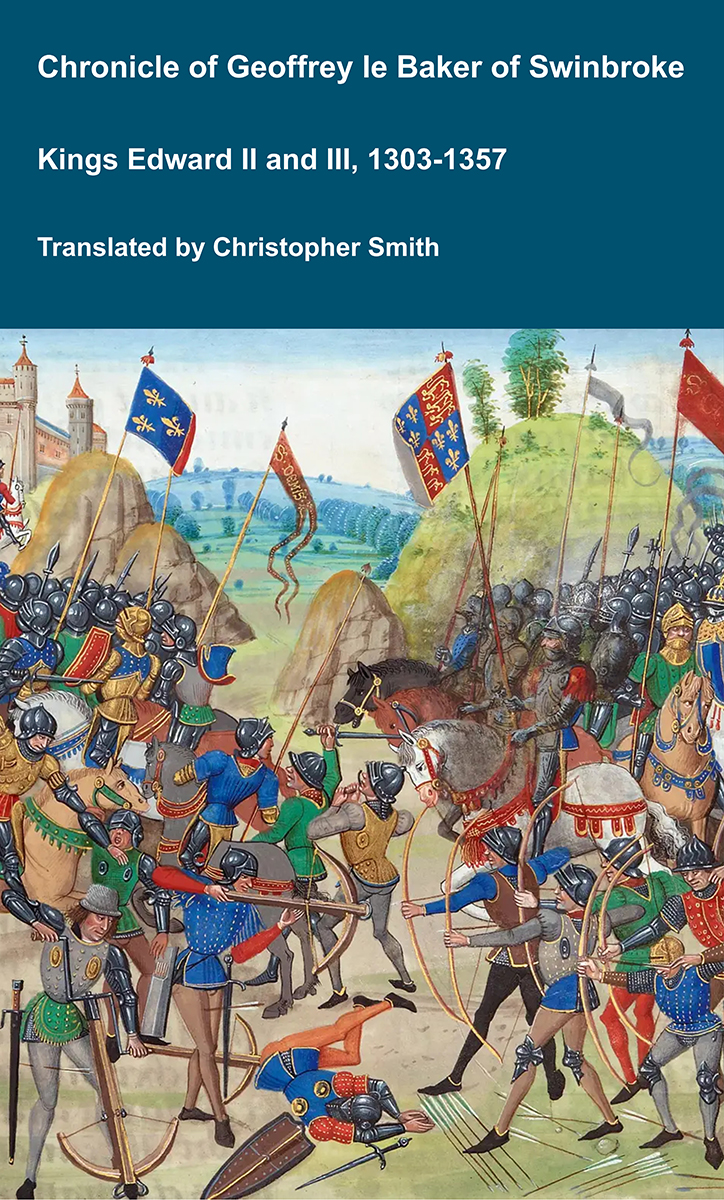
Chronicle of Geoffrey le Baker of Swinbroke
Baker was a secular clerk from Swinbroke, now Swinbrook, an Oxfordshire village two miles east of Burford. His Chronicle describes the events of the period 1303-1356: Gaveston, Bannockburn, Boroughbridge, the murder of King Edward II, the Scottish Wars, Sluys, Crécy, the Black Death, Winchelsea and Poitiers. To quote Herbert Bruce 'it possesses a vigorous and characteristic style, and its value for particular events between 1303 and 1356 has been recognised by its editor and by subsequent writers'. The book provides remarkable detail about the events it describes. Baker's text has been augmented with hundreds of notes, including extracts from other contemporary chronicles, such as the Annales Londonienses, Annales Paulini, Murimuth, Lanercost, Avesbury, Guisborough and Froissart to enrich the reader's understanding. The translation takes as its source the 'Chronicon Galfridi le Baker de Swynebroke' published in 1889, edited by Edward Maunde Thompson.
Available at Amazon in eBook and Paperback format.
27th October 1664. The same day at Council, there being Commissioners to be made to take care of such sick and wounded and prisoners of war, as might be expected upon occasion of a succeeding war and action at sea, war being already declared against the Hollanders, his Majesty [aged 34] was pleased to nominate me to be one, with three other gentlemen, Parliament men, viz, Sir William Doily, Knt. and Bart., Sir Thomas Clifford, and Bullein Rheymes, Esq; with a salary of £1,200 a year among us, besides extraordinaries for our care and attention in time of station, each of us being appointed to a particular district, mine falling out to be Kent and Sussex, with power to constitute officers, physicians, chirurgeons, provost-marshals, and to dispose of half of the hospitals through England. After the Council, we kissed his Majesty's hand. At this Council I heard Mr. Solicitor Finch plead most elegantly for the merchants trading to the Canaries, praying for a new Charter.
29th October 1664. Was the most magnificent triumph by water and land of the Lord Mayor. I dined at Guildhall [Map] at the upper table, placed next to Sir H. Bennett [aged 46], Secretary of State, opposite to my Lord Chancellor [aged 55] and the Duke of Buckingham [aged 36], who sat between Monsieur Comminges, the French Ambassador, Lord Treasurer [aged 57], the Dukes of Ormond [aged 54] and Albemarle [aged 55], Earl of Manchester [aged 62], Lord Chamberlain, and the rest of the great officers of state. My Lord Mayor came twice up to us, first drinking in the golden goblet his Majesty's [aged 34] health, then the French King's as a compliment to the Ambassador; we returned my Lord Mayor's health, the trumpets and drums sounding. The cheer was not to be imagined for the plenty and rarity, with an infinite number of persons at the tables in that ample hall. The feast was said to cost £1,000. I slipped away in the crowd, and came home late.
31st October 1664. I was this day 44 years of age; for which I returned thanks to Almighty God, begging his merciful protection for the year to come.
2nd November 1664. Her Majesty, the Queen-Mother [aged 54], came across the gallery in Whitehall [Map] to give me thanks for my book of "Architecture", which I had presented to her, with a compliment that I did by no means deserve.
16th November 1664. We chose our treasurer, clerks, and messengers, and appointed our seal, which I ordered should be the good Samaritan, with this motto, "Fac similiter". Painters' Hall, Queenhithe was lent us to meet in. In the great room were divers pictures, some reasonably good, that had been given to the Company by several of the wardens and masters of the Company.
23rd November 1664. Our statutes now finished, were read before a full assembly of the Royal Society.
24th November 1664. His Majesty [aged 34] was pleased to tell me what the conference was with the Holland Ambassador, which, as after I found, was the heads of the speech he made at the reconvention of the Parliament, which now began.
2nd December 1664. We delivered the Privy Council's letters to the Governors of St Thomas's Hospital, in Southwark, that a moiety of the house should be reserved for such sick and wounded as should from time to time be sent from the fleet during the war. This being delivered at their Court, the President and several Aldermen, Governors of that Hospital, invited us to a great feast in Fishmongers' Hall.
20th December 1664. To London, our last sitting, taking order for our personal visiting our several districts. I dined at Captain Cocke's (our treasurer), with that most ingenious gentleman, Matthew Wren [aged 35], son to the Bishop of Ely [aged 79], and Mr. Joseph Williamson, since Secretary of State.
22nd December 1664. I went to the launching of a new ship of two bottoms, invented by Sir William Petty [aged 41], on which were various opinions; his Majesty [aged 34] being present, gave her the name of the "Experiment": so I returned home, where I found Sir Humphry Winch [aged 42], who spent the day with me.
22nd December 1664. This year I planted the lower grove next the pond at Sayes Court [Map]. It was now exceedingly cold, and a hard, long, frosty season, and the comet was very visible.
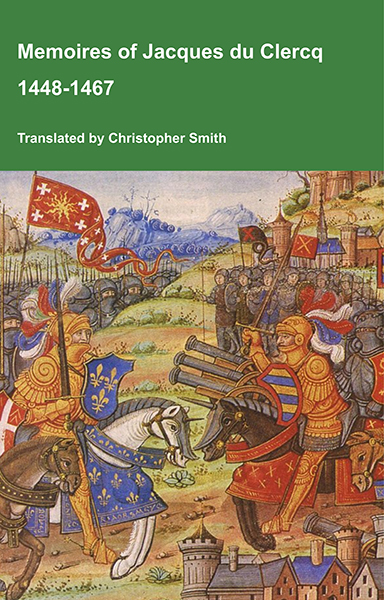
This is a translation of the 'Memoires of Jacques du Clercq', published in 1823 in two volumes, edited by Frederic, Baron de Reissenberg. In his introduction Reissenberg writes: 'Jacques du Clercq tells us that he was born in 1424, and that he was a licentiate in law and a counsellor to Philip the Good, Duke of Burgundy, in the castellany of Douai, Lille, and Orchies. It appears that he established his residence at Arras. In 1446, he married the daughter of Baldwin de la Lacherie, a gentleman who lived in Lille. We read in the fifth book of his Memoirs that his father, also named Jacques du Clercq, had married a lady of the Le Camelin family, from Compiègne. His ancestors, always attached to the counts of Flanders, had constantly served them, whether in their councils or in their armies.' The Memoires cover a period of nineteen years beginning in in 1448, ending in in 1467. It appears that the author had intended to extend the Memoirs beyond that date; no doubt illness or death prevented him from carrying out this plan. As Reissenberg writes the 'merit of this work lies in the simplicity of its narrative, in its tone of good faith, and in a certain air of frankness which naturally wins the reader’s confidence.' Du Clercq ranges from events of national and international importance, including events of the Wars of the Roses in England, to simple, everyday local events such as marriages, robberies, murders, trials and deaths, including that of his own father in Book 5; one of his last entries.
Available at Amazon in eBook and Paperback format.
28th December 1664. Some of my poor neighbours dined with me, and others of my tenants, according to my annual custom.
31st December 1664. Set my affairs in order, gave God praise for His mercies the past year, and prepared for the reception of the Holy Sacrament, which I partook of the next day, after hearing our minister on the 4th of Galatians, verses 4, 5, of the mystery of our Blessed Savior's Incarnation.