

William of Worcester's Chronicle of England
William of Worcester, born around 1415, and died around 1482 was secretary to John Fastolf, the renowned soldier of the Hundred Years War, during which time he collected documents, letters, and wrote a record of events. Following their return to England in 1440 William was witness to major events. Twice in his chronicle he uses the first person: 1. when writing about the murder of Thomas, 7th Baron Scales, in 1460, he writes '… and I saw him lying naked in the cemetery near the porch of the church of St. Mary Overie in Southwark …' and 2. describing King Edward IV's entry into London in 1461 he writes '… proclaimed that all the people themselves were to recognize and acknowledge Edward as king. I was present and heard this, and immediately went down with them into the city'. William’s Chronicle is rich in detail. It is the source of much information about the Wars of the Roses, including the term 'Diabolical Marriage' to describe the marriage of Queen Elizabeth Woodville’s brother John’s marriage to Katherine, Dowager Duchess of Norfolk, he aged twenty, she sixty-five or more, and the story about a paper crown being placed in mockery on the severed head of Richard, 3rd Duke of York.
Available at Amazon in eBook and Paperback format.
 John Evelyn's Diary January 1668
 John Evelyn's Diary February 1668
 John Evelyn's Diary March 1668
 John Evelyn's Diary April 1668
 John Evelyn's Diary May 1668
 John Evelyn's Diary July 1668
 John Evelyn's Diary August 1668
 John Evelyn's Diary November 1668
 John Evelyn's Diary December 1668
John Evelyn's Diary 1668 is in John Evelyn's Diary 1660s.
8th January 1668. I saw deep and prodigious gaming at the Groom-Porter's, vast heaps of gold squandered away in a vain and profuse manner. This I looked on as a horrid vice, and unsuitable in a Christian Court.
9th January 1668. Went to see the revels at the Middle Temple, which is also an old riotous custom, and has relation neither to virtue nor policy.

10th January 1668. To visit Mr. Povey [aged 54], where were divers great Lords to see his well-contrived cellar, and other elegancies.
24th January 1668. We went to stake out ground for building a college for the Royal Society at Arundel House [Map], but did not finish it, which we shall repent of.
4th February 1668. I saw the tragedy of "Horace" (written by the VIRTUOUS Mrs. Philips) acted before their Majesties [King Charles II of England Scotland and Ireland [aged 37] and Henrietta Maria Bourbon Queen Consort Catherine of Braganza Queen Consort England 1638-1705]. Between each act a masque and antique dance. The excessive gallantry of the ladies was infinite, those especially on that ... Castlemaine [aged 27], esteemed at £40,000 and more, far outshining the Queen [aged 29].


15th February 1668. I saw the audience of the Swedish Ambassador Count Donna, in great state in the Banqueting House, Whitehall Palace [Map].
3rd March 1668. Was launched at Deptford, Kent [Map], that goodly vessel, "The Charles" I was near his Majesty [aged 37]. She is longer than the "Sovereign", and carries 110 brass cannon; she was built by old Shish [aged 63], a plain, honest carpenter, master-builder of this dock, but one who can give very little account of his art by discourse, and is hardly capable of reading, yet of great ability in his calling. The family have been ship carpenters in this yard above 300 years.
12th March 1668. Went to visit Sir John Cotton [aged 47], who had me into his library, full of good MSS., Greek and Latin, but most famous for those of the Saxon and English antiquities, collected by his grandfather.


2nd April 1668. To the Royal Society, where I subscribed 50,000 bricks, toward building a college. Among other libertine libels, there was one now printed and thrown about, a bold petition of the poor w--s [Note. whores] to Baroness Castlemaine [aged 27].
Henrici Quinti, Angliæ Regis, Gesta, is a first-hand account of the Agincourt Campaign, and subsequent events to his death in 1422. The author of the first part was a Chaplain in King Henry's retinue who was present from King Henry's departure at Southampton in 1415, at the siege of Harfleur, the battle of Agincourt, and the celebrations on King Henry's return to London. The second part, by another writer, relates the events that took place including the negotiations at Troye, Henry's marriage and his death in 1422.
Available at Amazon in eBook and Paperback format.
9th April 1668. To London, about finishing my grand account of the sick and wounded, and prisoners at war, amounting to above £34,000.
9th April 1668. I heard Sir R. Howard [aged 42] impeach Sir William Penn [aged 46], in the House of Lords, for breaking bulk, and taking away rich goods out of the East India prizes, formerly taken by Lord Sandwich [aged 42].


28th April 1668. To London, about the purchase of Ravensbourne Mills, and land around it, in Upper Deptford [Map], of one Mr. Becher.
30th April 1668. We sealed the deeds in Sir Edward Thurland's [aged 61] chambers in the Inner Temple. I pray God bless it to me, it being a dear pennyworth; but the passion Sir R. Browne had for it, and that it was contiguous to our other grounds, engaged me!
13th May 1668. Invited by that expert commander, Captain Cox, master of the lately built "Charles II" now the best vessel of the fleet, designed for the Duke of York [aged 34], I went to Erith, where we had a great dinner.


16th May 1668. Sir Richard Edgecombe [aged 28], of Mount Edgecombe, by Plymouth, my relation, came to visit me; a very virtuous and worthy gentleman.
19th June 1668. To a new play with several of my relations, "The Evening Lover", a foolish plot, and very profane; it afflicted me to see how the stage was degenerated and polluted by the licentious times.
2nd July 1668. Sir Samuel Tuke, Bart [aged 53], and the lady he had married this day, came and bedded at night at my house, many friends accompanying the bride.
23rd July 1668. At the Royal Society, were presented divers glossa petras, and other natural curiosities, found in digging to build the fort at Sheerness Isle of Sheppey [Map]. They were just the same as they bring from Malta, pretending them to be viper's teeth, whereas, in truth, they are of a shark, as we found by comparing them with one in our repository.
3rd August 1668. Mr. Bramstone (son to Judge B), my old fellow-traveler, now reader at the Middle Temple, invited me to his feast, which was so very extravagant and great as the like had not been seen at any time. There were the Duke of Ormond [aged 57], Privy Seal [aged 62], Bedford [aged 52], Belasis [aged 54], Halifax [aged 34], and a world more of Earls and Lords.


14th August 1668. His Majesty [aged 38] was pleased to grant me a lease of a slip of ground out of Brick Close, to enlarge my fore-court [Map], for which I now gave him thanks; then, entering into other discourse, he talked to me of a new varnish for ships, instead of pitch, and of the gilding with which his new yacht was beautified. I showed his Majesty the perpetual motion sent to me by Dr. Stokes, from Cologne; and then came in Monsieur Colbert [aged 43], the French Ambassador.
Abbot John Whethamstede’s Chronicle of the Abbey of St Albans
Abbot John Whethamstede's Register aka Chronicle of his second term at the Abbey of St Albans, 1451-1461, is a remarkable text that describes his first-hand experience of the beginning of the Wars of the Roses including the First and Second Battles of St Albans, 1455 and 1461, respectively, their cause, and their consequences, not least on the Abbey itself. His text also includes Loveday, Blore Heath, Northampton, the Act of Accord, Wakefield, and Towton, and ends with the Coronation of King Edward IV. In addition to the events of the Wars of the Roses, Abbot John, or his scribes who wrote the Chronicle, include details in the life of the Abbey such as charters, letters, land exchanges, visits by legates, and disputes, which provide a rich insight into the day-to-day life of the Abbey, and the challenges faced by its Abbot.
Available at Amazon in eBook and Paperback format.
19th August 1668. I saw the magnificent entry of the French Ambassador Colbert [aged 43], received in the Banqueting House, Whitehall Palace [Map]. I had never seen a richer coach than that which he came in to Whitehall. Standing by his Majesty [aged 38] at dinner in the presence, there was of that rare fruit called the king-pine, growing in Barbadoes and the West Indies; the first of them I had ever seen. His Majesty having cut it up, was pleased to give me a piece off his own plate to taste of; but, in my opinion, it falls short of those ravishing varieties of deliciousness described in Captain Ligon's [aged 45] history, and others; but possibly it might, or certainly was, much impaired in coming so far; it has yet a grateful acidity, but tastes more like the quince and melon than of any other fruit he mentions.
28th August 1668. Published my book on "The Perfection of Painting", dedicated to Mr. Howard.
17th September 1668. I entertained Signor Muccinigo, the Venetian Ambassador, of one of the noblest families of the State, this being the day of making his public entry, setting forth from my house [Map] with several gentlemen of Venice and others in a very glorious train. He staid with me till the Earl of Anglesea [aged 54] and Sir Charles Cotterell [aged 53] (Master of the Ceremonies) came with the King's [aged 38] barge to carry him to the Tower [Map], where the guns were fired at his landing; he then entered his Majesty's coach, followed by many others of the nobility. I accompanied him to his house, where there was a most noble supper to all the company, of course. After the extraordinary compliments to me and my wife [aged 33], for the civilities he received at my house, I took leave and returned. He is a very accomplished person. He is since Ambassador at Rome.


29th September 1668. I had much discourse with Signor Pietro Cisij, a Persian gentleman, about the affairs of Turkey, to my great satisfaction. I went to see Sir Elias Leighton's project of a cart with iron axletrees.
8th November 1668. Being at dinner, my sister Evelyn sent for me to come up to London to my continuing sick brother [aged 45].
14th November 1668. To London, invited to the consecration of that excellent person, the Dean of Ripon, Dr. Wilkins [aged 54], now made Bishop of Chester; it was at Ely House, the Archbishop of Canterbury [aged 70], Dr. Cosin [aged 73], Bishop of Durham, the Bishops of Ely [aged 77], Salisbury, Rochester [aged 43], and others officiating. Dr. Tillotson [aged 38] preached. Then, we went to a sumptuous dinner in the hall, where were the Duke of Buckingham [aged 40], Judges, Secretaries of State, Lord-Keeper, Council, Noblemen, and innumerable other company, who were honorers of this incomparable man, universally beloved by all who knew him.


14th November 1668. My poor brother [aged 46] continuing ill, I went not from him till the 17th, when, dining at the Groom Porters, I heard Sir Edward Sutton play excellently on the Irish harp; he performs genteelly, but not approaching my worthy friend, Mr. Clark, a gentleman of Northumberland, who makes it execute lute, viol, and all the harmony an instrument is capable of; pity it is that it is not more in use; but, indeed, to play well, takes up the whole man, as Mr. Clark has assured me, who, though a gentleman of quality and parts, was yet brought up to that instrument from five years old, as I remember he told me.
25th November 1668. I waited on Lord Sandwich [aged 43], who presented me with a Sembrador [A type of seed drill] he brought out of Spain, showing me his two books of observations made during his embassy and stay at Madrid, in which were several rare things he promised to impart to me.
27th November 1668. I dined at my Lord Ashley's [aged 47] (since Earl of Shaftesbury), when the match of my niece was proposed for his only son, in which my assistance was desired for my Lord.


28th November 1668. Dr. Patrick preached at Convent Garden, on Acts xvii. 31, the certainty of Christ's coming to judgment, it being Advent; a most suitable discourse.
19th December 1668. I went to see the old play of "Cataline" acted, having been now forgotten almost forty years.

20th December 1668. I dined with my Lord Cornbury, at Clarendon House, now bravely furnished, especially with the pictures of most of our ancient and modern wits, poets, philosophers, famous and learned Englishmen; which collection of the Chancellor's I much commended, and gave his Lordship a catalogue of more to be added.
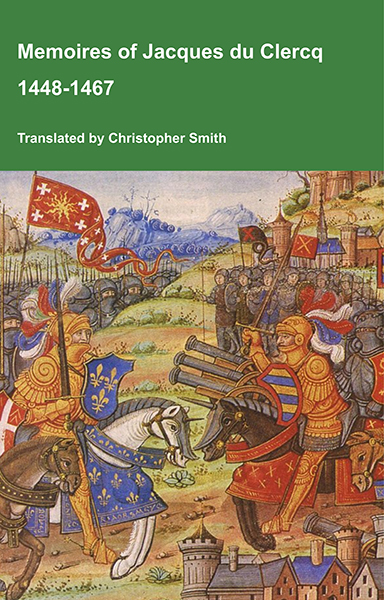
This is a translation of the 'Memoires of Jacques du Clercq', published in 1823 in two volumes, edited by Frederic, Baron de Reissenberg. In his introduction Reissenberg writes: 'Jacques du Clercq tells us that he was born in 1424, and that he was a licentiate in law and a counsellor to Philip the Good, Duke of Burgundy, in the castellany of Douai, Lille, and Orchies. It appears that he established his residence at Arras. In 1446, he married the daughter of Baldwin de la Lacherie, a gentleman who lived in Lille. We read in the fifth book of his Memoirs that his father, also named Jacques du Clercq, had married a lady of the Le Camelin family, from Compiègne. His ancestors, always attached to the counts of Flanders, had constantly served them, whether in their councils or in their armies.' The Memoires cover a period of nineteen years beginning in in 1448, ending in in 1467. It appears that the author had intended to extend the Memoirs beyond that date; no doubt illness or death prevented him from carrying out this plan. As Reissenberg writes the 'merit of this work lies in the simplicity of its narrative, in its tone of good faith, and in a certain air of frankness which naturally wins the reader’s confidence.' Du Clercq ranges from events of national and international importance, including events of the Wars of the Roses in England, to simple, everyday local events such as marriages, robberies, murders, trials and deaths, including that of his own father in Book 5; one of his last entries.
Available at Amazon in eBook and Paperback format.
31st December 1668. I entertained my kind neighbours, according to custom, giving Almighty God thanks for his gracious mercies to me the past year.