

Henrici Quinti, Angliæ Regis, Gesta, is a first-hand account of the Agincourt Campaign, and subsequent events to his death in 1422. The author of the first part was a Chaplain in King Henry's retinue who was present from King Henry's departure at Southampton in 1415, at the siege of Harfleur, the battle of Agincourt, and the celebrations on King Henry's return to London. The second part, by another writer, relates the events that took place including the negotiations at Troye, Henry's marriage and his death in 1422.
Available at Amazon in eBook and Paperback format.
 John Evelyn's Diary February 1681
 John Evelyn's Diary May 1681
 John Evelyn's Diary June 1681
 John Evelyn's Diary August 1681
 John Evelyn's Diary September 1681
 John Evelyn's Diary October 1681
 John Evelyn's Diary November 1681
John Evelyn's Diary 1681 is in John Evelyn's Diary 1680s.

10th February 1681. I was at the wedding of my nephew, John Evelyn of Wotton [aged 28], married by the Bishop of Rochester [aged 56] at Westminster, in Henry VII's chapel [Map], to the daughter and heir of Mr. Eversfield, of Sussex, her portion £8,000. The solemnity was kept with a few friends only at Lady Beckford's, the lady's mother.
Note. John Evelyn of Wotton and Catherine Eversfield were married.
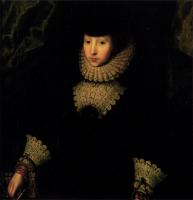
8th March 1681. Visited and dined at the Earl of Essex's [aged 49], with whom I spent most of the afternoon alone. Thence to my (yet living) godmother and kinswoman, Mrs. Keightley [aged 84], sister to Sir Thomas Evelyn and niece to my father, being now eighty-six years of age, sprightly, and in perfect health, her eyes serving her as well as ever, and of a comely countenance, that one would not suppose her above fifty.
27th March 1681. The Parliament now convened at Oxford. Great expectation of his Royal Highness's [aged 50] case as to the succession, against which the House was set.
27th March 1681. An extraordinary sharp, cold spring, not yet a leaf on the trees, frost and snow lying: while the whole nation was in the greatest ferment.
11th April 1681. I took my leave of Dr. Lloyd [aged 53] (Bishop of St. Asaph) at his house in Leicester Fields, now going to reside in his diocese.
12th April 1681. I dined at Mr. Brisbane's, Secretary to the Admiralty, a learned and industrious person, whither came Dr. Burnet [aged 37], to thank me for some papers I had contributed toward his excellent "History of the Reformation"..


26th April 1681. I dined at Don Pietro Ronquillo's, the Spanish Ambassador, at Wild House, who used me with extraordinary civility. The dinner was plentiful, half after the Spanish, half after the English way. After dinner, he led me into his bedchamber, where we fell into a long discourse concerning religion. Though he was a learned man in politics, and an advocate, he was very ignorant in religion, and unable to defend any point of controversy; he was, however, far from being fierce. At parting, he earnestly wished me to apply humbly to the blessed virgin to direct me, assuring me that he had known divers who had been averse from the Roman Catholic religion, wonderfully enlightened and convinced by her intercession. He importuned me to come and visit him often.
29th April 1681. But one shower of rain all this month.

5th May 1681. Came to dine with me Sir William Fermor [aged 32], of Northamptonshire, and Sir Christopher Wren [aged 57], his Majesty's [aged 50] architect and surveyor, now building the Cathedral of St. Paul [Map], and the column [Map] in memory of the city's conflagration, and was in hand with the building of fifty parish churches. A wonderful genius had this incomparable person.
Abbot John Whethamstede’s Chronicle of the Abbey of St Albans
Abbot John Whethamstede's Register aka Chronicle of his second term at the Abbey of St Albans, 1451-1461, is a remarkable text that describes his first-hand experience of the beginning of the Wars of the Roses including the First and Second Battles of St Albans, 1455 and 1461, respectively, their cause, and their consequences, not least on the Abbey itself. His text also includes Loveday, Blore Heath, Northampton, the Act of Accord, Wakefield, and Towton, and ends with the Coronation of King Edward IV. In addition to the events of the Wars of the Roses, Abbot John, or his scribes who wrote the Chronicle, include details in the life of the Abbey such as charters, letters, land exchanges, visits by legates, and disputes, which provide a rich insight into the day-to-day life of the Abbey, and the challenges faced by its Abbot.
Available at Amazon in eBook and Paperback format.
16th May 1681. Came my Lady Sunderland [aged 35], to desire that I would propose a match to Sir Stephen Fox [aged 54] for her son [aged 6], Lord Spencer, to marry Mrs. Jane [aged 12], Sir Stephen's daughter. I excused myself all I was able; for the truth is, I was afraid he would prove an extravagant man: for, though a youth of extraordinary parts, and had an excellent education to render him a worthy man, yet his early inclinations to extravagance made me apprehensive, that I should not serve Sir Stephen by proposing it, like a friend; this being now his only daughter, well-bred, and likely to receive a large share of her father's opulence. Lord Sunderland [aged 39] was much sunk in his estate by gaming and other prodigalities, and was now no longer Secretary of State, having fallen into displeasure of the King [aged 50] for siding with the Commons about the succession; but which, I am assured, he did not do out of his own inclination, or for the preservation of the Protestant religion, but by mistaking the ability of the party to carry it. However, so earnest and importunate was the Countess, that I did mention it to Sir Stephen, who said it was too great an honor, that his daughter was very young, as well as my Lord, and he was resolved never to marry her without the parties' mutual liking; with other objections which I neither would or could contradict. He desired me to express to the Countess the great sense he had of the honor done him, that his daughter and her son were too young, that he would do nothing without her liking, which he did not think her capable of expressing judiciously, till she was sixteen or seventeen years of age, of which she now wanted four years, and that I would put it off as civilly as I could.


20th May 1681. Our new curate preached, a pretty hopeful young man, yet somewhat raw, newly come from college, full of Latin sentences, which in time will wear off. He read prayers very well.
25th May 1681. There came to visit me Sir William Walter and Sir John Elowes: and the next day, the Earl of Kildare, a young gentleman related to my wife [aged 46], and other company. There had scarce fallen any rain since Christmas.
2nd June 1681. I went to Hampton Court [Map], when the Surrey gentlemen presented their addresses to his Majesty [aged 51], whose hand I kissed, introduced by the Duke of Albemarle [aged 27]. Being at the Privy Council, I took another occasion of discoursing with Sir Stephen Fox [aged 54] about his daughter [aged 12] and to revive that business, and at least brought it to this: That in case the young people liked one the other, after four years, he first desiring to see a particular of my Lord's [aged 39] present estate if I could transmit it to him privately, he would make her portion £14,000, though to all appearance he might likely make it £50,000 as easily, his eldest son [aged 15] having no child and growing very corpulent.

12th June 1681. It still continued so great a drought as had never been known in England, and it was said to be universal.
14th August 1681. No sermon this afternoon, which I think did not happen twice in this parish these thirty years; so gracious has God been to it, and indeed to the whole nation: God grant that we abuse not this great privilege either by our wantonness, schism, or unfaithfulness, under such means as he has not favored any other nation under Heaven besides!

23rd August 1681. I went to Wotton, Surrey [Map], and, on the following day, was invited to Mr. Denzil Onslow's [aged 39] at his seat at Purford, where was much company, and such an extraordinary feast, as I had hardly seen at any country gentleman's table. What made it more remarkable was, that there was not anything save what his estate about it did afford; as venison, rabbits, hares, pheasants, partridges, pigeons, quails, poultry, all sorts of fowl in season from his own decoy near his house, and all sorts of fresh fish. After dinner we went to see sport at the decoy, where I never saw so many herons.
23rd August 1681. The seat stands on a flat, the ground pasture, rarely watered, and exceedingly improved since Mr. Onslow [aged 39] bought it of Sir Robert Parkhurst, who spent a fair estate. The house is timber, but commodious, and with one ample dining-room, the hall adorned with paintings of fowl and huntings, etc., the work of Mr. Barlow, who is excellent in this kind from the life.
30th August 1681. From Wotton, Surrey [Map] I went to see Mr. Hussey (at Sutton in Shere), who has a very pretty seat well watered, near my brother's. He is the neatest husband for curious ordering his domestic and field accommodations, and what pertains to husbandry, that I have ever seen, as to his granaries, tacklings, tools, and utensils, plows, carts, stables, wood piles, wood houses, even to hen roosts and hog troughs. Methought, I saw old Cato, or Varro, in him; all substantial, all in exact order. The sole inconvenience he lies under, is the great quantity of sand which the stream brings along with it, and fills his canals and receptacles for fish too soon. The rest of my time of stay at Wotton was spent in walking about the grounds and goodly woods, where I have in my youth so often entertained my solitude; and so, on the 2d of September, I once more returned to my home.
6th September 1681. Died my pretty grandchild, and was interred on the 8th [at Deptford].
14th September 1681. Dined with Sir Stephen Fox [aged 54], who proposed to me the purchasing of Chelsea College, which his Majesty [aged 51] had sometime since given to our Society, and would now purchase it again to build a hospital [Map]; or infirmary for soldiers there, in which he desired my assistance as one of the Council of the Royal Society.
15th September 1681. I had another opportunity of visiting his Majesty's [aged 51] private library at Whitehall.
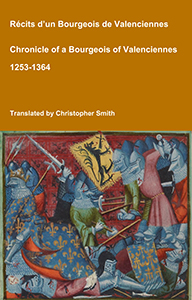
Chronicle of a Bourgeois of Valenciennes
Récits d’un bourgeois de Valenciennes aka The Chronicle of a Bourgeois of Valenciennes is a vivid 14th-century vernacular chronicle written by an anonymous urban chronicler from Valenciennes in the County of Hainaut. It survives in a manuscript that describes local and regional history from about 1253 to 1366, blending chronology, narrative episodes, and eyewitness-style accounts of political, military, and social events in medieval France, Flanders, and the Low Countries. The work begins with a chronological framework of events affecting Valenciennes and its region under rulers such as King Philip VI of France and the shifting allegiances of local nobility. It includes accounts of conflicts, sieges, diplomatic manoeuvres, and the impact of broader struggles like the Hundred Years’ War on urban life in Hainaut. Written from the perspective of a burgher (bourgeois) rather than a monastery or royal court, the chronicle offers a rare lay viewpoint on high politics and warfare, reflecting how merchants, townspeople, and civic institutions experienced the turbulence of the 13th and 14th centuries. Its narrative style combines straightforward reporting of events with moral and civic observations, making it a valuable source for readers interested in medieval urban society, regional politics, and the lived experience of war and governance in pre-modern Europe.
Available at Amazon in eBook and Paperback format.

15th September 1681. To Sir Samuel Morland's [aged 56], to see his house and mechanics.
17th September 1681. I went with Monsieur Faubert about taking the Countess of Bristol's [aged 61] house for an academy, he being lately come from Paris for his religion, and resolving to settle here.
23rd September 1681. I went to see Sir Thomas Bond's [aged 61] fine house and garden at Peckham, Surrey.

2nd October 1681. I went to Camberwell, Surrey [Map], where that good man Dr. Parr (late chaplain to Archbishop Usher) preached on Acts xvi. 30.

11th October 1681. To Fulham [Map], to visit the Bishop of London [aged 49], in whose garden I first saw the Sedum arborescens in flower, which was exceedingly beautiful.
5th November 1681. Dr. Hooper preached on Mark xii. 16, 17, before the King [aged 51], of the usurpation of the Church of Rome. This is one of the first rank of pulpit men in the nation.
15th November 1681. I dined with the Earl of Essex [aged 49] who, after dinner in his study, where we were alone, related to me how much he had been scandalized and injured in the report of his being privy to the marriage of his Lady's [aged 45] niece [aged 14], the rich young widow of the late Lord Ogle, sole daughter of the Earl of Northumberland; showing me a letter of Mr. Thynn's [aged 33], excusing himself for not communicating his marriage to his Lordship. He acquainted me also with the whole story of that unfortunate lady being betrayed by her grandmother, the Countess of Northumberland [aged 58], and Colonel Bret, for money; and that though, upon the importunity of the Duke of Monmouth [aged 32], he had delivered to the grandmother a particular of the jointure which Mr. Thynn pretended he would settle on the lady, yet he totally discouraged the proceeding as by no means a competent match for one that both by birth and fortune might have pretended to the greatest prince in Christendom; that he also proposed the Earl of Kingston [aged 21], or the Lord Cranburn, but was by no means for Mr. Thynn.


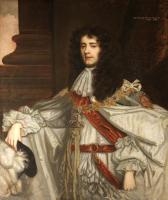
19th November 1681. I dined with my worthy friend, Mr. Erskine, Master of the Charter House, uncle to the Duchess of Monmouth [aged 30]; a wise and learned gentleman, fitter to have been a privy councillor and minister of state than to have been laid aside.
24th November 1681. I was at the audience of the Russian Ambassador [aged 64] before both their Majesties in the Banqueting House, Whitehall Palace [Map]. The presents were carried before him, held up by his followers in two ranks before the King's [aged 51] State, and consisted of tapestry (one suite of which was doubtlessly brought from France as being of that fabric, the Ambassador having passed through that kingdom as he came out of Spain), a large Persian carpet, furs of sable and ermine, etc.; but nothing was so splendid and exotic as the Ambassador who came soon after the King's restoration. This present Ambassador was exceedingly offended that his coach was not permitted to come into the Court, till, being told that no King's Ambassador did, he was pacified, yet requiring an attestation of it under the hand of Sir Charles Cotterell [aged 66], the Master of the Ceremonies; being, it seems, afraid he should offend his Master, if he omitted the least punctilio. It was reported he condemned his son to lose his head for shaving off his beard, and putting himself in the French mode at Paris, and that he would have executed it, had not the French King interceded-but qy. of this.


30th November 1681. Sir Christopher Wren [aged 58] chosen President [of the Royal Society], Mr. Austine, Secretary, with Dr. Plot, the ingenious author of the "History of Oxfordshire". There was a most illustrious appearance.