

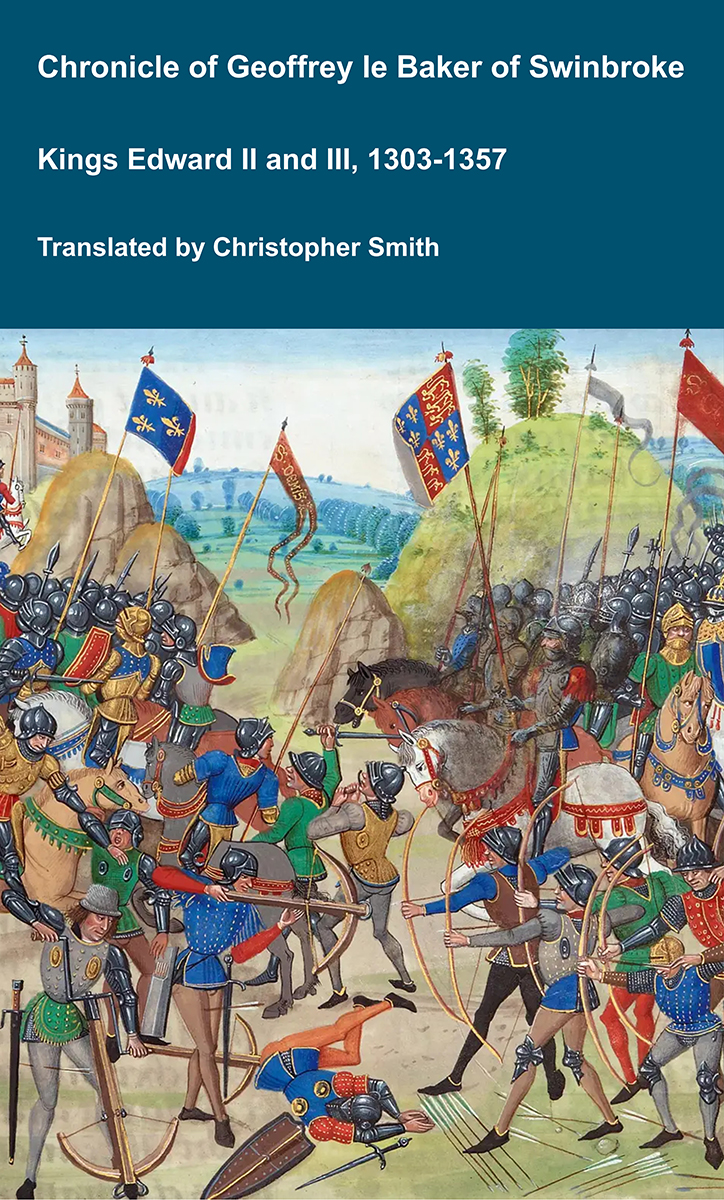
Chronicle of Geoffrey le Baker of Swinbroke
Baker was a secular clerk from Swinbroke, now Swinbrook, an Oxfordshire village two miles east of Burford. His Chronicle describes the events of the period 1303-1356: Gaveston, Bannockburn, Boroughbridge, the murder of King Edward II, the Scottish Wars, Sluys, Crécy, the Black Death, Winchelsea and Poitiers. To quote Herbert Bruce 'it possesses a vigorous and characteristic style, and its value for particular events between 1303 and 1356 has been recognised by its editor and by subsequent writers'. The book provides remarkable detail about the events it describes. Baker's text has been augmented with hundreds of notes, including extracts from other contemporary chronicles, such as the Annales Londonienses, Annales Paulini, Murimuth, Lanercost, Avesbury, Guisborough and Froissart to enrich the reader's understanding. The translation takes as its source the 'Chronicon Galfridi le Baker de Swynebroke' published in 1889, edited by Edward Maunde Thompson.
Available at Amazon in eBook and Paperback format.
Lancaster and York is in Modern Era.
Lancaster And York A Century Of English History. (A.D. 1399-1485). By Sir James H. Ramsay of Bamff, Bart., M.A. Barrister-At-Law; Late Student Of Christ Church. With Maps And Illustrations. Volume 2. 1892.
On the 14th May [1464] Montagu made a fresh start from Newcastle, with the Lords Greystock and Willoughby1. Next day they found the enemy some two or three miles Battle of from Hexham, on the south side of the Tyne, encamped at the Linnels, in a meadow of some fifteen or twenty acres on the banks of the Devil's Water; a nice sheltered camping-ground, if concealment was the object, but a very bad battle-field, a mere trap, in fact, with one entrance and no outlet, the meadow being enclosed on one side by the bushy banks of the river, and on the other side by steep wooded heights.
Note 1. Both of these had fought on Margaret's side at the second battle of St Albans ; neither apparently was at Towton, though Willoughby's father, Lord Welles, fell there. Willoughby was admitted to grace by Edward at Gloucester in September, 1461; Rot Pari. v. 617.