

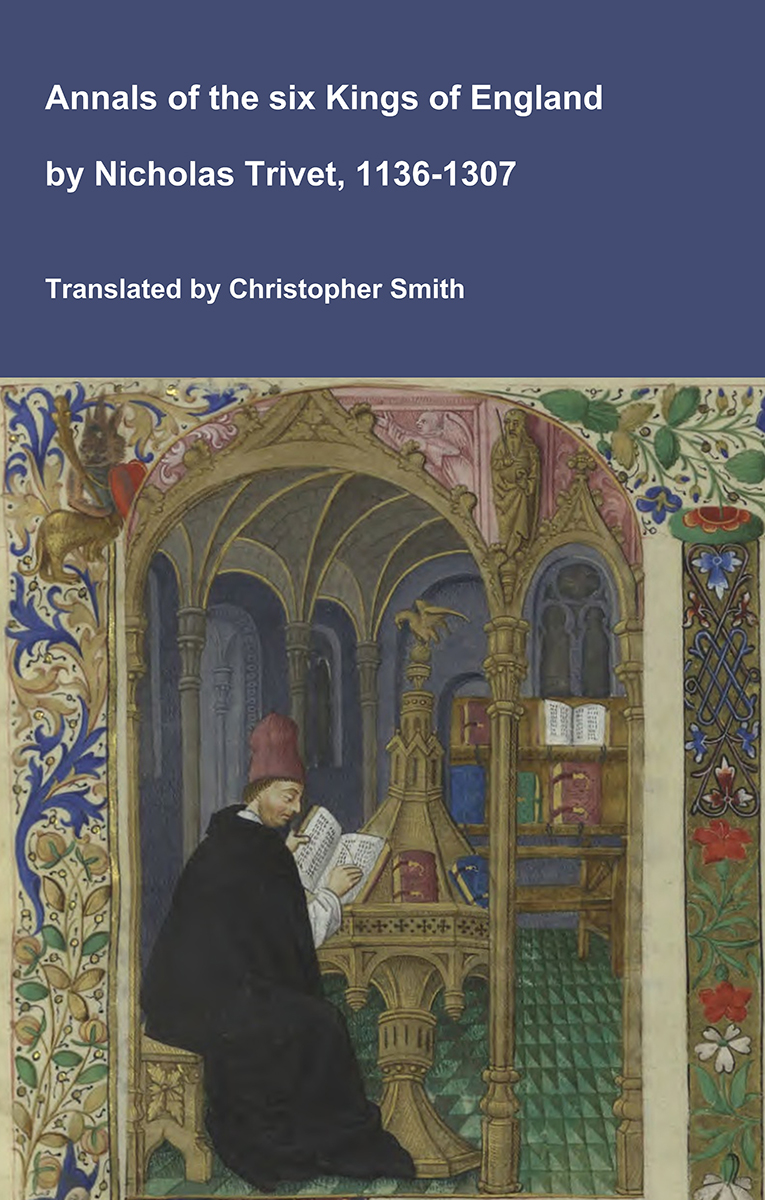
Annals of the six Kings of England by Nicholas Trivet
Translation of the Annals of the Six Kings of England by that traces the rise and rule of the Angevin aka Plantagenet dynasty from the mid-12th to early 14th century. Written by the Dominican scholar Nicholas Trivet, the work offers a vivid account of English history from the reign of King Stephen through to the death of King Edward I, blending political narrative with moral reflection. Covering the reigns of six monarchs—from Stephen to Edward I—the chronicle explores royal authority, rebellion, war, and the shifting balance between crown, church, and nobility. Trivet provides detailed insight into defining moments such as baronial conflicts, Anglo-French rivalry, and the consolidation of royal power under Edward I, whose reign he describes with particular immediacy. The Annals combines careful year-by-year reporting with thoughtful interpretation, presenting history not merely as a sequence of events but as a moral and political lesson. Ideal for readers interested in medieval history, kingship, and the origins of the English state, this chronicle remains a valuable and accessible window into the turbulent world of the Plantagenet kings.
Available at Amazon in eBook and Paperback format.
Liber de Antiquis Legibus is in Late Medieval Books.
1255. Sheriffs.: Matthew Bukerel, John le Mynur
23rd June 1255. This year, upon the Feast of Saint Eldreda [23 June] which was on a Sunday, the sister of the King of Spain, wife of Sir Edward, eldest son of his lordship the King, came to London, and a countless multitude of Bishops, Earls, Barons, Knights, and citizens, went forth from the City to meet her, as also his lordship the King, in person; the City of London being most nobly tapestried and arrayed.
In this year, seeing that it is specified in the Charters as to the Mayoralty, that the citizens may remove their Mayor at the end of the year, and substitute another, or retain him, if they will, on condition that he be presented to the King, Ralph Hardel was continued Mayor, and did not even vacate the Mayoralty, as all the Mayors before had been wont to do; and on the third day was presented to the King, sitting at the Exchequer, and there admitted, not being sworn, but only charged in accordance with the oath that he had made in the preceding year. On the same day, the King took the City into his hand, because the citizens, who had been repeatedly pressed for the1 Queen's Gold, would not agree to pay it; and so the City remained in the hands of the Treasurer, to whom the King had entrusted it, until the Octaves of Saint Martin [11 November]; on which day, by writ of his lordship the King, the City was restored to the citizens, in accordance with their request made at Windlesore.
Note 1. A compulsory charge of ten per cent in favour of the Queen Consort, upon certain fines.
22nd November 1255. In the same year, upon the Feast of Saint Cecilia [22 November], which was on a Monday, two-and-ninety Jews were brought to Westminster from Lincoln, and were imprisoned in the Tower of London, for the death of a certain male child, whom they purposely slew at Lincoln, in despite of the Christian faith. Eighteen of these, who, when the King was at Lincoln, had declined to put themselves upon the verdict of Christians, without Jews, as concerning that death, and had been then indicted for the same before the King, were on the same day drawn, and, after the hour of dinner, and towards the close of the day, hanged. The other 74 were taken back to the Tower.
30th November 1255. In the same year, Sir Edward, the King's eldest son, came to London from Gascoigne, on the Vigil of Saint Andrew [30 November], the City being handsomely hung with tapestry for the occasion.
1255. In this year, the Queen, for a sum of 400 marks, remitted to the citizens of London all claim which she had against them on account of her Gold; which Gold all the other men of the realm were wont to pay upon fine made to his lordship the King.
15th August 1255. In the same year, the King of Scotland and his Queen, daughter of the King of England, came into England, and, on the Assumption of Saint Mary [15 August] were with his lordship the King at Wudestok; upon which day, the said King held a great and most noble Court, nearly all his Earls and Barons being present.
29th August 1255. After this, on the Sunday before the Decollation of Saint John [29 August] the King of Scotland and his Queen came to London, the City being decorated and hung with tapestry.
Archaeologia Volume 29 Section XIII. When the body of the Queen was approaching London, the King, accompanied, says Walsingham, by the whole Nobility, Prelates, and other dignified Clergy, went forth to meet it. Five and thirty years before the Queen had been welcomed with equal splendour, but with far different feelings, by Henry the Third, when she arrived first in London, a young and beautiful bridei. The citizens on that occasion manifested their joy in a manner still practised on the continent, by hanging the fronts of their houses with tapestry. Now was a time for sorrow, there never having been a royal consort of England who had won more of the people's love than she.
Note i. There is an account of this in the City of London Chronicle, the Liber de Antiquis Legibus, as it is called.