

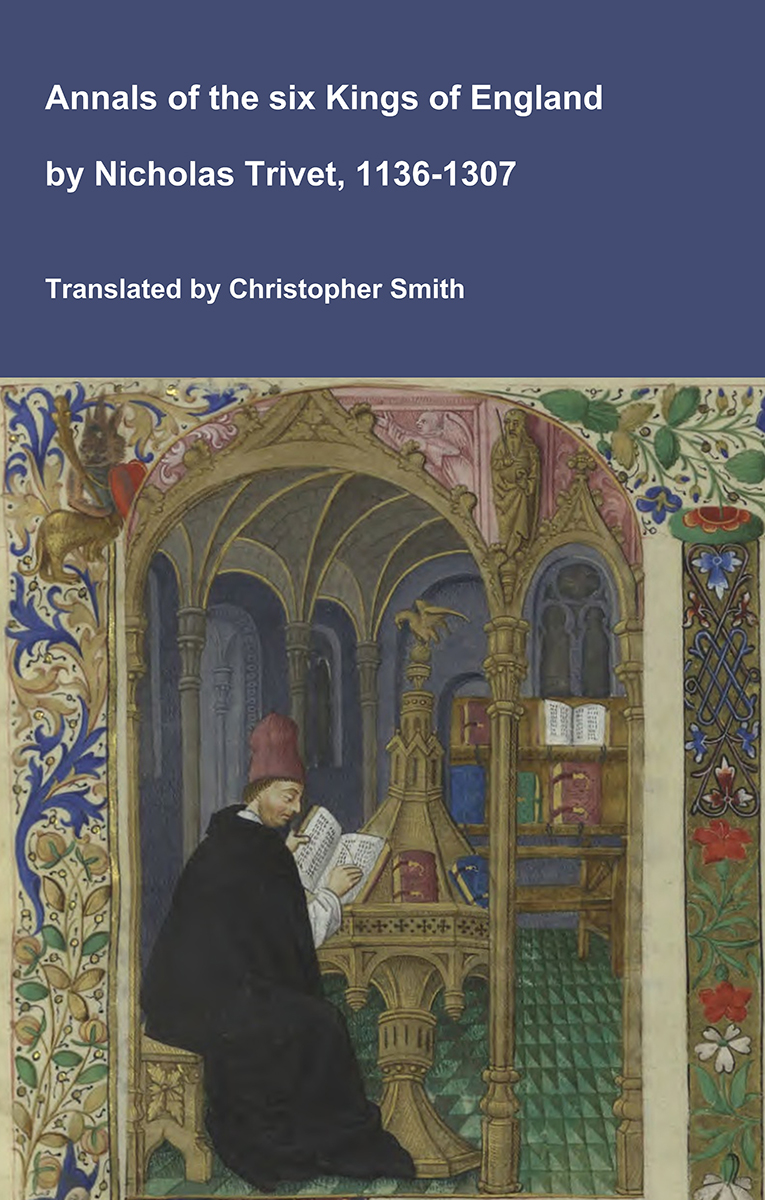
Annals of the six Kings of England by Nicholas Trivet
Translation of the Annals of the Six Kings of England by that traces the rise and rule of the Angevin aka Plantagenet dynasty from the mid-12th to early 14th century. Written by the Dominican scholar Nicholas Trivet, the work offers a vivid account of English history from the reign of King Stephen through to the death of King Edward I, blending political narrative with moral reflection. Covering the reigns of six monarchs—from Stephen to Edward I—the chronicle explores royal authority, rebellion, war, and the shifting balance between crown, church, and nobility. Trivet provides detailed insight into defining moments such as baronial conflicts, Anglo-French rivalry, and the consolidation of royal power under Edward I, whose reign he describes with particular immediacy. The Annals combines careful year-by-year reporting with thoughtful interpretation, presenting history not merely as a sequence of events but as a moral and political lesson. Ideal for readers interested in medieval history, kingship, and the origins of the English state, this chronicle remains a valuable and accessible window into the turbulent world of the Plantagenet kings.
Available at Amazon in eBook and Paperback format.
Lives of the Queens of England is in Victorian Books.
There is, however, some reason to doubt whether the mangled remains of this hapless queen repose in the place generally pointed out in St Peter's church, of the Tower, as the spot where she was interred. It is true, that her warm and almost palpitating form was there conveyed in no better coffin than an old elm-chest that had been used for keeping arrows1, and there, in less than half-an-hour after the executioner had performed his part, thrust into a grave that had been prepared for her by the side of her murdered brother. And there she was interred, without other obsequies than the whispered prayers and choking sobs of those true-hearted ladies who had attended her on the scaffold, and were the sole mourners who followed her to the grave. It is to be lamented that history has only presented one name out of this gentle sisterhood, that of Mary Wyatt, when all were worthy to have been inscribed in golden characters in every page sacred to female tenderness and charity.
Note 1. Sir John Spelman's Notes Id Burnet.
In Anne Boleyn's native county, Norfolk, a curious tradition has been handed down from father to son, for upwards of three centuries, which affirms that her remains were secretly removed from the Tower church under cover of darkness, and privately conveyed to Salle church [Map], the ancient burial-place of the Boleyns1,' and there interred at midnight, with the holy rites that were denied to her by her royal husband at her first unhallowed funeral. A plain black marble slab, without any inscription, is still shown in Salle church as a monumental memorial of this queen, and is generally supposed, by all classes of persons, in that neighborhood, to cover her remains. 'The mysterious sentence with which Wyatt closes his eloquent memorial of the death of this unfortunate queen affords a singular confirmation of the local tradition of her removal and reinterment:—"God," says he, "provided for her corpse sacred burial, even in a place as it were consecrate to innocence2." This expression would lead us to infer that Wyatt was in the secret, if not one of the parties who assisted in the exhumation of Anne Boleyn's remains, if the romantic tradition we have repeated be indeed based on facts. After all, there is nothing to violate probability in the tale, romantic though it be. King Henry, on the day of his queen's execution, tarried no longer in the vicinity of his metropolis than till the report of the signal gun, booming faintly through the forest glade, reached his ear, and announced the joyful tidings that he had been made a widower. He then rode off at fiery speed to his bridal orgies at Wolf hall. With him went the confidential myrmidons of his council, caring little, in their haste to offer their homage to the queen of the morrow, whether the mangled form of the queen of yesterday was securely guarded in the dishonored grave into which it had been thrust with indecent haste that noon. There was neither singing nor saying for her, —no chapelle ardente, nor midnight requiem, as for other queens; and, in the absence of these solemnities, it was easy for her father, for Wyatt, or even for his sister, to bribe the porter and sextons of the church to connive at the removal of the royal victim's remains. That old elm chest could excite no suspicion when carried through the dark narrow streets and the Aldgate portal of the city to the eastern road: it probably passed as a coffer of stores for the country, no one imagining that such a receptacle enclosed the earthly relics of their crowned and anointed queen.
Note 1. The stately tower of Salle church is supposed to be the tallest in Norfolk, and it is certainly one of the most magnificent in the east of England. The profound solitude of the neighbourhood where this majestic fane rises in lonely grandeur, remote from the haunts of village life, must have been favourable for the stolen obsequies of the distinguished queen, if the tradition were founded on fact. Her father was the lord of the soil, and all his Norfolk ancestry were buried in that church. It is situated between Norwich and Reepham, on a gentle eminence.
Note 2. Singer's edition of Cavendish's Wolsey, vol. ii. p. 215.
It is remarkable that in the ancient church of Horndonon-the-Hill, in Essex, a nameless black marble monument is also pointed out by village antiquaries as the veritable monument of this queen1. The existence of w similar tradition of the kind in two different counties, but in both instances in the neighborhood of sir Thomas Boleyn's estates, can only be accounted for on the supposition that rumors of the murdered queen's removal from the Tower chapel were at one time in circulation among the tenants and dependents of her paternal house, and were by them orally transmitted to their descendants as matter of fact. Historical traditions are, however, seldom devoid of some kind of foundation; and whatever be their discrepancies, they frequently afford a shadowy evidence of real but unrecorded events, which, if steadily investigated, would lend a clue whereby things of great interest might be traced out. A great epic poet? of our own times has finely said:—
"Tradition. Oh, tradition! thou of the seraph tongue,
The ark that links two ages, the ancient and the young."
Note 1. I am indebted to my amiable and highly-gifted friend, lady Petre, for this information, and also for the following description of the monument, which is within a narrow window-seat: The black marble or touchstone that covers it rises about a foot between the seat and the window, and is of a rough description: it has rather the appearance of a shrine that has been broken open. It may have contained her head or her heart, for it is too short to contain a body, and indeed seems to be of more ancient date than the sixteenth century. The oldest people in the neighborhood all declare that they have heard the tradition in their youth, from a previous generation of aged persons, who all affirmed it to be Anne Boleyn's monument. Horndon-on-the-Hill is about a mile from Thorndon hall, the splendid mansion of lord Petre, and sixteen miles from Newhall, once the seat of sir Thomas Boleyn, and afterwards a favorite country palace of Henry 8th, who tried to change its name to Beaulieu; but the force of custom was too strong even for the royal will in that neighborhood, and Beaulieu is forgotten in the original name.
A book in the college of Arms supplies the following particulars of the obsequies of Henry VIII : "The chest wherein the royal corpse was laid stood in the midst of the privy-chamber, with- lights; and divine service was said about him, with masses, obsequies, and continual watch made by the chaplains and gentlemen of the privy-chamber, in their course and order, night and day for five days, till the chapel was ready, where was a goodly hearse with eighty square tapers, every light containing two feet in length,—in the whole 1800 or 2000 weight in wax, garnished with pensils, escutcheons, banners, and bannerols of descents; and at the four corners, banners of saints, beaten in fine gold upon damask, with a majesty (i.e, canopy) over of rich cloth of tissue, and valance of black silk, and fringe of black silk and gold. The barriers without the hearse, and the sides and floor of the chapel, were covered with black cloth to the high altar, and the sides and ceiling set with the banners and standards of St. George and others. The 2d of February [1547] the corpse was removed and brought into the chapel, by the lord great-master and officers of the household, and there placed within the hearse, under a pall of rich cloth of tissue garnished with scutcheons, and a rich cloth of gold set with precious stones. It continued there twelve days, with masses and diriges sung and said every day, Norroy each day standing at the choir-door, and beginning with these words in a loud voice:—‘Of your charity pray for the soul of the high and mighty prince, our late sovereign lord and king, Henry VIII.'" February 14th, the corpse was removed for interment
There is an appalling incident connected with that journey which we copy from a contemporary document among the Sloane collection: "The king, being carried to Windsor to be buried, stood all night among the broken walls of Sion [Abbey] [Map], and there the leaden coffin being cleft by the shaking of the carriage, the pavement of the church was wetted with Henry's blood. In the morning came plumbers to solder the coffin, under whose feet—I tremble while I write it," says the author—"was suddenly seen a dog creeping and licking up the king’s blood. If you ask me how I know this, I answer, William Greville, who could scarcely drive away the dog, told me, and so did the plumber also." It appears certain that the sleepy mourners and choristers had retired to rest after the midnight dirges were sung, leaving the dead king to defend himself as best he might from the assaults of his ghostly enemies, and some people might think they made their approaches in a currish form. It is scarcely, however, to be wondered that a circumstance so frightful should have excited feelings of superstitious horror, especially at such a time and place; for this desecrated convent had been the prison of his unhappy queen, Katharine Howard, whose tragic fate was fresh in the minds of men, and, by a singular coincidence, it happened that Henry’s corpse rested there the very day after the fifth anniversary of her execution. There is a class of writers who regard the accident which has just been related as a serious fulfilment of friar Peyto’s denunciation against Henry from the pulpit of Greenwich church in 1553, when that daring preacher compared him to Ahab, and told him to his face, "that the dogs would, in like manner, lick his blood1." In a very different light was Henry represented by bishop Gardiner in the adulatory funeral sermon which he preached at Windsor, on the 16th of February, on the text, "Blessed are the dead who die in the Lord," in which he enlarged on his virtues, and lamented the loss both high and low had sustained in the death of so good and gracious a king.
Note 1. Tytler’s State-Papers, pp. 20, 21.
But to return to the ceremonial. "The corpse, being conveyed with great pomp to St. George’s chapel, Windsor castle, was then interred [on 16th February 1547], let down into the vault by means of a vice, with the help of sixteen tall yeomen of the guard; the same bishop [Gardiner (age 64)], standing at the head of the vault, proceeded in the burial service, and about the same stood all the head officers of the household,—as the lord great-master, the lord chamberlain, lord treasurer, lord comptroller, sergeant-porter, and the four gentlemen ushers in ordinary, with their staves and rods in their hands; and when the mould was brought and cast into the grave by the officiating prelate, at the words ‘pulvis pulveri, cinis cineri [dust to dust, ashes to ashes], then first the lord great-master, and after him the lord chamberlain and all the rest break their staves in shivers upon their heads, and cast them after the corpse into the pit with exceeding sorrow and heaviness, not without grievous sighs and tears. After this, De profundis was said, the grave covered over with planks, and Garter, attended by his officers, stood in the midst of the choir and proclaimed the young king’s titles, and the rest of his officers repeated the same after him thrice. Then the trumpets sounded with great melody and courage, to the comfort of all them that were present1," acting as a cordial to the official weepers, it may be presumed, after their hydraulic efforts were concluded. On the banners carried at Henry VIII.’s funeral, the arms of his late wife, queen Jane, were displayed, quartered with his; likewise a banner of the arms of queen Katharine Parr2, his widow,—these being the only wives he acknowledged out of six.
Note 1. MS. in college of Arms.
Note 2. "Tn the east window of the hall of Baynard’s Castle," Sandford says, "stood the escutcheon of this queen, Katharine Parr, which I delineated from the original on the 8th of November, 1664, in which she did bear quarterly of six pieces :—the Ist, argent, on a pile, gules, betwixt six roses of the first, the roses of the second, which was an augmentation given to her, being queen. 2. Argent, two bars, azure, a border engrailed, sable, Parr. 3. Or, three waterbougets, sable, Roos of Kendal. 4. Varry, argent and azure, a fess, gules, Marmion. 5. Three chevrons interlaced in base, and a chief, or, Fitzhugh. 6. Vert, three bucks, standing at gaze, or, Green. These quarterings are ensigned with a royal crown, and are between a K and a P, for Katharine Parr."’ —Genealogical Hist. of England, fol. ed. p. 460. One of the badges of ‘Parr, marquess of Northampton, borne by him at a review of the gentlemen pensioners in Greenwich park, was a maiden’s head, crowned with gold.