


Text this colour links to Pages. Text this colour links to Family Trees. Text this colour are links that disabled for Guests.
Place the mouse over images to see a larger image. Click on paintings to see the painter's Biography Page.
Mouse over links for a preview. Move the mouse off the painting or link to close the popup.
Abbot John Whethamstede’s Chronicle of the Abbey of St Albans
Abbot John Whethamstede's Register aka Chronicle of his second term at the Abbey of St Albans, 1451-1461, is a remarkable text that describes his first-hand experience of the beginning of the Wars of the Roses including the First and Second Battles of St Albans, 1455 and 1461, respectively, their cause, and their consequences, not least on the Abbey itself. His text also includes Loveday, Blore Heath, Northampton, the Act of Accord, Wakefield, and Towton, and ends with the Coronation of King Edward IV. In addition to the events of the Wars of the Roses, Abbot John, or his scribes who wrote the Chronicle, include details in the life of the Abbey such as charters, letters, land exchanges, visits by legates, and disputes, which provide a rich insight into the day-to-day life of the Abbey, and the challenges faced by its Abbot.
Available at Amazon in eBook and Paperback format.
Magna Britannia Volume 4 is in Magna Britannica.
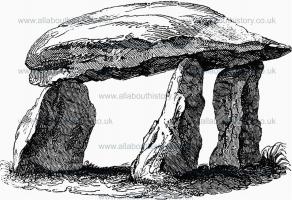
1807 The cromlech [Drewsteighton Cromlech aka Spinsters' Rock, Devon [Map]] at Drewe's Teignton, of which much has been said and written, has been supposed by some to have been the sepulchre of an arch-druid: that it was sepulchral there is little doubt; and from the rarity of such monuments, it is most probable that it was for some eminent person; but there is no more reason for supposing that it had any thing to do with druidism, than that the name of Drewe's Teignton was derived from that source.1 This cromlech is on a tenement called Shilston. It is of moor-stone, about 12 feet in length, and about nine feet wide in the widest part. The supporting stones are from six feet to six feet and a half to the under part of the covering stone.
The sketch beneath is from an accurate drawing, made by my brother, in 1807.
Note 1. See "Cornwall," General History, p. clxxxii. clxxxiv. and ccxvii., on the subject of Logan stones and rock basins, and p. 493. of this volume, as to the name of Drewe's Teignton; to which may be added, that there is no authority whatever for the place having been so called before the time of Drewe de Teignton. The natural excavations called Rock basins, occur in numerous places on the granite rocks of Dartmoor, &c. The most celebrated Logan stone in Devon is that on the banks of the Teign, in the parish of Drewe's Teignton; but I am informed that the motion is now scarcely perceptible. A natural pile of rocks in the parish of Manaton, called Bowerman's Nose, somewhat resembling the Cheesewring near Alternon, in Cornwall, has, by some enthusiasts in druidism, been supposed to have been a rock-idol.