

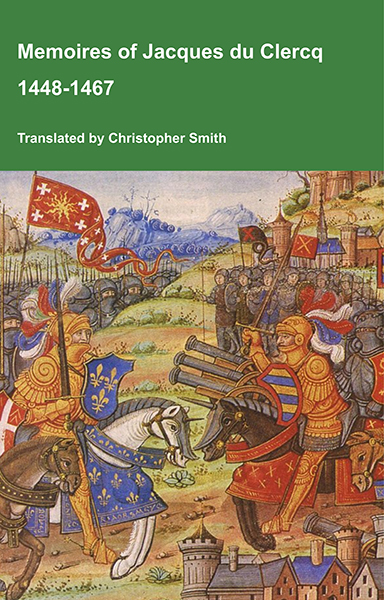
This is a translation of the 'Memoires of Jacques du Clercq', published in 1823 in two volumes, edited by Frederic, Baron de Reissenberg. In his introduction Reissenberg writes: 'Jacques du Clercq tells us that he was born in 1424, and that he was a licentiate in law and a counsellor to Philip the Good, Duke of Burgundy, in the castellany of Douai, Lille, and Orchies. It appears that he established his residence at Arras. In 1446, he married the daughter of Baldwin de la Lacherie, a gentleman who lived in Lille. We read in the fifth book of his Memoirs that his father, also named Jacques du Clercq, had married a lady of the Le Camelin family, from Compiègne. His ancestors, always attached to the counts of Flanders, had constantly served them, whether in their councils or in their armies.' The Memoires cover a period of nineteen years beginning in in 1448, ending in in 1467. It appears that the author had intended to extend the Memoirs beyond that date; no doubt illness or death prevented him from carrying out this plan. As Reissenberg writes the 'merit of this work lies in the simplicity of its narrative, in its tone of good faith, and in a certain air of frankness which naturally wins the reader’s confidence.' Du Clercq ranges from events of national and international importance, including events of the Wars of the Roses in England, to simple, everyday local events such as marriages, robberies, murders, trials and deaths, including that of his own father in Book 5; one of his last entries.
Available at Amazon in eBook and Paperback format.
Memoirs of Thomas Seddon is in Victorian Books.
Memoir and Letters of the late Thomas Seddon, Artist. By his brother London: James Nisbet And Co., 21 Berners Street. M.DCCC.LVIII [1858].
It appears that on his arrival in Egypt, those that had known him during his previous residence there remarked how much paler and thinner he appeared. There can be no doubt that he had suffered fearfully during the voyage, from the unwholesome diet and want of comfort in the vessel, combined with the boisterous weather; and perhaps he exerted himself too much immediately after his arrival.
17th November 1856. He was missed from his accustomed place in church on the Sunday after he had removed to Old C^iro; and the Eev. Mr Lieder, the Church of England missionary, hearing that he had been ill, rode down after service to see him. He foimd him in a state of extreme prostration, the result of dysentery, and the next day, November the 17th, he most kindly removed him to his own house, and nothing could exceed the care and attention he received there from Mrs Lieder and her friend Miss Daniell, who resided with them.
The remedies of Dr Abbott, who continued to attend him, appeared to have overcome the disorder, but though everything was done that medical skill or Christian kindness could devise, his strength rapidly gave way. The manner in which he was then repaid, by the hands of strangers, for all the devotedness with which he had himself watched by the dying bed of Mr Nicholson, in circumstances similar to those in which he was now placed, is too remarkable to be passed without notice. He seemed to be quite unconscious of his danger, and spoke hopefully of the future, yet expressing entire resignation to God's will. He was throughout calm and devotional trusting fully in the atoning blood of his Eedeemer; he was often engaged in silent prayer, and spoke frequently of the importance of hallowing the Sabbath, and of the barrier it presents to the influx of worldliness. Once he remarked, "When I recover I will have no compromise between religion and the world: I will, with the Lord's help, be wholly on the Saviour's side,"
23rd November 1856. Those around him [Thomas Seddon (age 35)] were so satisfied with his frame of mind, that as long as there was any hope of his recovery they forbore alluding to the probability of a fatal termination to his disorder, lest in his enfeebled state it might prove hurtful; and when, on Thursday the 20th, it became sadly apparent that his hours were numbered, he sank into unconsciousness, and remained in that state until he gently expired at 3 a.m. on Sunday, November the 23d.
[After 23rd November 1856] He [Thomas Seddon (deceased)] was buried with all due solemnity in the same small cemetery whither he had, two years before, followed the remains of Mr Nicholson, and which he has touchingly described in a letter written at that time. A marble slab, with a simple, plain cross standing thereon, bearing the following inscription at its foot: "To me to live is Christ, and to die is gain," will mark the spot where his remains rest. On the slab is engraved—
Thomas Seddon, Artist,
Who Died At Cairo, The 23d of November, 1856, Aged 35.
To which is added a verse from one of his favourite hymns —
"Thou art gone to the grave, but we will not deplore thee.
Whose God was thy ransom, thy guardian, thy guide;
He gave thee. He took thee, and He will restore thee,
And death has no sting, for the Saviour hath died."1
Note 1. His family have since learned with unfeigned pleasure, that before this memorial had arrived in Egypt, a marble headstone bearing his name, with the words, "Erected by a friend," already marked his grave. In gratitude for this kindness from an unknown friend, they cannot but desire that this headstone may remain in connexion with the slab that has been sent over by his widow.
The surprise and sorrow which the tidings of his death awakened throughout the whole circle of his friends and acquaintance cannot eaily be described. His buoyant spirits and sparkling wit, but, in a still greater degreef his unselfish and affectionate nature, had rendered him the life and soul of the society in which he moved. The reputation he had already won gave such promise for the future that much fruit had been expected from this second Eastern journey; and he had so recently left in cheerful spirits and good hope, that this sudden and unlooked-for termination to his labours and his life cast quite a gloom over those that knew him.