

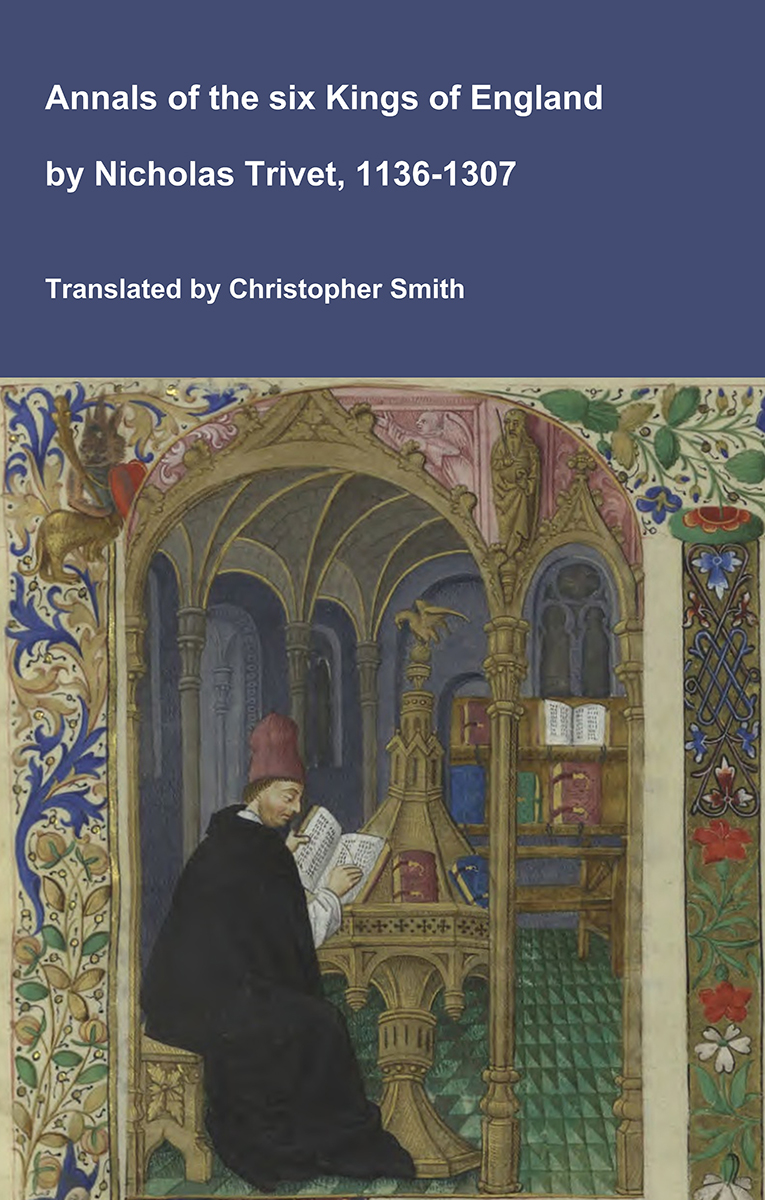
Annals of the six Kings of England by Nicholas Trivet
Translation of the Annals of the Six Kings of England by that traces the rise and rule of the Angevin aka Plantagenet dynasty from the mid-12th to early 14th century. Written by the Dominican scholar Nicholas Trivet, the work offers a vivid account of English history from the reign of King Stephen through to the death of King Edward I, blending political narrative with moral reflection. Covering the reigns of six monarchs—from Stephen to Edward I—the chronicle explores royal authority, rebellion, war, and the shifting balance between crown, church, and nobility. Trivet provides detailed insight into defining moments such as baronial conflicts, Anglo-French rivalry, and the consolidation of royal power under Edward I, whose reign he describes with particular immediacy. The Annals combines careful year-by-year reporting with thoughtful interpretation, presenting history not merely as a sequence of events but as a moral and political lesson. Ideal for readers interested in medieval history, kingship, and the origins of the English state, this chronicle remains a valuable and accessible window into the turbulent world of the Plantagenet kings.
Available at Amazon in eBook and Paperback format.
Memorials of Charlotte Williams-Wynn is in Victorian Books.
1st November 1854. London, November 1, 1854. We landed at Dover on the 13th, and since then have had so much business and anxiety that I have really lived only upon the newspapers. On our arrival we were met by the news of the death of my cousin, Arthur Williams-Wynn, in that fearful battle. For two others we are also in mourning, though they were not such near relations. My poor Uncle, Sir Henry (age 71), has been quite overwhelmed by his loss - his favourite son, and the one whom he trusted was coming home to many and live with him! Every alleviation that the case admitted of they have. The poor (?) boy had a presentiment he should fall, and wrote the day before to take leave of his father and sister, expressing his last wishes. The next evening he was found surrounded by his brother-officers close to the Russian gun, lying sword in hand, the ball having passed through his forehead. He evidently had died instantaneously, and for this exemption from suffering we are most thankful, for the thought of the long agony that the wounded went through is a horrible one. In truth, one never realised before what war is; you all know it well, and our fathers knew it! I do not think, if I had a dozen brothers there, that I could feel more anxiety. The mourning is sadly general, hardly a family that has not suffered remotely, and London looks very melancholy from the quantity of black worn in the streets, although this proceeds from the ravages which the cholera made rather than from those of the war. We are all busy sending out chaplains and nurses, and surgeons and comforts, to the sick and wounded - but to me it is just as bad to read, as I did to-day in the Times, that the air is tainted with the number of Russians who have fallen, as if they were our soldiers. It is the fact that such scenes are going on that burdens one's spirit!