

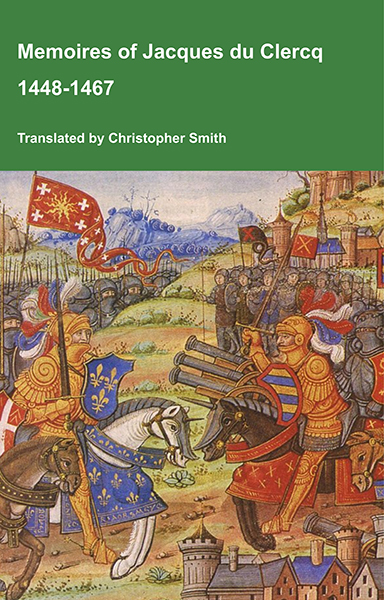
This is a translation of the 'Memoires of Jacques du Clercq', published in 1823 in two volumes, edited by Frederic, Baron de Reissenberg. In his introduction Reissenberg writes: 'Jacques du Clercq tells us that he was born in 1424, and that he was a licentiate in law and a counsellor to Philip the Good, Duke of Burgundy, in the castellany of Douai, Lille, and Orchies. It appears that he established his residence at Arras. In 1446, he married the daughter of Baldwin de la Lacherie, a gentleman who lived in Lille. We read in the fifth book of his Memoirs that his father, also named Jacques du Clercq, had married a lady of the Le Camelin family, from Compiègne. His ancestors, always attached to the counts of Flanders, had constantly served them, whether in their councils or in their armies.' The Memoires cover a period of nineteen years beginning in in 1448, ending in in 1467. It appears that the author had intended to extend the Memoirs beyond that date; no doubt illness or death prevented him from carrying out this plan. As Reissenberg writes the 'merit of this work lies in the simplicity of its narrative, in its tone of good faith, and in a certain air of frankness which naturally wins the reader’s confidence.' Du Clercq ranges from events of national and international importance, including events of the Wars of the Roses in England, to simple, everyday local events such as marriages, robberies, murders, trials and deaths, including that of his own father in Book 5; one of his last entries.
Available at Amazon in eBook and Paperback format.
Observations Jure Ducatus is in Victorian Books.
Seventy-Seventh Proposition
If the conclusions contained in all the aforegoing Propositions had rested merely on the unsanctioned opinions of the Auditor, he would STILL have presumed (with that humility and diffidence which becomes him) to submit them, with the evidence in their support, to the better judgment and decision of others; but now, sanctioned and supported as those opinions are by the high legal AUTHORITIES of the Lords KENYON and ELLENBOROUGH, he does not hesitate to assert them with a confidence which those authorities may justly entitle him to assume.
The numerous Cases of Fact and Precedent, which have been brought to light (by the Auditor, with the able assistance of Mr. Hardy,) from existing, but long concealed Records, in support of these DUCHY Rights, commence with the FORFEITURE of Lands, & c., in GLOUCESTERSHIRE, by Sir John de Minsterworth1, for HIGH TREASON, (47 Edward III., A. D. 1373.) The Precedents which have been adduced of the ACTUAL OCCUPATION, and BENEFICIAL enjoyment Jure DUCATUS of Lands forfeited for HIGH TREASON, may be considered as terminating in the 26th Elizabeth (A. D. 1584), a period of Two HUNDRED and ELEVEN Years. The ASSERTION by the Duchy Officers of the RIGHT to SUCH Forfei- tures may be considered as coming down to the 6th of Queen Anne (A. D. 1708), a period of THREE HUNDRED and THIRTY - FOUR Years. The DUCHY Rights to ESCHEATS, propter DEFECTUM SANGUINIS, within its FEES and Liberties, may be considered as terminating with the opinion of the late Lord ELLENBOROUGH, A. D. 1800; a period which, from the date of the Forfeiture of Sir John de Minsterworth, embraces a space of no less than FOUR HUNDRED and TWENTY - SEVEN Years. May it not be said, with confidence, that these Cases of Recorded Fact and Precedent, (with one solitary exception of the Error in the reign of Henry IV., for which a reason has with diffidence been offered in explanation,) demonstrate that the practical consequences, which have before been stated, and proved, are the results of the necessary CONCLUSIONS IN LAW, deducible from them, according to the UNIFORM professional opinions of every Attorney and Solicitor - General of the King Jure CORONE, for the time being, throughout this long period? May they not be said to be decisive of the Law of the Land, down to a very RECENT period? Since that very recent period (A. D. 1800), nothing has occurred to shake its validity, excepting the opinions of the late Mr. Perceval (in Potgeisser's Case), and of the late and present Attornies and Solicitors - General, which, with great humility, and a sincere, conscientious feeling of his own inefficiency, the Auditor, in discharge of his zealous and sworn duty to the King, will shortly presume to consider.
Note 1. It is a circumstance, not as affecting the present Question, but as not altogether undeserving of notice as an historical fact, that at the DATE of this Forfeiture to John of Gaunt of the Lands of Sir John de Minsterworth, in Gloucestershire, for HIGH TREASON, there was no Earl PALATINE of Lancaster in existence, Henry, the 4th Earl and 1st Duke, being created Earl Palatine for HIS LIFE only, 25 Edward III. He died in the 35th Edward III., when the PALATINATE ceased as such to exist. And it was not re - erected into a PALATINATE until sixteen years afterwards, in the 51st Edward III., and then for LIFE of JOHN of GAUNT only: -this was confirmed by Statute 2 Richard II., and in the thirteenth year of his Reign, the PALATINATE was extended to the Heirs Male of JOHN of GAUNT.