

William of Worcester's Chronicle of England
William of Worcester, born around 1415, and died around 1482 was secretary to John Fastolf, the renowned soldier of the Hundred Years War, during which time he collected documents, letters, and wrote a record of events. Following their return to England in 1440 William was witness to major events. Twice in his chronicle he uses the first person: 1. when writing about the murder of Thomas, 7th Baron Scales, in 1460, he writes '… and I saw him lying naked in the cemetery near the porch of the church of St. Mary Overie in Southwark …' and 2. describing King Edward IV's entry into London in 1461 he writes '… proclaimed that all the people themselves were to recognize and acknowledge Edward as king. I was present and heard this, and immediately went down with them into the city'. William’s Chronicle is rich in detail. It is the source of much information about the Wars of the Roses, including the term 'Diabolical Marriage' to describe the marriage of Queen Elizabeth Woodville’s brother John’s marriage to Katherine, Dowager Duchess of Norfolk, he aged twenty, she sixty-five or more, and the story about a paper crown being placed in mockery on the severed head of Richard, 3rd Duke of York.
Available at Amazon in eBook and Paperback format.
On Three Chroniclers by Jean Stengers is in Modern Era.
For the original French text see the Free University of Brussels 'Sur trois chroniqueurs: Note sur les rapports entre la continuation anonyme de Monstrelet, les "Mémoires" de Jacques du Clercq et les "Chronique d'Angleterre" de Jean de Wavrin', oai:dipot.ulb.ac.be:2013/250509, here.
Jean Stengers, Research Fellow of the F.N.R.S. On Three Chroniclers. A Note on the Relationships between the Anonymous Continuation of Monstrelet, the 'Memoirs' of Jacques du Clercq, and the 'Chronicles of England' of Jean de Wavrin. Extract of the Annals of Burgundy.
ON THREE CHRONICLERS
A Note on the Relationships between the Anonymous Continuation of Monstrelet, the 'Memoirs' of Jacques du Clercq, and the 'Chronicles of England' of Jean de Wavrin.
The Ancient Chronicles of England by Jean de Wavrin, the anonymous continuation of Monstrelet, and the 'Memoirs' of Jacques du Clercq present striking textual similarities among themselves. One need only read, for example, in these three chronicles the account of the reconciliation of Philip the Good with his son in April 1465 — a reconciliation followed by the session of the Estates General at which the old duke announces that he is placing the Count of Charolais at the head of the army sent into France to fight Louis XI1. The few fairly slight formal differences that may be observed from one text to another do not prevent the reader from recognizing at first glance the fundamental identity of the three versions: it is clearly one and the same narrative.
Note 1. Wavrin, ed. Hardy, vol. V, pp. 468–469; Monstrelet, vol. III, fo III ro; Du Clercq, ed. Reiffenberg, vol. IV, pp. 137–139 (see above for the full references to these three works).
'Coincidences' of this kind are fairly frequent in the chronicles I have just cited. They raise a problem, namely that of the mutual relationship of the three texts. To examine the way in which this problem has hitherto been resolved, to test the value of the earlier solutions, and, if need be, to propose new ones: such is the purpose I set before myself here.
The early editions — from the sixteenth and seventeenth centuries1 — of the chronicle of Monstrelet offered a continuous narrative running from the year 1400 to 1467; these three-quarters of a century of history were presented as being entirely the work of Enguerrand de Monstrelet. It required the perceptive eye of Dacier to detect the deception. In his learned Memoir on the Life and Chronicles of Enguerrand de Monstrelet, published in 1786 in the Mémoires de l'Académie des Inscriptions et Belles-Lettres (vol. 43)2, Dacier established that Monstrelet's own work ended in 1444; moreover, the chronicler, having died in 1453, would in any case have been quite unable to continue his work to 1467. From 1444 to 1467, one is dealing with an anonymous continuation. Dacier noted in it numerous textual borrowings from the Grandes Chroniques de France. Furthermore, having become aware of a notice concerning a copy of the Memoirs of Jacques du Clercq providing the table of chapters of that work, he observed such conformity in the arrangement of material with the continuation of Monstrelet that he declared it 'impossible that two writers should coincide so exactly, unless one had worked from the other.' He therefore concluded that either one of the two authors had copied the other, or that Jacques du Clercq himself was the author of the continuation of Monstrelet.
Note 1. Listed in J. Lelong, Bibliothèque historique de la France, new edition, revised by Févret de Fontette, vol. II, Paris, 1769, p. 195, no. 17,295, and in J.-Ch. Brunet, Manuel du Libraire, vol. III, Paris, 1862, cols. 1831–1832. I make use of the 1603 edition (Chronicle of Enguerrand de Monstrelet… beginning in the year 1400… and ending in the year 1467, 3 vols., Paris, Marc Orry, 1603), which is in fact the same as those of 1572 and 1595; only the title page, with the date, has been replaced (cf. Lelong, op. cit.).
Note 2. Memoir reproduced in the Buchon edition of the Chronicles of Enguerrand de Monstrelet, vol. I, Paris, 1826, pp. 1–45 (Collection of French National Chronicles).
Note 3. Op. cit., p. 55
Note 4. Ibid., p. 560-561.
In 1823, Baron de Reiffenberg published for the first time the Memoirs of Jacques du Clercq1 — memoirs covering the period 1448–1467. He based his edition on a copy preserved in Brussels2, which had been made in the eighteenth century by order of Cobenzl from a manuscript of du Clercq kept at the abbey of Saint-Vaast at Arras. Of this latter manuscript — which he believed to be the original — the Baron de Reiffenberg had at first vainly tried to obtain access3. A little later, however, he succeeded in doing so and discovered that the Arras4 manuscript was itself a copy dating from the sixteenth century. In the second edition of the Memoirs of Du Clercq5 — an edition which, apart from the preface, is exactly the same as the first — he added four supplements, one at the end of each volume, in which he provided a list of the passages that the collation of the Arras manuscript had enabled him to correct.
Note 1. Memoirs of Jacques du Clercq, published by Baron de Reiffenberg, 4 vols., octavo, Brussels, 1823. On Jacques du Clercq, see J. Stecher in the Biographie nationale, vol. VI, 1878, cols. 234–236, and A. Molinier, Sources de l'Histoire de France, vol. V, Paris, 1904, p. 44, no. 4741. For the death of the chronicler, J. Stecher still gives the date as around 1475. He was unaware of the note by Mlle Dupont (Jacques du Clercq, in the Bulletin de la Société de l'Histoire de France, 1857–1858, pp. 104–107), in which she provided the exact date of his death: September 1501.
Note 2. This is the present manuscript 9942–9943 of the Royal Library (cf. J. van den Gheyn, Catalogue des manuscrits de la Bibliothèque royale de Belgique, vol. VII, Brussels, 1907, p. 323, no. 4997).
Note 3. Cf. on all this the Preface of vol. I, pp. 4–5.
Note 4. Today in the Public Library of Arras (General Catalogue of Manuscripts of the Public Libraries of the Departments, in-4o series, vol. IV, Paris, 1872, p. 231, no. 578).
Note 5. 4 vols., Brussels, 1835–1836.
As regards the relationship between Jacques du Clercq and the author of the continuation of Monstrelet1, Reiffenberg was aware of Dacier's observations, whose memoir he cites, but he did not take the trouble to compare the two texts.
Note 1. Cf. 1st ed., vol. I, Introduction, p. 19, n. 1.
William of Worcester's Chronicle of England
William of Worcester, born around 1415, and died around 1482 was secretary to John Fastolf, the renowned soldier of the Hundred Years War, during which time he collected documents, letters, and wrote a record of events. Following their return to England in 1440 William was witness to major events. Twice in his chronicle he uses the first person: 1. when writing about the murder of Thomas, 7th Baron Scales, in 1460, he writes '… and I saw him lying naked in the cemetery near the porch of the church of St. Mary Overie in Southwark …' and 2. describing King Edward IV's entry into London in 1461 he writes '… proclaimed that all the people themselves were to recognize and acknowledge Edward as king. I was present and heard this, and immediately went down with them into the city'. William’s Chronicle is rich in detail. It is the source of much information about the Wars of the Roses, including the term 'Diabolical Marriage' to describe the marriage of Queen Elizabeth Woodville’s brother John’s marriage to Katherine, Dowager Duchess of Norfolk, he aged twenty, she sixty-five or more, and the story about a paper crown being placed in mockery on the severed head of Richard, 3rd Duke of York.
Available at Amazon in eBook and Paperback format.
This comparison was made by Buchon three years later, when he published the Chronicles of Monstrelet in his Collection of French National Chronicles. Analyzing the first seventy-five chapters of the continuation of Monstrelet, Buchon pointed out that more than half were copied verbatim from the Grandes Chroniques de France; one or two were abridgements of those same Grandes Chroniques; the remainder was copied from the Memoirs of Jacques du Clercq, as the recent publication of that work by Baron de Reiffenberg made it possible, according to Buchon, to verify.
Note 1. Chronicles of Enguerrand de Monstrelet, Paris, 1826, vol. I, Preface, pp. XII–XVI. Following this reasoning and its conclusions, Buchon announced that, instead of publishing the 'indigest and confused mixture' constituted by the continuation of Monstrelet, he would publish, following Monstrelet, the text of the Memoirs of Jacques du Clercq. This he did in vols. XII to XV of the Chronicles of Enguerrand de Monstrelet (Paris, 1826). This edition of the Memoirs was based on that of Baron de Reiffenberg, which Buchon nevertheless stated he had collated 'with a copy that the Marquis Levert had made from the manuscript of Jacques du Clercq, from the library of Saint-Vaast at Arras, and which he kindly communicated to me' (Preface of vol. XII, p. II). But it seems that this collation was very imperfect (cf. de Reiffenberg in the 2nd edition of du Clercq, vol. I, pp. 487–488).
These conclusions were generally accepted. A. Molinier, in particular, merely repeats them; the continuation of Monstrelet, he writes1, is 'drawn from the Chronicles of Jean Chartier, except for a few passages borrowed from Jacques du Clercq' Let us note that Molinier very aptly substitutes for the Grandes Chroniques de France, invoked by Dacier and Buchon, the Chronicle of Charles VII by Jean Chartier2: the Grandes Chroniques are in fact only a compilation into which Chartier's work has been incorporated.
Note 1. Sources de l'histoire de France, vol. V, p. 23, no. 4,664.”
Note 2. Jean Chartier, Chronicle of Charles VII, King of France, ed. Vallet de Viriville, Paris, 1858, 3 vols. On Chartier (c. 1385–1464), see Ch. Samaran, The Unpublished Latin Chronicle of Jean Chartier, Paris, 1928, p. 9 ff.
Note 2. Jean Chartier, Chronique de Charles VII, roi de France, éd. Vallet de Viriville, Paris, 1858, 3 vol. Sur Chartier (vers 1385-1464), cf. Ch. Samaran, La chronique latine inédite de Jean Chartier, Paris, 1928, p. 9 et s.
Some thirty years after the Memoirs of Du Clercq, the chronicles of Jean de Wavrin1 in turn received the honour of publication. From 1858 to 1863, Mlle Dupont edited for the Société de l'Histoire de France a Selection of Unpublished Chapters from the Ancient Chronicles of England. For the period with which we are concerned (1444–1467), Wavrin's narrative, according to the editor, was in large part 'copied from Du Clercq and from the third volume of Monstrelet2' — that is to say, the anonymous continuation of Monstrelet. It nevertheless also contained a certain number of original chapters. Mlle Dupont published only these latter, contenting herself, for the others — the more numerous — with referring the reader either to Du Clercq or to vol. III of Monstrelet.
Note 1. On Jean de Wavrin, see most recently M. Yans, in the Biographie nationale, 1938, vol. XXVII, cols. 129–132.
Note 2. Introduction at the beginning of vol. III, p. XL.
In 1864, a new edition of Wavrin appeared in the series Rerum Britannicarum medii aevi Scriptores. This time it was a complete edition: Wavrin’s entire text was printed, whether original or not. The editor, Hardy, acknowledged in his preface the close resemblance which, as Mlle Dupont had rightly observed, existed between Wavrin’s chronicle and the anonymous continuation of Monstrelet. But he cleared his chronicler of the charge of plagiarism by putting forward the hypothesis that the continuation of Monstrelet was in fact written by Wavrin himself and constituted, as it were, a first version of his work. This hypothesis — moreover unsupported by any substantial argument on Hardy’s part — does not seem, at least to my knowledge, to have been the subject of critical discussion since 1864.
Note 1. Jehan de Wavrin, Collection of the Chronicles and Ancient Histories of Great Britain, edited by W. Hardy and, for vol. V, by W. Hardy and E. Hardy, London, 1864–1891, 5 vols.
Note 2. Vol. I, Introduction, pp. CLVI–CLXI.
Note 3. Which did not prevent Pauli, in his review in the Historische Zeitschrift (1865, vol. XIV, p. 504), from accepting it as ‘very probable.’
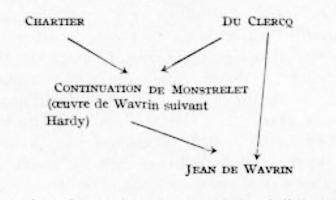
One may therefore represent the present state of the question concerning the relationships between the three aforementioned chronicles in the form of the following diagram, which summarizes the critical opinions I have just set out:
This diagram does not, in my view, correspond to the reality of the matter, and I shall undertake to demonstrate this point by point.
I. — The continuation of Monstrelet.
Buchon, who was familiar with the Memoirs of Jacques du Clercq, had noticed such similarities between this text and the continuation of Monstrelet that he concluded the continuator had made direct use of the Memoirs. But he did not yet have access to Wavrin’s text, which was still unpublished at that time. Now that we have Wavrin before us, no doubt is possible: the direct source of the continuation is Wavrin, whom it follows step by step and almost always copies word for word. The resemblance to Du Clercq is explained by the fact that Wavrin himself, as we shall see a little further on, made use of the Memoirs of his compatriot.
Moreover, on two occasions the continuation explicitly refers to Wavrin’s work. Two passages copied verbatim from Wavrin are introduced by the following formulas:
In the said year, according to the chronicler of Arras… (fol. 34 vo; Wavrin, ed. Hardy, vol. V, pp. 171–172).
At this point, says the chronicler of Arras… (fol. 40 vo; Wavrin, vol. V, p. 194).
This latter formula is in fact merely a transcription of the one that the compiler of the continuation encountered in Wavrin’s original text:
Here the author says that… (vol. V, p. 194).
It is unnecessary to emphasize that these very clear references to Wavrin’s Chronicles completely invalidate W. Hardy’s hypothesis that the author of the continuation was none other than Wavrin himself.
Henrici Quinti, Angliæ Regis, Gesta, is a first-hand account of the Agincourt Campaign, and subsequent events to his death in 1422. The author of the first part was a Chaplain in King Henry's retinue who was present from King Henry's departure at Southampton in 1415, at the siege of Harfleur, the battle of Agincourt, and the celebrations on King Henry's return to London. The second part, by another writer, relates the events that took place including the negotiations at Troye, Henry's marriage and his death in 1422.
Available at Amazon in eBook and Paperback format.
However, for the study of Wavrin’s work, the continuation offers a particular interest: it was in fact copied from a manuscript of Wavrin more complete than the one edited by Hardy. For his edition of Wavrin’s sixth book, Hardy had access to only a single manuscript: ms. 6748–6759 of the old French collection of the Bibliothèque nationale. He himself considered it likely that this manuscript did not provide the chronicler’s complete text, and indeed a manuscript discovered later in Vienna proved to contain, for the period 1422–1425, several passages that were not found in the Paris manuscript4.
Note 1. For the sake of convenience, I speak here only of the printed continuation. But, strictly speaking, I ought rather to refer to ms. 6762 of the old French collection of the Bibliothèque nationale, which is the direct or indirect source of the printed text. This manuscript is entitled: ‘Of the wars and events that have occurred from the year 1444 to the year 1471 in the kingdoms of France and England and in all the lands of the Duke of Burgundy’ (description of the manuscript in P. Paris, The French Manuscripts of the King’s Library, Paris, 1836, vol. I, p. 99, no. 6,762; Catalogue of French Manuscripts, Paris, 1868, old collection, vol. I, p. 5, no. 88; M. Gachard, The National Library in Paris. Notices and Extracts of Manuscripts Concerning the History of Belgium, Brussels, 1875, vol. I, p. 3, no. 4). The printed text of the continuation of Monstrelet is an exact reproduction of it, with the following differences: (1) it stops at 1467; (2) several chapters of ms. 6762 relating to English affairs in 1450 and 1462 have been omitted or heavily abridged in the printed text (cf. W. Hardy, Introduction to his edition of Wavrin, p. CLX and note 1, pp. CLXX–CLXXI and CLXXXV).
Note 2. Vol. I, Introduction, p. CCXI.
Note 3. Ibid., p. XLIII, n. 2. A very characteristic indication in this respect — and one that Hardy did not notice — is the following. In vol. III, p. 265 ff., of his edition of Wavrin, Mlle Dupont published a History of Charles, the last Duke of Burgundy. The entire first part of this composite work — that is, the section covering the period 1467–1471 — is copied verbatim in Wavrin (cf. Mlle Dupont, Preface to vol. III, pp. X–XI). Now, it contains long passages that are absent from Hardy’s edition.
Note 4. Cf. S. Bougenot, Notices and Extracts of Manuscripts Relating to the History of France Preserved in the Imperial Library of Vienna (13th–16th centuries) (Historical and Philological Bulletin of the Committee for Historical Works, year 1892, pp. 12–13 and 49–56).
One is therefore not surprised to encounter in the continuation of Monstrelet various episodes of manifestly ‘Wavrinesque’ origin which have no counterpart in Hardy’s edition; I shall mention in particular the account of the solemn entry of Philip the Good into Ghent in 1458 (fol. 74 ro and vo)1, that of the holding of a chapter of the Order of the Golden Fleece at Saint-Omer in 1461 (fol. 85 ro), a notice of the death in 1463 of Robert le Jeune, governor of Arras, accompanied by an account of his career (fol. 95 vo), and some information on the embassy sent by Philip the Good to the pope in 1463 concerning his vow of crusade (fol. 96 ro).
Note 1. This event is recounted at greater length from fol. 75 vo to fol. 77 ro, but this is a passage borrowed from Jean Chartier (ed. Vallet, vol. III, pp. 80–89). On the use of Jean Chartier by the continuation, see the immediate continuation of my study.
Alongside Wavrin, the continuation of Monstrelet also makes very extensive use of Jean Chartier’s Chronicle of Charles VII. As Buchon and Molinier have already noted, it is by entire chapters that the work of the chronicler of Saint-Denis passes into the pseudo-Monstrelet. Moreover, the compiler of the continuation does not conceal the source of his borrowings; just as he had written ‘In the said year, according to the chronicler of Arras,’ he introduces a long passage copied from Chartier (ed. Vallet, vol. II, p. 249 ff.) with the following words:
In the year fourteen hundred and fifty-one, in the month of May, according to the chronicler of Saint-Denis… (fol. 34 vo).
Note 1. Chartier’s chronicle is even more clearly identified in a passage of manuscript 6762 (see above, p. 127, n. 1) which the printed text has not reproduced. The compiler there refers to it as ‘the book of King Charles, the seventh of that name,’ which ends in the year 1461 (passage cited by Mlle Dupont, ed. of Wavrin, preface to vol. III, p. xi; cited in English translation in Wavrin, ed. Hardy, vol. I, Introduction, p. CLXXXIX). These two references prove that Chartier was used directly by the compiler of the continuation; they exclude the hypothesis that the compiler knew Chartier only through Wavrin (in whom, as we shall see, extensive use is likewise made of the chronicler of Saint-Denis). The continuation, moreover, borrows from Chartier several episodes that Wavrin does not mention: for example, the arrest of Jacques Cœur (fols. 40 vo and 41 ro; = Chartier, ed. Vallet, vol. II, pp. 327–328). I do not, however, insist on this last argument, which has only the value of a presumption, since we are not certain of knowing Wavrin’s complete text.
Note 1. La chronique de Chartier est plus clairement désignée encore dans un passée du manuscrit 6.762 (v. plus haut, p. 127, n. I) que le texte imprimé n'a pas repris. Le compilateur s'y réfère «au livre du roy Charles, VII de ce nom», qui se termine en. l'an 1461 (passage cité par Mlle DUPONT, éd. de Wavrin, préface en tête du t. III, p. xi; cité en traduction anglaise dans Wavrin, éd. Hardy, t. I, Intr., p. CLXXXIX). Ces deux mentions prouvent que Chartier a été utilisé directement par le compilateur de la continuation; ils excluent l'hypothèse suivant laquelle ce compilateur n'aurait connu Chartier qu'à travers Wavrin (où, comme nous le verrons, ample usage est également fait du chroniqueur de Saint-Denis). l,a continuation reprend d'ailleurs à Chartier divers épisodes que Wavrin ne cite pas: ainsi l'arrestation de Jacques Cœur (fo 40 vo et 41 Io; = Chartier, éd. Vallet, t. II, p. 327-328). Je n'insiste cependant pas sur ce dernier argument, qui n'a que la valeur d'une présomption, puisque nous ne sommes pas assmés de connaître le texte intégral de Wavrin.
Like all honest and mediocre compilers, the continuator of Monstrelet did not shrink from repetitions. On more than one occasion, he conscientiously recopied from Chartier the account of an event that he had already reported a little earlier from Wavrin. Thus, the trial of the Duke of Alençon is narrated first from Wavrin at fols. 77 ro to 78 vo (= Wavrin, ed. Hardy, vol. V, pp. 379–385), then a second time from Chartier (ed. Vallet, vol. III, pp. 90–111) at fols. 79 ro to 83 ro. A brief description of the funeral of Charles VII, taken from Wavrin (fol. 87 ro = Wavrin, ed. Hardy, vol. V, p. 399), is followed a few pages later by a detailed account of the same ceremony, this time borrowed from Chartier (fols. 92 ro to 93 ro = Chartier, ed. Vallet, vol. III, pp. 114–120).
2. — Jacques du Clercq.
Jacques du Clercq also makes use of Jean Chartier. He does not conceal this; recounting, on the basis of Chartier (ed. Vallet, vol. III, pp. 66–69), the series of defeats that the Hungarians inflicted on the Turks in 1456, he states that he is borrowing his account from the ‘chronicle of France in the church of Saint-Denis’ (vol. II, p. 235). But, unlike the continuator of Monstrelet and Wavrin, Du Clercq more often summarizes the work of Jean Chartier than copies it verbatim. This observation applies in particular to the long narrative that Du Clercq gives, drawn from Chartier, of the campaigns in Normandy and Guyenne in the years 1449 to 1451 (= ed. Reiffenberg, vol. I, pp. 299–430). — Where he does not make use of Chartier, Du Clercq appears to be original.
3. — Jean de Wavrin.
Wavrin makes extensive use of Jacques du Clercq, sometimes copying verbatim, sometimes paraphrasing or summarizing the Memoirs of his compatriot. These borrowings have been indicated in their proper places by Mlle Dupont in her edition of Wavrin.
That these are indeed borrowings by Wavrin from Du Clercq, and not by Du Clercq from Wavrin, is shown in particular by the following text.
In 1465, relates Jacques du Clercq, the men of Liège declared war on the Duke of Burgundy and, ‘burning and ravaging all the lands of the duke, went to lay siege before the town of Limburg.’ The same account appears in Wavrin, but instead of Limburg it is ‘Luxembourg’ that the men of Liège go to besiege — and ‘Luxembourg’ likewise appears in the continuation of Monstrelet (fol. 118 vo), which copies Wavrin. Of the two readings, ‘Luxembourg’ and ‘Limbourg,’ the latter (which corresponds to historical reality) is clearly the lectio difficilior [the more difficult reading]. The text of Du Clercq therefore represents the original and the source from which Wavrin drew.
Note 1. Ed. Reiffenberg, t. IV, p. 194-195.
Note 2. Ed. Hardy, t. V, p. 494-495
Chronicle of Geoffrey le Baker of Swinbroke
Baker was a secular clerk from Swinbroke, now Swinbrook, an Oxfordshire village two miles east of Burford. His Chronicle describes the events of the period 1303-1356: Gaveston, Bannockburn, Boroughbridge, the murder of King Edward II, the Scottish Wars, Sluys, Crécy, the Black Death, Winchelsea and Poitiers. To quote Herbert Bruce 'it possesses a vigorous and characteristic style, and its value for particular events between 1303 and 1356 has been recognised by its editor and by subsequent writers'. The book provides remarkable detail about the events it describes. Baker's text has been augmented with hundreds of notes, including extracts from other contemporary chronicles, such as the Annales Londonienses, Annales Paulini, Murimuth, Lanercost, Avesbury, Guisborough and Froissart to enrich the reader's understanding. The translation takes as its source the 'Chronicon Galfridi le Baker de Swynebroke' published in 1889, edited by Edward Maunde Thompson.
Available at Amazon in eBook and Paperback format.
It should be noted, however, that although Wavrin uses Du Clercq, he often supplements the latter’s account, enriching it either with new facts of which he had knowledge or with personal reflections. Thus, when he recounts the conspiracy of the Bastard of Rubempré (ed. Hardy, vol. V, pp. 443–445), he follows Du Clercq’s narrative (vol. IV, pp. 66–67), but expands it to such an extent that one is in fact faced with a largely original account. In such cases, however, Mlle Dupont, in her edition of Wavrin, merely refers the reader to Du Clercq1. These references cannot therefore be relied upon; they do not dispense with reading, in Hardy’s complete edition, the chapters thus dismissed, since they often contain additions to Du Clercq’s text.
Note 1. Cf., in the example cited above, Dupont edition, vol. II, p. 325.
Besides the borrowings from Du Clercq, Mlle Dupont had also detected in Wavrin, as we have seen, numerous borrowings from the continuation of Monstrelet. Here, the French editor is entirely mistaken.
When there is correspondence between the text of Wavrin and that of the continuation of Monstrelet, it is a matter of:
— either of passages from Jean Chartier copied simultaneously by both chronicles.
Example: the account of the siege of Bayonne by the French in 1451 (Chartier, ed. Vallet, vol. II, pp. 313–323
= Monstrelet, vol. III, fols. 38 vo to 40 ro — which copies Chartier verbatim;
= Wavrin, ed. Hardy, vol. V, pp. 187–193 — which also copies Chartier, but abbreviates it here and there somewhat;
Mlle Dupont, vol. II, p. 165, simply refers, for this account, to the continuation of Monstrelet.
— or else of passages copied by the continuator from the chronicles of Jean de Wavrin; these borrowings have already been noted above. In this latter case, Wavrin’s text is sometimes original1, sometimes borrowed from Du Clercq2.
Note 1. The account of the capture of Sandwich, in August 1457, by a French landing force (ed. Hardy, vol. V, pp. 385–388) is, in particular, original; this account is copied by the continuation of Monstrelet (fols. 70 vo and 71 ro). The essential elements of this narrative have been confirmed by an archival document brought to light by M. Ch. Porée, Note to establish the accuracy of a continuator of Monstrelet (in the Bulletin historique et philologique du Comité des travaux historiques, year 1902, pp. 483–488). But Porée, who was unaware of Wavrin and regarded the text of the continuation as original, believes he has demonstrated the accuracy of that continuation, whereas all the credit for this accuracy obviously belongs to Wavrin.
Note 2. The borrowings from Du Clercq are therefore, overall, more numerous than Mlle Dupont indicated, since they also affect passages that the editor of the Société de l’Histoire de France believed to have been copied from the continuation of Monstrelet.
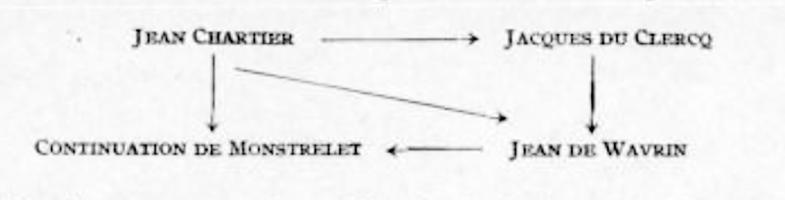
In summary, I schematize as follows the mutual relationships of the different texts that have just been examined:
Finally, let us note the significance of the fact that Du Clercq, Wavrin, and the continuator of Monstrelet all independently made use of Jean Chartier’s chronicle. This fact confirms what we already knew about the popularity of the official historiography of Saint-Denis.