

The Deeds of the Dukes of Normandy
The Gesta Normannorum Ducum [The Deeds of the Dukes of Normandy] is a landmark medieval chronicle tracing the rise and fall of the Norman dynasty from its early roots through the pivotal events surrounding the Norman Conquest of England. Originally penned in Latin by the monk William of Jumièges shortly before 1060 and later expanded at the behest of William the Conqueror, the work chronicles the deeds, politics, battles, and leadership of the Norman dukes, especially William’s own claim to the English throne. The narrative combines earlier historical sources with firsthand information and oral testimony to present an authoritative account of Normandy’s transformation from a Viking settlement into one of medieval Europe’s most powerful realms. William’s history emphasizes the legitimacy, military prowess, and governance of the Norman line, framing their expansion, including the conquest of England, as both divinely sanctioned and noble in purpose. Later chroniclers such as Orderic Vitalis and Robert of Torigni continued the history, extending the coverage into the 12th century, providing broader context on ducal rule and its impact. Today this classic work remains a foundational source for understanding Norman identity, medieval statesmanship, and the historical forces that reshaped England and Western Europe between 800AD and 1100AD.
Available at Amazon in eBook and Paperback format.
Stonehenge Chapter II is in Stonehenge A Temple Restored To The British Druids By William Stukeley.
Of the name of Stonehenge. These works prior to the Roman times. Who were the builders? Of the general situation of it, again. Of the beauty of its general proportion. A peep into it. A walk round the area. Remarks on two stones standing on the vallum, and two corresponding cavities for water vases: explained from ancient coins. That the Welsh are the remains of the Belgæ from the continent, who lived here at the Roman invasion, and by whose reports, Stonehenge was built by the most ancient oriental colony, that brought the Druids hither.
If we walk a little to the left hand, Tab. VIII. is presented. See the northern long barrow: on this side of which, the eye takes in the whole length of the Cursus . Many barrows at the end and on both sides of it. That mark'd P. was open'd by my Lord Pembroke, those mark'd S. were open'd by myself. What was discover'd therein will be treated of hereafter. Further to the west, the highest ground of that spot whereon Stonehenge stands, eclipses a distant view, and there are the nearest barrows planted with rabbets, which do much damage too at Stonehenge, and threaten no less than the ruin of the whole. Upon the vallum of Stonehenge is one of the stones there, which seems to be a small altar, for some kind of libations, and at the letter A. the mark of a cavity; of which more particularly, in the next page.
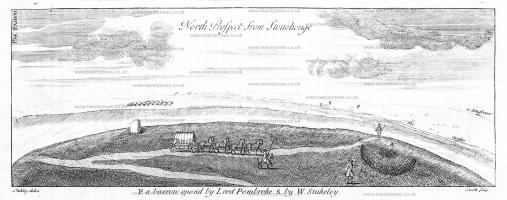
Table VIII. North Prospect from Stonehenge. P. A barrow opened by Lord Pembroke. S. By William Stukeley.
The next south-west prospect, Tab. IX. from Stonehenge, takes in the country from Berwickbarn, and my Lord Pembroke's wood of Groveley, to Salisbury steeple: a chain of barrows reaching a 6th part of the whole horizon. Many from the great quantity of these sepulchral tumuli here, injudiciously conclude, that there have been great battels upon the plain, and that the slain were bury'd there. But they are really no other than family burying-places, set near this temple, for the same reason as we bury in church-yards and consecrated ground. Salisbury steeple seen from hence, brings to my sorrowful remembrance, the great Thomas Earl of Pembroke, whose noble allies are there deposited. He was patron of my studies, particularly those relating to Stonehenge. Virtue, piety, magnanimity, learning, generosity, all sublime qualities recommended and added to his illustrious descent. Glorious it will be for me, if these pages live to testify to another age, the intimacy he was pleased to honour me with.

Table IX. Southern Prospect from Stonehenge. A. the barrow Ld Pembroke opened [Map]. B.B. [Map] those I opened. C. Bushbarrow [Map] D. a cavity in the vallum.